


The US Senate has overwhelmingly endorsed a plan allowing the US to ship civilian nuclear fuel and technology to India, handing President George W. Bush an important victory on one of his top foreign policy initiatives.
Senior lawmakers from both political parties championed the proposal, which reverses decades of US anti-proliferation policy, saying it strengthens a key relationship with a friendly Asian power that has long maintained what the US considers a responsible nuclear program. Thursday's vote was 85-12.
Republican Senator Richard Lugar called the plan "a lasting incentive" for India to shun future nuclear weapons tests. Democratic Senator Joseph Biden said the Senate's endorsement pushes America "a giant step closer" to a shift in US-Indian relations that "will increase the prospect for stability and progress in South Asia and in the world at large."
Bush gratified
Bush, in a statement made during a trip to Singapore, praised the Senate for endorsing his plan, saying it will "bring India into the international nuclear nonproliferation mainstream and will increase the transparency of India's entire civilian nuclear program."
His remarks were echoed by Secretary of State Condoleezza Rice, in Vietnam with the president for a meeting of Asia-Pacific leaders.
"This really does open up an extraordinary new era, both in US-Indian relations, but also I think for the many interests that will served, from the economic point of view, from an energy point of view and from a nonproliferation point of view," she said.
Even with the strong approval by the Senate, however, several hurdles loom before India and the US could begin civil nuclear trade.
First on that list, lawmakers in the House of Representatives, which overwhelmingly endorsed the plan in July, and the Senate must now reconcile their versions into a single bill before the next congressional session begins in January. That bill would then be sent to Bush for his signature.
Critics argued that the plan would ruin the world's nonproliferation regime and boost India's nuclear arsenal. The extra civilian nuclear fuel that the deal would provide, they say, could free India's domestic uranium for use in its weapons program. Pakistan and China could respond by increasing their nuclear stockpiles, sparking a regional arms race.
Democratic Senator Byron Dorgan called the agreement "a horrible mistake" that "provides a green light" for India to produce more nuclear weapons. "I believe one day we will look back at this with great regret," he said.
During debate on Thursday, supporters beat back changes they said would have killed the proposal by making it unacceptable to India. Critics said the changes were necessary to guard against nuclear proliferation.
Democratic Senator Barbara Boxer unsuccessfully proposed a condition that would have required India to cut off military-to-military ties with Iran before allowing civil nuclear cooperation.
Wrong signal
Congressman Ed Markey, a Democratic critic in the House, said the Senate's endorsement of the proposal "sends the wrong signal at a time when the world is trying to prevent Iran from getting" a nuclear bomb.
The plan, he said, would set "a precedent that other nations can invoke when they seek nuclear cooperation with countries that also refuse to abide by nonproliferation rules."
The bill carves out an exemption in US law to allow US civilian nuclear trade with India in exchange for Indian safeguards and inspections at its 14 civilian nuclear plants; eight military plants would be off-limits.
Congressional action is necessary because US law bars nuclear trade with countries that have not submitted to full international inspections. India built its nuclear weapons program outside the Nuclear Non-Proliferation Treaty, which provides civil nuclear trade in exchange for a pledge from nations not to pursue nuclear weapons.
There are other necessary steps before US-Indian nuclear cooperation could begin. An exception for India must be made by the Nuclear Suppliers Group, an assembly of nations that export nuclear material. Indian officials also must negotiate a safeguard agreement with the UN nuclear watchdog.
And once technical negotiations on an overall cooperation agreement are settled between India and the US, the US Congress would then hold another vote on the overall deal.
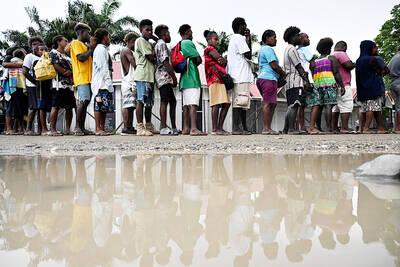
SEEKING CHANGE: A hospital worker said she did not vote in previous elections, but ‘now I can see that maybe my vote can change the system and the country’ Voting closed yesterday across the Solomon Islands in the south Pacific nation’s first general election since the government switched diplomatic allegiance from Taiwan to Beijing and struck a secret security pact that has raised fears of the Chinese navy gaining a foothold in the region. The Solomon Islands’ closer relationship with China and a troubled domestic economy weighed on voters’ minds as they cast their ballots. As many as 420,000 registered voters had their say across 50 national seats. For the first time, the national vote also coincided with elections for eight of the 10 local governments. Esther Maeluma cast her vote in the
Nearly half of China’s major cities are suffering “moderate to severe” levels of subsidence, putting millions of people at risk of flooding, especially as sea levels rise, according to a study of nationwide satellite data released yesterday. The authors of the paper, published by the journal Science, found that 45 percent of China’s urban land was sinking faster than 3mm per year, with 16 percent at more than 10mm per year, driven not only by declining water tables, but also the sheer weight of the built environment. With China’s urban population already in excess of 900 million people, “even a small portion

UNSETTLING IMAGES: The scene took place in front of TV crews covering the Trump trial, with a CNN anchor calling it an ‘emotional and unbelievably disturbing moment’ A man who doused himself in an accelerant and set himself on fire outside the courthouse where former US president Donald Trump is on trial has died, police said yesterday. The New York City Police Department (NYPD) said the man was declared dead by staff at an area hospital. The man was in Collect Pond Park at about 1:30pm on Friday when he took out pamphlets espousing conspiracy theories, tossed them around, then doused himself in an accelerant and set himself on fire, officials and witnesses said. A large number of police officers were nearby when it happened. Some officers and bystanders rushed

HYPOCRISY? The Chinese Ministry of Foreign Affairs yesterday asked whether Biden was talking about China or the US when he used the word ‘xenophobic’ US President Joe Biden on Wednesday called for a hike in steel tariffs on China, accusing Beijing of cheating as he spoke at a campaign event in Pennsylvania. Biden accused China of xenophobia, too, in a speech to union members in Pittsburgh. “They’re not competing, they’re cheating. They’re cheating and we’ve seen the damage here in America,” Biden said. Chinese steel companies “don’t need to worry about making a profit because the Chinese government is subsidizing them so heavily,” he said. Biden said he had called for the US Trade Representative to triple the tariff rates for Chinese steel and aluminum if Beijing was


 RSS
RSS