


The US, the world's biggest emitter of greenhouse gases, staunchly defended its record on battling global warming on Wednesday, as the UN lamented a "frightening lack" of international leadership on climate change. Australia's prime minister said yesterday that he will seek support at the coming APEC summit for an alternative to the Kyoto Protocol on global warming.
The US and Australia are the only major industrialized countries to reject the Kyoto Protocol. US President George W. Bush says it would harm the US economy, and it should have required cutbacks in poorer nations as well. US officials also say the country is doing better at voluntarily restraining the growth of such gases than are some countries committed to reductions under the Kyoto Protocol.
"The United States is committed to addressing the serious global challenge of climate change," said Paula Dobriansky, a US undersecretary of state and head of the US delegation to the UN climate conference in Nairobi.
The two-week meeting, entering its final three days, has been working on technical issues involving the Kyoto Protocol, which obliges 35 industrial nations to reduce emissions of greenhouse gases by 5 percent below 1990 levels by 2012.
UN Secretary-General Kofi Annan told the conference earlier on Wednesday that those who would deny global warming or delay taking action against it are "out of step" and "out of time."
"Let no one say we cannot afford to act," Annan declared.
The Bush administration is among those who say reducing global-warming gases would be a setback for economies.
"It is increasingly clear it will cost far less to cut emissions now than to deal with the consequences later," Annan said.
Asked about Annan's charges of poor international leadership on climate, Dobriansky replied: "We think the United States has been leading with its groundbreaking initiatives" that take into account the economy and sustainable development.
Closed-door talks here in Nairobi are focusing on how to set emissions quotas for the post-2012 period -- a regime many hope will include the US.
At best, however, the conference may simply set a timetable for continuing talks into next year. Many here think real negotiations must await the end of the Bush administration.
"The United States will return to the negotiating table with a serious proposal when a new president takes office in 2009," said veteran conference observer Philip Clapp.
Clapp, president of the US group National Environmental Trust, noted that Democratic and Republican contenders in the 2008 presidential election favor capping US emissions.
Australia recently announced a partial change of stance on the Kyoto Protocol. Australian Prime Minister John Howard has repeatedly said that the deal would damage Australia's economy by giving a competitive advantage to China and India, which are not bound by the 2012 target.
But in a recent turnabout, Howard said he would consider a system of global carbon trading -- a key part of the Kyoto agreement -- if it did not damage Australian industries.
Carbon trading works by setting caps on countries' emissions, then allowing them to sell credits if they do not use their full entitlements.
Howard said he would seek support for a Kyoto alternative in meetings with George W. Bush and Chinese President Hu Jintao (
"We need a new arrangement that includes everybody, so that Australia won't be disadvantaged," Howard told reporters yesterday.
He has not yet said what form a Kyoto alternative might take, only that China and India must be part of the deal.
However, Indian Finance Minister P. Chidambaram said any new approach must recognize the desire of developing countries for rapid economic growth.

Republican US lawmakers on Friday criticized US President Joe Biden’s administration after sanctioned Chinese telecoms equipment giant Huawei unveiled a laptop this week powered by an Intel artificial intelligence (AI) chip. The US placed Huawei on a trade restriction list in 2019 for contravening Iran sanctions, part of a broader effort to hobble Beijing’s technological advances. Placement on the list means the company’s suppliers have to seek a special, difficult-to-obtain license before shipping to it. One such license, issued by then-US president Donald Trump’s administration, has allowed Intel to ship central processors to Huawei for use in laptops since 2020. China hardliners
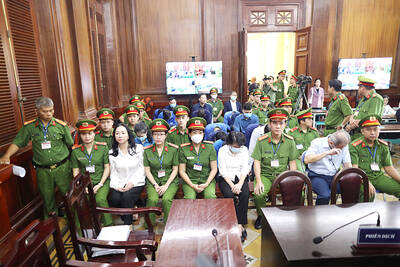
A top Vietnamese property tycoon was on Thursday sentenced to death in one of the biggest corruption cases in history, with an estimated US$27 billion in damages. A panel of three hand-picked jurors and two judges rejected all defense arguments by Truong My Lan, chair of major developer Van Thinh Phat, who was found guilty of swindling cash from Saigon Commercial Bank (SCB) over a decade. “The defendant’s actions ... eroded people’s trust in the leadership of the [Communist] Party and state,” read the verdict at the trial in Ho Chi Minh City. After the five-week trial, 85 others were also sentenced on

‘DELUSIONAL’: Targeting the families of Hamas’ leaders would not push the group to change its position or to give up its demands for Palestinians, Ismail Haniyeh said Israeli aircraft on Wednesday killed three sons of Hamas’ top political leader in the Gaza Strip, striking high-stakes targets at a time when Israel is holding delicate ceasefire negotiations with the militant group. Hamas said four of the leader’s grandchildren were also killed. Ismail Haniyeh’s sons are among the highest-profile figures to be killed in the war so far. Israel said they were Hamas operatives, and Haniyeh accused Israel of acting in “the spirit of revenge and murder.” The deaths threatened to strain the internationally mediated ceasefire talks, which appeared to gain steam in recent days even as the sides remain far

The Taliban’s reclusive supreme leader made a rare public appearance yesterday, an Afghan government spokesman said, leading thousands of worshipers in prayers marking Eid al-Fitr. Hibatullah Akhundzada has made only a handful of public appearances since inheriting the leadership of the Taliban in 2016 and leading the movement back to power with the withdrawal of US forces in 2021. Taliban government spokesman Zabihullah Mujahid said prayer in the largest mosque in Kandahar was “performed under the leadership of the supreme leader.” In a statement on X, he said the early-morning service “was attended by thousands of compatriots” in the southern province considered the


 RSS
RSS