


China has finished assembling its first lunar satellite probe and is working to design pollution-free rockets, an official said yesterday.
"Smooth progress has been made in research and development of Chang'e I [the probe], and we have completed assembly of the satellite," Sun Laiyan (孫來燕), head of the China National Space Administration, said at a news conference.
Chang'e I is expected to be launched next year "to test the technical feasibility and reliability of our technology," Sun said.
He was speaking at the release of a government report on China's space activities this year, the 50th anniversary of the founding of the country's aerospace industry.
The Chang'e I project is part of an effort to land an unmanned probe on the moon by 2010.
Chang'e I, named after a mythical lunar-dwelling Chinese fairy, will orbit the moon at an altitude of 200km and "will explore the environment and atmosphere between the Earth and the moon," Sun said.
State media say the satellite will take three-dimensional images of the lunar surface and analyze its materials.
The report said one of China's key tasks in the next five years is to develop "nontoxic, pollution-free, high-performance, low-cost and powerful thrust carrier rockets."
The next Chinese manned space flight is due next year. Sun said the project was "going smoothly," but did not give details.
China may one day offer trips into space for tourists, Sun said.
He also defended the cost of the space programme, saying Beijing spent far less than the US, it benefited ordinary people and was anyway a matter of national pride.
In 2003, China became only the third country -- after the US and the former Soviet Union -- to launch a man into space aboard its own rocket. In October last year, it sent two men into orbit and plans a space walk by 2008.
"The success of our manned space missions, becoming only the third country in the world to put a man into space on our own, is a source of pride for the Chinese nation," Sun said.
Sending up tourists, like Iranian-American telecom billionaire Anousheh Ansari who paid US$20 million for a stay on the International Space Station, is an option China could go for, Sun said.
"Once our technology is more mature, more reliable, there is this possibility. Not only male tourists, but female too," he said.
Sun defended the billions of dollars China -- a developing country where millions still struggle to clothe and feed themselves -- earmarks for space exploration.
China will next year spend only a tenth of the US$17 billion NASA has budgeted for the same timeframe, he said.
The first stage of China's lunar exploration plan will cost just slightly more than 1 billion yuan (US$126.4 million).
Money well spent, Sun said.
"We think that China's space program can solve many economic and social problems that we are now facing," he said.
Chinese satellites help with weather forecasting and sending seeds into space has helped breed better, faster maturing crops, Sun said.
Chinese farmers would also be helped by beaming educational radio and television programs into their houses, he added.
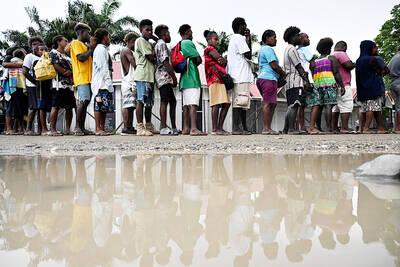
SEEKING CHANGE: A hospital worker said she did not vote in previous elections, but ‘now I can see that maybe my vote can change the system and the country’ Voting closed yesterday across the Solomon Islands in the south Pacific nation’s first general election since the government switched diplomatic allegiance from Taiwan to Beijing and struck a secret security pact that has raised fears of the Chinese navy gaining a foothold in the region. The Solomon Islands’ closer relationship with China and a troubled domestic economy weighed on voters’ minds as they cast their ballots. As many as 420,000 registered voters had their say across 50 national seats. For the first time, the national vote also coincided with elections for eight of the 10 local governments. Esther Maeluma cast her vote in the
Nearly half of China’s major cities are suffering “moderate to severe” levels of subsidence, putting millions of people at risk of flooding, especially as sea levels rise, according to a study of nationwide satellite data released yesterday. The authors of the paper, published by the journal Science, found that 45 percent of China’s urban land was sinking faster than 3mm per year, with 16 percent at more than 10mm per year, driven not only by declining water tables, but also the sheer weight of the built environment. With China’s urban population already in excess of 900 million people, “even a small portion

UNSETTLING IMAGES: The scene took place in front of TV crews covering the Trump trial, with a CNN anchor calling it an ‘emotional and unbelievably disturbing moment’ A man who doused himself in an accelerant and set himself on fire outside the courthouse where former US president Donald Trump is on trial has died, police said yesterday. The New York City Police Department (NYPD) said the man was declared dead by staff at an area hospital. The man was in Collect Pond Park at about 1:30pm on Friday when he took out pamphlets espousing conspiracy theories, tossed them around, then doused himself in an accelerant and set himself on fire, officials and witnesses said. A large number of police officers were nearby when it happened. Some officers and bystanders rushed

HYPOCRISY? The Chinese Ministry of Foreign Affairs yesterday asked whether Biden was talking about China or the US when he used the word ‘xenophobic’ US President Joe Biden on Wednesday called for a hike in steel tariffs on China, accusing Beijing of cheating as he spoke at a campaign event in Pennsylvania. Biden accused China of xenophobia, too, in a speech to union members in Pittsburgh. “They’re not competing, they’re cheating. They’re cheating and we’ve seen the damage here in America,” Biden said. Chinese steel companies “don’t need to worry about making a profit because the Chinese government is subsidizing them so heavily,” he said. Biden said he had called for the US Trade Representative to triple the tariff rates for Chinese steel and aluminum if Beijing was


 RSS
RSS