


Heavy clashes broke out between government troops and Tamil Tiger rebels in three areas of Sri Lanka's volatile north and east, killing a large number of insurgents and injuring eight soldiers, the military said yesterday.
The fighting came a day after the government said it is ready to resume stalled peace talks with the Tamil rebels late this month in Switzerland.
The Tigers launched an attack on a military camp in Mankerni in Batticaloa District early yesterday, military spokesman Brigadier Prasad Samarasinghe said.
Rebels could not immediately be reached for comment.
The army, supported by fighter helicopters, repulsed the rebel attack.
"We have pushed them back," Samarasinghe said, adding that a large number of rebel bodies were lying on the battlefield, but that exact details were unavailable and that fighting was continuing.
Two soldiers were wounded in the attack, Samarasinghe said.
In the northern Jaffna Peninsula, six soldiers were wounded yesterday when Tamil Tigers fired artillery toward northern defense line, he said.
Samarasinghe said the air force later launched air strikes on rebel artillery and mortar positions.
Separately, soldiers destroyed six Tamil Tiger rebel boats off the country's northern coast suspected of transporting fuel, he said.
The boats were destroyed overnight in the sea near Pallaithivu, an islet off the northern Jaffna Peninsula, by the soldiers' artillery fire from the ground, he said.
A suspected oil storage facility on the islet also caught fire and was destroyed, he said.
A round of peace talks is planned for Oct. 28 and 29 in Switzerland. The last round of peace talks aimed at ending two decades of civil war was held in February.
The rebels agreed to unconditional talks with the government, but warned they would pull out of a 2002 ceasefire accord if the government persists with its military campaign.
The government cautioned it would counter any offensives by the insurgents.

Republican US lawmakers on Friday criticized US President Joe Biden’s administration after sanctioned Chinese telecoms equipment giant Huawei unveiled a laptop this week powered by an Intel artificial intelligence (AI) chip. The US placed Huawei on a trade restriction list in 2019 for contravening Iran sanctions, part of a broader effort to hobble Beijing’s technological advances. Placement on the list means the company’s suppliers have to seek a special, difficult-to-obtain license before shipping to it. One such license, issued by then-US president Donald Trump’s administration, has allowed Intel to ship central processors to Huawei for use in laptops since 2020. China hardliners

Conjoined twins Lori and George Schappell, who pursued separate careers, interests and relationships during lives that defied medical expectations, died this month in Pennsylvania, funeral home officials said. They were 62. The twins, listed by Guinness World Records as the oldest living conjoined twins, died on April 7 at the Hospital of the University of Pennsylvania, obituaries posted by Leibensperger Funeral Homes of Hamburg said. The cause of death was not detailed. “When we were born, the doctors didn’t think we’d make 30, but we proved them wrong,” Lori said in an interview when they turned 50, the Philadelphia Inquirer reported. The
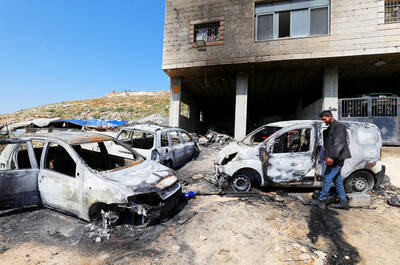
RAMPAGE: A Palestinian man was left dead after dozens of Israeli settlers searching for a missing 14-year-old boy stormed a village in the Israeli-occupied West Bank US President Joe Biden on Friday said he expected Iran to attack Israel “sooner, rather than later” and warned Tehran not to proceed. Asked by reporters about his message to Iran, Biden simply said: “Don’t,” underscoring Washington’s commitment to defend Israel. “We are devoted to the defense of Israel. We will support Israel. We will help defend Israel and Iran will not succeed,” he said. Biden said he would not divulge secure information, but said his expectation was that an attack could come “sooner, rather than later.” Israel braced on Friday for an attack by Iran or its proxies as warnings grew of
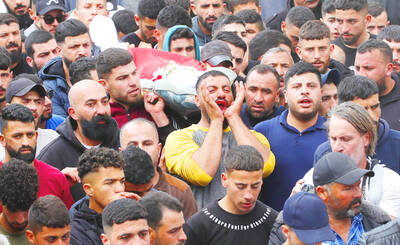
IN PURSUIT: Israel’s defense minister said the revenge attacks by Israeli settlers would make it difficult for security forces to find those responsible for the 14-year-old’s death Israeli Prime Minister Benjamin Netanyahu on Saturday condemned the “heinous murder” of an Israeli teenager in the occupied West Bank as attacks on Palestinian villages intensified following news of his death. After Benjamin Achimeir, 14, was reported missing near Ramallah on Friday, hundreds of Jewish settlers backed by Israeli forces raided nearby Palestinian villages, torching vehicles and homes, leaving at least one villager dead and dozens wounded. The attacks escalated in several villages on Saturday after Achimeir’s body was found near the Malachi Hashalom outpost. Agence France-Presse correspondents saw smoke rising from burned houses and fields. Mayor Amin Abu Alyah, of the


 RSS
RSS