


Japanese Prime Minister Shinzo Abe said yesterday he wanted to move quickly toward revising the post-World War II pacifist Constitution, in his first policy speech to parliament since taking office.
"The present Constitution was established at a time when Japan was occupied and since then nearly 60 years have passed," said Abe, Japan's first leader born after World War II.
"Active debates are underway for a constitution that would be more suitable to a new generation," Abe said.
"First of all, I hope bills to set up the necessary steps to revise the Japanese Constitution will pass the parliament at an early stage," he said.
Abe also laid out his vision of a "Beautiful Country" that can be proud of its traditions and culture while also being respected -- and loved -- by the world.
Abe, 52, who took over this week as Japan's first leader born after Japan's defeat in World War II, has made it a central part of his agenda to escape a "post-war regime" that conservatives believe deprived Japanese of pride in their history and culture.
"Our country, Japan, is a country endowed with a long history, culture, tradition and beautiful natural environment of which we can be proud before the world," Abe told parliament in his first policy speech since becoming prime minister last Tuesday.
"The time has come for us to step forward, with quiet pride in our hearts to create a new country," he said, speaking in a low-key manner that contrasted sharply with the often emotional style of his popular maverick predecessor, Junichiro Koizumi.
Abe's rise to Japan's top job has aroused concerns in some quarters, both at home and abroad, about a rise in nationalism, even as Tokyo seeks to repair ties with China and South Korea.
Relations with Beijing and Seoul were soured by Koizumi's visits to Yasukuni shrine, seen by many as a symbol of Japan's past militarism because Japanese leaders convicted as war criminals are revered there along with war dead.
On Friday, Abe sought to define his concept of a "Beautiful Country, Japan," as a nation that could both lead and be loved.
"It is a country that values its culture, tradition and history" -- but also one "with leadership that is trusted, respected and loved by the world," he said.
Abe spoke of his commitment to tighter ties with Tokyo's security ally, the US, but also expressed his determination to boost Japan's say in global affairs, a break from past diplomacy, which has tended to follow Washington.
"The time has come for our country to shift to an assertive diplomacy based on new thinking," he said, repeating a mantra that had become familiar during his campaign to become ruling Liberal Democratic Party president.
Abe said he wanted to build mutual trust with Beijing and Seoul, but devoted little space to the topic in his 15-page speech. Abe had backed Koizumi's visits to Yasukuni, but has declined to say if he would go there as prime minister himself.
"China and South Korea are important neighbors," he said. "Strengthening trust with the two is key for the Asian region and for the international community, and it is important for all sides to work to have honest, future-oriented discussions."
Abe has already agreed with South Korean President Roh Moo-hyun that the two should meet soon, and Kyodo news agency reported yesterday that the preparations were under way for him to visit Seoul early next month.
There is also speculation that he might meet Chinese President Hu Jintao (

Republican US lawmakers on Friday criticized US President Joe Biden’s administration after sanctioned Chinese telecoms equipment giant Huawei unveiled a laptop this week powered by an Intel artificial intelligence (AI) chip. The US placed Huawei on a trade restriction list in 2019 for contravening Iran sanctions, part of a broader effort to hobble Beijing’s technological advances. Placement on the list means the company’s suppliers have to seek a special, difficult-to-obtain license before shipping to it. One such license, issued by then-US president Donald Trump’s administration, has allowed Intel to ship central processors to Huawei for use in laptops since 2020. China hardliners
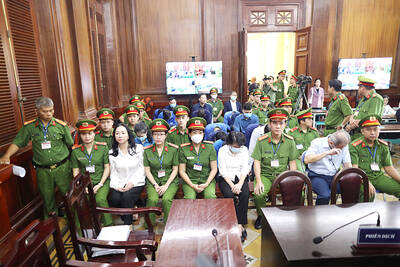
A top Vietnamese property tycoon was on Thursday sentenced to death in one of the biggest corruption cases in history, with an estimated US$27 billion in damages. A panel of three hand-picked jurors and two judges rejected all defense arguments by Truong My Lan, chair of major developer Van Thinh Phat, who was found guilty of swindling cash from Saigon Commercial Bank (SCB) over a decade. “The defendant’s actions ... eroded people’s trust in the leadership of the [Communist] Party and state,” read the verdict at the trial in Ho Chi Minh City. After the five-week trial, 85 others were also sentenced on

Conjoined twins Lori and George Schappell, who pursued separate careers, interests and relationships during lives that defied medical expectations, died this month in Pennsylvania, funeral home officials said. They were 62. The twins, listed by Guinness World Records as the oldest living conjoined twins, died on April 7 at the Hospital of the University of Pennsylvania, obituaries posted by Leibensperger Funeral Homes of Hamburg said. The cause of death was not detailed. “When we were born, the doctors didn’t think we’d make 30, but we proved them wrong,” Lori said in an interview when they turned 50, the Philadelphia Inquirer reported. The

RAMPAGE: A Palestinian man was left dead after dozens of Israeli settlers searching for a missing 14-year-old boy stormed a village in the Israeli-occupied West Bank US President Joe Biden on Friday said he expected Iran to attack Israel “sooner, rather than later” and warned Tehran not to proceed. Asked by reporters about his message to Iran, Biden simply said: “Don’t,” underscoring Washington’s commitment to defend Israel. “We are devoted to the defense of Israel. We will support Israel. We will help defend Israel and Iran will not succeed,” he said. Biden said he would not divulge secure information, but said his expectation was that an attack could come “sooner, rather than later.” Israel braced on Friday for an attack by Iran or its proxies as warnings grew of


 RSS
RSS