


US President George W. Bush appealed to the bickering presidents of Pakistan and Afghanistan to put aside their differences and "strategize together" over dinner on ways to defeat the common enemy of terrorism.
Standing between Pakistani President General Pervez Musharraf and Afghan President Hamid Karzai on Wednesday, Bush emphasized "the need to cooperate, to make sure that people have got a hopeful future" in both countries.
Judging by the body language Bush himself had said he would be watching, there were plenty of tensions to overcome over a light dinner of soup, sea bass and salad. The meal was billed as an iftar, a meal that breaks the daytime fast during the Muslim holy month of Ramadan. Musharraf and Karzai are Muslims.
The Afghan and Pakistani leaders stood stiffly on either side of Bush during a brief Rose Garden appearance before they ate. The pair, key US allies in a volatile region, shook hands with Bush, but not with each other.
"Today's dinner is a chance for us to strategize together" and find common solutions, Bush said.
Musharraf remained expressionless during his host's brief remarks, while Karzai repeatedly nodded agreeably.
"These two men are personal friends of mine," Bush said. "They are strong leaders who have an understanding of the world in which we live. They understand that the forces of moderation are being challenged by extremists and radicals."
After the meal, the White House issued a statement that called the session a "constructive exchange" but outlined no new agreements or initiatives.
"They committed to supporting moderation and defeating extremism through greater intelligence sharing, coordinated action against terrorists and common efforts to enhance the prosperity of the people of Afghanistan and Pakistan," the statement from Press Secretary Tony Snow said.
For months, Karzai and Musharraf have been trading barbs and criticizing each other's efforts to fight terrorists along their long, remote, mountainous border.
Afghan officials allege that Pakistan lets Taliban militants hide out and launch attacks into Afghanistan. Musharraf says Karzai has bad information and notes that Pakistan has deployed 80,000 troops along the porous border.
Karzai says Musharraf turns a blind eye to hatred and extremism being bred at Islamic schools in Pakistan. At one point, Musharraf said Karzai is behaving "like an ostrich," refusing to acknowledge the truth and trying to shore up his political standing at home.
Right up to Wednesday night's White House dinner, they have also pointed fingers at one another over al-Qaeda leader Osama bin Laden and other terror leaders. Each says bin Laden isn't hiding in his country and suggests the other might do more to help find him.
Musharraf wants Karzai to agree to "a verbal ceasefire" and stepped-up intelligence cooperation to fight terrorism and bring peace to both countries, Pakistani Foreign Minister Khurshid Kasuri said on Wednesday in an interview.
All this comes as Afghanistan suffers its worst reversals since the US-led ouster of the extremist Taliban regime nearly five years ago.
The Taliban militants have regrouped and launched an offensive earlier this year whose strength and organization took Afghan and US officials by surprise.
They have adopted methods commonly used by militants in Iraq: suicide bombings, ambushes and beheadings. Illegal opium production has risen yearly despite billions spent to suppress it, and Afghanistan is now the source of more than 90 percent of the world's supply.

Republican US lawmakers on Friday criticized US President Joe Biden’s administration after sanctioned Chinese telecoms equipment giant Huawei unveiled a laptop this week powered by an Intel artificial intelligence (AI) chip. The US placed Huawei on a trade restriction list in 2019 for contravening Iran sanctions, part of a broader effort to hobble Beijing’s technological advances. Placement on the list means the company’s suppliers have to seek a special, difficult-to-obtain license before shipping to it. One such license, issued by then-US president Donald Trump’s administration, has allowed Intel to ship central processors to Huawei for use in laptops since 2020. China hardliners
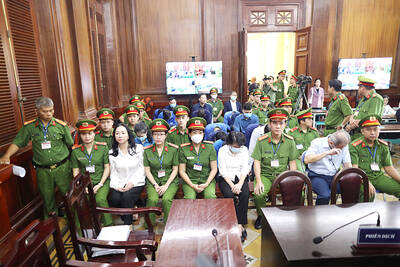
A top Vietnamese property tycoon was on Thursday sentenced to death in one of the biggest corruption cases in history, with an estimated US$27 billion in damages. A panel of three hand-picked jurors and two judges rejected all defense arguments by Truong My Lan, chair of major developer Van Thinh Phat, who was found guilty of swindling cash from Saigon Commercial Bank (SCB) over a decade. “The defendant’s actions ... eroded people’s trust in the leadership of the [Communist] Party and state,” read the verdict at the trial in Ho Chi Minh City. After the five-week trial, 85 others were also sentenced on

Conjoined twins Lori and George Schappell, who pursued separate careers, interests and relationships during lives that defied medical expectations, died this month in Pennsylvania, funeral home officials said. They were 62. The twins, listed by Guinness World Records as the oldest living conjoined twins, died on April 7 at the Hospital of the University of Pennsylvania, obituaries posted by Leibensperger Funeral Homes of Hamburg said. The cause of death was not detailed. “When we were born, the doctors didn’t think we’d make 30, but we proved them wrong,” Lori said in an interview when they turned 50, the Philadelphia Inquirer reported. The
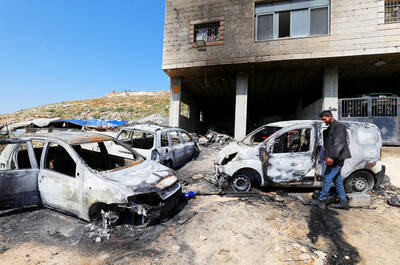
RAMPAGE: A Palestinian man was left dead after dozens of Israeli settlers searching for a missing 14-year-old boy stormed a village in the Israeli-occupied West Bank US President Joe Biden on Friday said he expected Iran to attack Israel “sooner, rather than later” and warned Tehran not to proceed. Asked by reporters about his message to Iran, Biden simply said: “Don’t,” underscoring Washington’s commitment to defend Israel. “We are devoted to the defense of Israel. We will support Israel. We will help defend Israel and Iran will not succeed,” he said. Biden said he would not divulge secure information, but said his expectation was that an attack could come “sooner, rather than later.” Israel braced on Friday for an attack by Iran or its proxies as warnings grew of


 RSS
RSS