


Leon Nunn stepped out his front door one recent afternoon only to be waved back by a squadron of drug agents using a battering ram on a neighbor's home.
The US$500,000 home in the quiet subdivision was stuffed with high-grade marijuana, plants covering nearly every square meter.
The bust is one example of a phenomenon that has come to light recently in subdivisions around Sacramento, the capital of California.
Marijuana growers with suspected ties to Asian organized crime have been buying suburban homes -- many in newer developments -- because of the anonymity drug dealers believe the neighborhoods afford.
They close the blinds and get to work gutting the inside, converting otherwise nondescript tract homes into the latest battleground in the state's campaign against marijuana cartels.
Police are bashing in doors at more homes virtually every day as they develop new leads or are tipped by suddenly wary neighbors.
More than three dozen homes have been found to be hiding marijuana groves in just the past seven weeks, most in Sacramento, Elk Grove and Stockton.
Like the others, the home on Elk Grove's Mainline Drive had been converted to what law enforcement officials call a hothouse, with 1,000-watt lights for growing and irrigation networks feeding high-tech hydroponic growing systems.
Walls and ceilings were smashed to allow for complex ventilation and air filtration systems that vented the telltale odor through the attic.
A web of extension cords and makeshift electric panels illegally tapped into the outside grid to avoid detection and save thousands of dollars in power bills.
Hundreds of thousands of dollars were spent to convert each of the homes to so that millions of dollars worth of marijuana could be grown in them.
The phenomenon began in the province of British Columbia, Canada, where organized crime outfits gutted houses to grow potent "B.C. Bud" that can sell for US$5,000 or more per 450g in the US, said Corporal Pierre Lemaitre of the Royal Canadian Mounted Police.
Growers headed south to avoid increased border protections after the Sept. 2001, 2001, terrorist attacks.
"It's definitely a concerted effort by Asian organized crime groups in Canada to move part of their operation down to the [US]," said Rodney Benson, the Drug Enforcement Agency's special agent in charge of Washington, Oregon, Alaska and Idaho.

Republican US lawmakers on Friday criticized US President Joe Biden’s administration after sanctioned Chinese telecoms equipment giant Huawei unveiled a laptop this week powered by an Intel artificial intelligence (AI) chip. The US placed Huawei on a trade restriction list in 2019 for contravening Iran sanctions, part of a broader effort to hobble Beijing’s technological advances. Placement on the list means the company’s suppliers have to seek a special, difficult-to-obtain license before shipping to it. One such license, issued by then-US president Donald Trump’s administration, has allowed Intel to ship central processors to Huawei for use in laptops since 2020. China hardliners
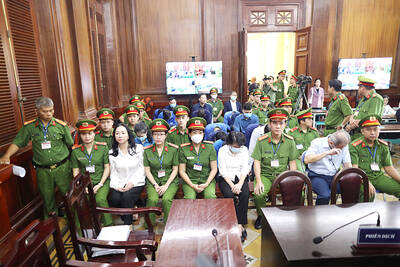
A top Vietnamese property tycoon was on Thursday sentenced to death in one of the biggest corruption cases in history, with an estimated US$27 billion in damages. A panel of three hand-picked jurors and two judges rejected all defense arguments by Truong My Lan, chair of major developer Van Thinh Phat, who was found guilty of swindling cash from Saigon Commercial Bank (SCB) over a decade. “The defendant’s actions ... eroded people’s trust in the leadership of the [Communist] Party and state,” read the verdict at the trial in Ho Chi Minh City. After the five-week trial, 85 others were also sentenced on

‘DELUSIONAL’: Targeting the families of Hamas’ leaders would not push the group to change its position or to give up its demands for Palestinians, Ismail Haniyeh said Israeli aircraft on Wednesday killed three sons of Hamas’ top political leader in the Gaza Strip, striking high-stakes targets at a time when Israel is holding delicate ceasefire negotiations with the militant group. Hamas said four of the leader’s grandchildren were also killed. Ismail Haniyeh’s sons are among the highest-profile figures to be killed in the war so far. Israel said they were Hamas operatives, and Haniyeh accused Israel of acting in “the spirit of revenge and murder.” The deaths threatened to strain the internationally mediated ceasefire talks, which appeared to gain steam in recent days even as the sides remain far
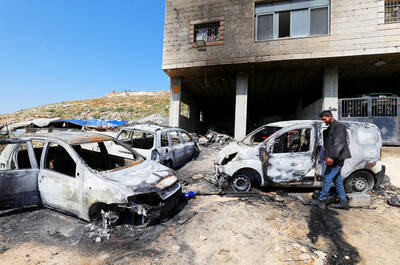
RAMPAGE: A Palestinian man was left dead after dozens of Israeli settlers searching for a missing 14-year-old boy stormed a village in the Israeli-occupied West Bank US President Joe Biden on Friday said he expected Iran to attack Israel “sooner, rather than later” and warned Tehran not to proceed. Asked by reporters about his message to Iran, Biden simply said: “Don’t,” underscoring Washington’s commitment to defend Israel. “We are devoted to the defense of Israel. We will support Israel. We will help defend Israel and Iran will not succeed,” he said. Biden said he would not divulge secure information, but said his expectation was that an attack could come “sooner, rather than later.” Israel braced on Friday for an attack by Iran or its proxies as warnings grew of


 RSS
RSS