


Romania and Bulgaria can be admitted as full members in the EU on Jan. 1 next year, EU officials said yesterday in a report recommending to the 25 governments already in the bloc that they accept the two poorer Balkan nations.
The European Commission said in its much-anticipated final report that both nations had made enough progress for entry. However, it said that a significant chunk of expected economic aid should be made conditional on the completion of further reforms needed in justice and home affairs, as well as food safety and state subsidies.
The decision to admit the two neighboring countries increases the size of the EU to 27 nations, but comes at a time of growing doubts about whether the bloc's rapid expansion should continue to take in nations such as Turkey and Croatia in coming years.
EU leaders will meet next month to give formal approval to Romania and Bulgaria whose bid for EU membership had been stalled due to their spotty records on fighting corruption. Both rank among the poorest nations in Europe.
Four countries -- France, Germany, Denmark and Belgium -- have yet to ratify the entry of Romania, a country of 22 million, and Bulgaria, with 8 million, but are expected to do so soon.
"Bulgaria and Romania have made further progress to complete their preparations for membership, demonstrating their capacity to apply EU principles and legislation from Jan. 1, 2007," said the report presented by European Commission President Jose Manuel Barroso and the EU's expansion commissioner, Olli Rehn.
Barroso said the entry of the two nations into the bloc would be a "historic achievement."
Both countries will face restrictions in terms of their work force gaining access to other EU markets. Britain, Sweden and Ireland, which opened the door to workers from the 10 newcomers who joined in 2004, are likely to set the strictest conditions. But they may also be shut out of labor markets in Hungary, Slovakia and the Czech Republic -- themselves battling restrictions by countries further west.
Bulgaria and Romania will have to regularly report on progress of their reform to Brussels, with the first report to come on March 31 next year.
Bulgaria's prime minister, Sergei Stanishev, said yesterday that EU membership signified "the final fall of the Berlin Wall for Bulgaria," but warned that it must work hard to integrate socially and economically into the bloc.
Money laundering and serious crime are of a particular concern in Bulgaria, whose judiciary has been criticized by the EU as sluggish and graft-prone. Romania must establish an anti-corruption agency that will also examine state officials' potential conflicts of interest, the commission said.
In particular, Bulgaria was asked to change its constitution to ensure the independence and accountability of the judicial system; guarantee a more transparent and efficient judicial process; conduct non-partisan investigations into allegations of high corruption; and implement a strategy to fight organized crime.
Romania will have to ensure a more transparent and efficient judicial process; and establish an agency veryifying assets of state officials and potential conflict of interest.
Both countries must eradicate swine fever to be able to sell pork in the rest of the EU without restrictions, and improve safety of dairy products.

Republican US lawmakers on Friday criticized US President Joe Biden’s administration after sanctioned Chinese telecoms equipment giant Huawei unveiled a laptop this week powered by an Intel artificial intelligence (AI) chip. The US placed Huawei on a trade restriction list in 2019 for contravening Iran sanctions, part of a broader effort to hobble Beijing’s technological advances. Placement on the list means the company’s suppliers have to seek a special, difficult-to-obtain license before shipping to it. One such license, issued by then-US president Donald Trump’s administration, has allowed Intel to ship central processors to Huawei for use in laptops since 2020. China hardliners
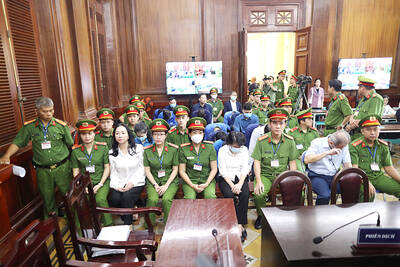
A top Vietnamese property tycoon was on Thursday sentenced to death in one of the biggest corruption cases in history, with an estimated US$27 billion in damages. A panel of three hand-picked jurors and two judges rejected all defense arguments by Truong My Lan, chair of major developer Van Thinh Phat, who was found guilty of swindling cash from Saigon Commercial Bank (SCB) over a decade. “The defendant’s actions ... eroded people’s trust in the leadership of the [Communist] Party and state,” read the verdict at the trial in Ho Chi Minh City. After the five-week trial, 85 others were also sentenced on

Conjoined twins Lori and George Schappell, who pursued separate careers, interests and relationships during lives that defied medical expectations, died this month in Pennsylvania, funeral home officials said. They were 62. The twins, listed by Guinness World Records as the oldest living conjoined twins, died on April 7 at the Hospital of the University of Pennsylvania, obituaries posted by Leibensperger Funeral Homes of Hamburg said. The cause of death was not detailed. “When we were born, the doctors didn’t think we’d make 30, but we proved them wrong,” Lori said in an interview when they turned 50, the Philadelphia Inquirer reported. The
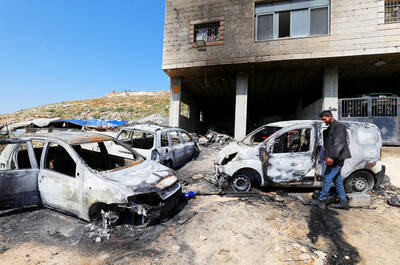
RAMPAGE: A Palestinian man was left dead after dozens of Israeli settlers searching for a missing 14-year-old boy stormed a village in the Israeli-occupied West Bank US President Joe Biden on Friday said he expected Iran to attack Israel “sooner, rather than later” and warned Tehran not to proceed. Asked by reporters about his message to Iran, Biden simply said: “Don’t,” underscoring Washington’s commitment to defend Israel. “We are devoted to the defense of Israel. We will support Israel. We will help defend Israel and Iran will not succeed,” he said. Biden said he would not divulge secure information, but said his expectation was that an attack could come “sooner, rather than later.” Israel braced on Friday for an attack by Iran or its proxies as warnings grew of


 RSS
RSS