


Iraqi President Jalal Talabani, in an interview published yesterday, asked for a long-term US military presence in Iraq, saying his country will need two permanent US air bases to deter "foreign interference."
He did not elaborate on the nature of the threat, but his remarks contained an indication he had in mind neighboring Iran.
"I think we will be in need of American forces for a long time -- even two military bases to prevent foreign interference," Talabani told the Washington Post.
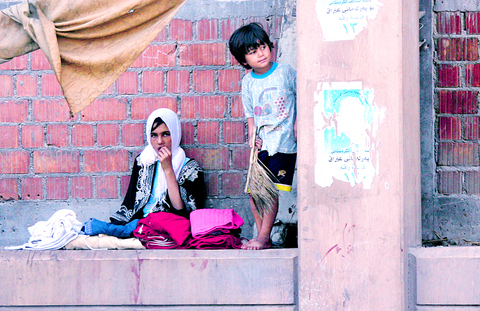
PHOTO: AP
"I don't ask to have 100,000 American soldiers -- 10,000 soldiers and two air bases would be enough," he added.
The president made clear the bases would be most welcome in Kurdistan, an autonomous region in northern Iraq that has practiced de facto self-government since the 1991 Gulf War.
But he suggested that the Sunni Arab segment of the Iraqi population would also welcome a long-term US military presence.
"In some places Sunnis want the Americans to stay," he argued. "Sunnis think the main danger is coming from Iran now."
The comments come as top US military commanders admitted the US will not be able to reduce its 147,000-strong contingent in Iraq in the coming months because of spreading sectarian violence and the possibility of the country slipping into civil war.
US Central Command head General John Abizaid told defense reporters last week any previous plans to draw down US troops in Iraq had been put off until at least next spring, and the force level might even go up.
"I think these are prudent force levels," Abizaid said of the current contingent. "We'll bring in more forces if we have to."
Several US congressional leaders have raised the possibility of the US acquiring long-term basing rights in Iraq in the past, but so far the administration of President George W. Bush has not made a firm commitment.
Talabani met with Bush last week.
The Iraqi President pointed out that US forces had already withdrawn from seven out of 18 Iraqi provinces, handing control over them to fledgling Iraqi security forces.
He predicted that by the end of this year this number will have grown to 12.
But he acknowledged that his government will need a sizable contingent of US and coalition forces until at least 2008, when it hoped Iraqi armed forces are able "to face terrorism and defeat it."
"I think within two years we will be able to train our army and have the capacity to face terrorism," Talabani assured.
However, he insisted that the presence of US forces beyond that point, "even a symbolic one, will frighten those who are trying to interfere in our affairs."
Meanwhile, the official start to Ramadan yesterday was punctuated with violent attacks around Iraq, including an assault on a police station and the discovery of more apparent victims of sectarian death squads in the capital.
One policeman was killed and six wounded when their station in Musayyib, about 60km south of Baghdad came under heavy attack, police said.
Six cars drove up to the building at about 8:30am and opened fire with machine-guns, then began firing volleys of mortar shells, police Captain Salah al-Maamouri said.
The unidentified attackers then fled when US troops arrived.
Nearly half of China’s major cities are suffering “moderate to severe” levels of subsidence, putting millions of people at risk of flooding, especially as sea levels rise, according to a study of nationwide satellite data released yesterday. The authors of the paper, published by the journal Science, found that 45 percent of China’s urban land was sinking faster than 3mm per year, with 16 percent at more than 10mm per year, driven not only by declining water tables, but also the sheer weight of the built environment. With China’s urban population already in excess of 900 million people, “even a small portion

UNSETTLING IMAGES: The scene took place in front of TV crews covering the Trump trial, with a CNN anchor calling it an ‘emotional and unbelievably disturbing moment’ A man who doused himself in an accelerant and set himself on fire outside the courthouse where former US president Donald Trump is on trial has died, police said yesterday. The New York City Police Department (NYPD) said the man was declared dead by staff at an area hospital. The man was in Collect Pond Park at about 1:30pm on Friday when he took out pamphlets espousing conspiracy theories, tossed them around, then doused himself in an accelerant and set himself on fire, officials and witnesses said. A large number of police officers were nearby when it happened. Some officers and bystanders rushed
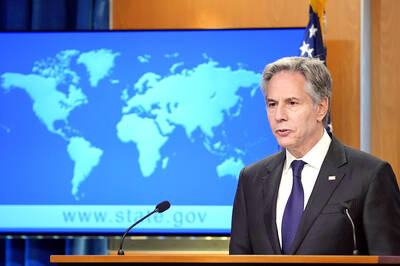
Beijing is continuing to commit genocide and crimes against humanity against Uyghurs and other Muslim minorities in its western Xinjiang province, U.S. Secretary of State Antony Blinken said in a report published on Monday, ahead of his planned visit to China this week. The State Department’s annual human rights report, which documents abuses recorded all over the world during the previous calendar year, repeated language from previous years on the treatment of Muslims in Xinjiang, but the publication raises the issue ahead of delicate talks, including on the war in Ukraine and global trade, between the top U.S. diplomat and Chinese

HYPOCRISY? The Chinese Ministry of Foreign Affairs yesterday asked whether Biden was talking about China or the US when he used the word ‘xenophobic’ US President Joe Biden on Wednesday called for a hike in steel tariffs on China, accusing Beijing of cheating as he spoke at a campaign event in Pennsylvania. Biden accused China of xenophobia, too, in a speech to union members in Pittsburgh. “They’re not competing, they’re cheating. They’re cheating and we’ve seen the damage here in America,” Biden said. Chinese steel companies “don’t need to worry about making a profit because the Chinese government is subsidizing them so heavily,” he said. Biden said he had called for the US Trade Representative to triple the tariff rates for Chinese steel and aluminum if Beijing was


 RSS
RSS