


Canadian police wrongly informed US authorities an Ottawa man was an Islamic extremist suspected of links to al-Qaeda -- information that likely led the US authorities to deport him to Syria where he was imprisoned and tortured, a government-commissioned report found on Monday.
The two-and-a-half year inquiry into the case of Syrian-born Maher Arar exonerated him of terrorist activity and urged the Canadian government to pay compensation to him. Arar is perhaps the world's best known victim of extraordinary rendition -- or the US transfer of foreign terror suspects to third countries without court approval.
"I am able to say categorically that there is no evidence to indicate that Arar has committed any offense or that his activities constitute a threat to the security of Canada," Commissioner Dennis O'Connor said in a three-volume report on the inquiry's findings.
Arar, a software engineer, was traveling on a Canadian passport when he was detained at New York's Kennedy Airport on Sept. 26, 2002, during a stopover on his way home to Canada from vacation in Tunisia.
Arar said US authorities sent him to Syria for interrogation as a suspected al-Qaeda member, an allegation he denied.
He spent nearly a year in prison in Syria. After his release in 2003, Arar made detailed allegations about extensive interrogations, beatings and whippings with electrical cable in Syrian prison cells.
Justice O'Connor also criticized the US and recommended that Ottawa file formal protests with both Washington and the Syrian government over Arar's treatment.
"They removed him to Syria against his wishes and in the face of his statements that he would be tortured if sent there. Moreover, they dealt with Canadian officials involved with Arar's case in a less than forthcoming manner," O'Connor wrote.
The US already faces intense criticism from human rights groups over the practice of taking suspects to countries where they could be tortured.
US President George W. Bush acknowledged earlier this month that terrorism suspects had been held in secret CIA-run prisons in other countries. They included the mastermind of the Sept. 11, 2001, attacks, Khalid Sheik Mohammed.
The US and Syria refused to cooperate in the Canadian inquiry.
The commission found the Royal Canadian Mounted Police (RCMP) shared information about Arar with US anti-terrorist agencies before and after he was detained.
The RCMP asked the US to put Arar on a watch list as an "Islamic extremist individual suspected of being linked to the al-Qaeda terrorist movement," the report said.
They did this after Arar met with another man who was under surveillance, a meeting Arar has said in interviews was merely about where to find inexpensive computer equipment. Police had no evidence linking Arar to terrorist activity, yet they asked the US to put him on a watch list as an "Islamic extremist."
"The RCMP had no basis for this description, which had the potential to create serious consequences for Arar in light of US attitudes and practices," the report said in reference to the climate after the Sept. 11 attacks.
The force also described him as the "target" of a domestic anti-terrorist investigation in Canada when he was a peripheral figure seen in the company of the man who was under surveillance.
O'Connor said much of the material had not been checked to ensure its accuracy and reliability -- a violation of the RCMP's rules for sharing information.
O'Connor concluded the inaccurate information passed by Canadian police to US authorities "very likely" led to their decision to send Arar to Syria.
"It's quite clear that the RCMP sent inaccurate information to US officials," Arar said. "I would have not have even been sent to Syria had this information not been given to them."
"I have waited a long time to have my name cleared. I was tortured and lost a year of my life," Arar said.
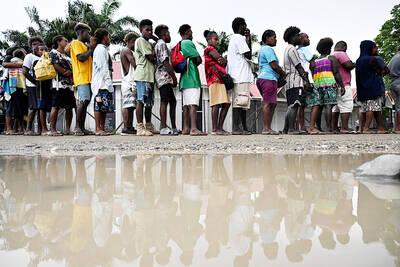
SEEKING CHANGE: A hospital worker said she did not vote in previous elections, but ‘now I can see that maybe my vote can change the system and the country’ Voting closed yesterday across the Solomon Islands in the south Pacific nation’s first general election since the government switched diplomatic allegiance from Taiwan to Beijing and struck a secret security pact that has raised fears of the Chinese navy gaining a foothold in the region. The Solomon Islands’ closer relationship with China and a troubled domestic economy weighed on voters’ minds as they cast their ballots. As many as 420,000 registered voters had their say across 50 national seats. For the first time, the national vote also coincided with elections for eight of the 10 local governments. Esther Maeluma cast her vote in the
Nearly half of China’s major cities are suffering “moderate to severe” levels of subsidence, putting millions of people at risk of flooding, especially as sea levels rise, according to a study of nationwide satellite data released yesterday. The authors of the paper, published by the journal Science, found that 45 percent of China’s urban land was sinking faster than 3mm per year, with 16 percent at more than 10mm per year, driven not only by declining water tables, but also the sheer weight of the built environment. With China’s urban population already in excess of 900 million people, “even a small portion

UNSETTLING IMAGES: The scene took place in front of TV crews covering the Trump trial, with a CNN anchor calling it an ‘emotional and unbelievably disturbing moment’ A man who doused himself in an accelerant and set himself on fire outside the courthouse where former US president Donald Trump is on trial has died, police said yesterday. The New York City Police Department (NYPD) said the man was declared dead by staff at an area hospital. The man was in Collect Pond Park at about 1:30pm on Friday when he took out pamphlets espousing conspiracy theories, tossed them around, then doused himself in an accelerant and set himself on fire, officials and witnesses said. A large number of police officers were nearby when it happened. Some officers and bystanders rushed

HYPOCRISY? The Chinese Ministry of Foreign Affairs yesterday asked whether Biden was talking about China or the US when he used the word ‘xenophobic’ US President Joe Biden on Wednesday called for a hike in steel tariffs on China, accusing Beijing of cheating as he spoke at a campaign event in Pennsylvania. Biden accused China of xenophobia, too, in a speech to union members in Pittsburgh. “They’re not competing, they’re cheating. They’re cheating and we’ve seen the damage here in America,” Biden said. Chinese steel companies “don’t need to worry about making a profit because the Chinese government is subsidizing them so heavily,” he said. Biden said he had called for the US Trade Representative to triple the tariff rates for Chinese steel and aluminum if Beijing was


 RSS
RSS