


NATO forces in Afghanistan were struck by another suicide car bomb yesterday as they wound down the military phase of their biggest operation against Taliban fighters in the south.
The car bomb exploded near a military convoy in the southern city of Kandahar, killing a civilian believed to be of Pakistani origin and wounding five Afghans, police said.
The NATO-led International Security Assistance Force (ISAF) said it suffered no casualties in the blast, which had damaged a military vehicle.
Suicide blasts are a hallmark of an insurgency launched by the Taliban after it was toppled from government in late 2001.
There have been move than 40 suicide blasts in southern Afghanistan this year, most of them in Kandahar, according to the ISAF.
The bombings have killed more than 100 people, about 80 percent of them civilians.
The ISAF commander, Lieutenant General David Richards, told a British TV station on Saturday that the military campaign against the Taliban could last for another three to five years.
Richards told Channel 4 News he was determined the campaign would be successful and the Taliban would "start dancing to my tune."
Tackling the booming illegal opium trade -- which many officials have linked to the insurgency -- was likely to take "many years," the general said.
"But if we do that cleverly, then in terms of the insurgency I reckon within between about three to five years this campaign ... people might say `well, we've just about won,'" Richards said.
Meanwhile, Afghan and NATO forces announced yesterday that they had driven Taliban out of an insurgent stronghold in Kandahar Province and were starting reconstruction work.
The combat phase of Operation Medusa, which kicked off on Sept. 2, was over, Kandahar Province Governor Assadullah Khalid told reporters.
"We believe we have cleared the Taliban out of the Panjwayi Pashmul area," ISAF spokesman Major Quentin Innes said.
There were however a "significant" number of Taliban-laid mines and improvised explosive devices in the area and troops wanted to remove them before encouraging the thousands of people who had fled the area to return home, Innes said.
The troops would now help with reconstruction and humanitarian aid, he said.
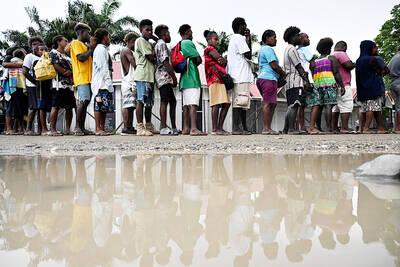
SEEKING CHANGE: A hospital worker said she did not vote in previous elections, but ‘now I can see that maybe my vote can change the system and the country’ Voting closed yesterday across the Solomon Islands in the south Pacific nation’s first general election since the government switched diplomatic allegiance from Taiwan to Beijing and struck a secret security pact that has raised fears of the Chinese navy gaining a foothold in the region. The Solomon Islands’ closer relationship with China and a troubled domestic economy weighed on voters’ minds as they cast their ballots. As many as 420,000 registered voters had their say across 50 national seats. For the first time, the national vote also coincided with elections for eight of the 10 local governments. Esther Maeluma cast her vote in the
Nearly half of China’s major cities are suffering “moderate to severe” levels of subsidence, putting millions of people at risk of flooding, especially as sea levels rise, according to a study of nationwide satellite data released yesterday. The authors of the paper, published by the journal Science, found that 45 percent of China’s urban land was sinking faster than 3mm per year, with 16 percent at more than 10mm per year, driven not only by declining water tables, but also the sheer weight of the built environment. With China’s urban population already in excess of 900 million people, “even a small portion

UNSETTLING IMAGES: The scene took place in front of TV crews covering the Trump trial, with a CNN anchor calling it an ‘emotional and unbelievably disturbing moment’ A man who doused himself in an accelerant and set himself on fire outside the courthouse where former US president Donald Trump is on trial has died, police said yesterday. The New York City Police Department (NYPD) said the man was declared dead by staff at an area hospital. The man was in Collect Pond Park at about 1:30pm on Friday when he took out pamphlets espousing conspiracy theories, tossed them around, then doused himself in an accelerant and set himself on fire, officials and witnesses said. A large number of police officers were nearby when it happened. Some officers and bystanders rushed

HYPOCRISY? The Chinese Ministry of Foreign Affairs yesterday asked whether Biden was talking about China or the US when he used the word ‘xenophobic’ US President Joe Biden on Wednesday called for a hike in steel tariffs on China, accusing Beijing of cheating as he spoke at a campaign event in Pennsylvania. Biden accused China of xenophobia, too, in a speech to union members in Pittsburgh. “They’re not competing, they’re cheating. They’re cheating and we’ve seen the damage here in America,” Biden said. Chinese steel companies “don’t need to worry about making a profit because the Chinese government is subsidizing them so heavily,” he said. Biden said he had called for the US Trade Representative to triple the tariff rates for Chinese steel and aluminum if Beijing was


 RSS
RSS