


Where as many as 10,000 fishing boats once docked, now only a few bob in a long, serpentine harbor flecked with wrecks. All along the shoreline here, families that only recently made a rich living from the sea stare glumly at reminders of their loss.
Clearly, this fishing village and others near the mouth of a bay on China's southeast coast suffered catastrophic damage when Super Typhoon Saomai blew through on Aug. 10 with sustained winds of 240kph. Yet the next day, initial reports listed only 17 people dead and 138 missing in Fujian Province.
By noon on Aug. 10, according to news reports distributed nationwide, more than 500,000 people had been evacuated and 5 million others had been alerted to the impending danger through messages sent to cellphone users. The emergency response was trumpeted as a triumph.
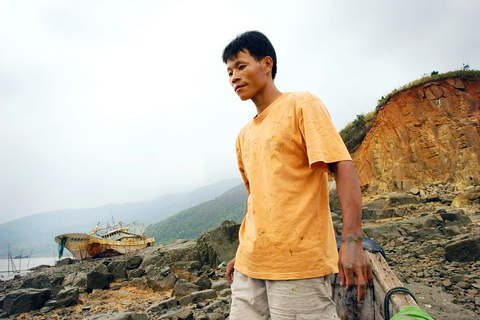
PHOTO: NY TIMES NEWS SERVICE
In the storm's aftermath, however, a very different account of events has gradually taken shape. Although it is unlikely that an accurate death toll will ever be determined, the actual numbers appear to far surpass the official totals.
Visiting the area two days after the storm struck, Chinese Vice Premier Hui Liangyu (
But an internal report by the official Xinhua news agency, compiled in the days after the storm and intended only for the authorities, bluntly contradicted the official picture.
In succeeding days, the Chinese news media also took an increasingly skeptical view of the official accounts. After consulting with local fishermen, these publications, among them Chinese Newsweek, concluded that about 900 boats from the immediate area had been lost at sea. Because each fishing boat typically carries a crew of two, they estimated that some 2,000 people had died just in this vicinity, where the storm hit hardest.
One fisherman, Wei Dingxian, said: "I've never seen such a big wind, and neither has anyone who has lived here in the last 60 years."
Wei, 34, whose boat was destroyed, and whose brother drowned on another craft, told one Chinese magazine that he saw bodies floating in the bay for several days as he searched for his brother.
AT WAR WITH NEWS
During events like these it often seems that the Chinese authorities are at war with the news, or even with the truth itself. Weeks after the storm, local residents complained bitterly that the vice premier had been led by local officials to a village where the damage was minimal, participating in a masquerade, wittingly or not.
In a further indication of official concerns, a foreign reporter's visit to the site was interrupted by a video camera-wielding crew of local propaganda officials who stopped his tour and escorted him out of the province.
Earlier this year, the State Council approved a law that would assess large fines against "news media that violate the regulations and release reports about the situation regarding management of sudden incidents."
The law is under consideration in the legislature.
Just this week, China announced new regulations prohibiting foreign news organizations from distributing news, photos or graphics in China, and warning them against reports that "endanger national security."
In the case of Super Typhoon Saomai, it was the Chinese news media themselves that confronted, however tentatively, the fictitious picture of a monster storm masterfully handled.
Two days after the storm, and a day after Hui visited the area, reporters from the headquarters of Xinhua in neighboring Zhejiang Province arrived to discover scenes of devastation unlike anything that had been reported.
Following a tradition from the time of Mao Zedong (毛澤東), who pressed the agency into service as part of an exclusive information gathering network for the country's top leaders, the agency's team wrote an "internal reference" report that night. The report, parts of which have been quoted in the Chinese news media, forced the Fujian Province officials to raise their estimates of the death toll to 178, with another 94 missing, for the area.
The revised figures were published grudgingly, with comments in a local newspaper from the provincial Communist Party secretary condemning "some media, including reporters from other provinces who came to the area hit by the calamity and produced a lot of unreal reports based on hearsay."
FACADE
Over the ensuing weeks, though, cracks in the facade of silence over the true extent of death and devastation from the storm continued to widen, including a report from a state television crew that put the number of boats in the harbor at the time of the storm at 10,000.
The most telling accounts of what happened, of the carnage and of the more than 900 boats reliably known to have been lost at sea, still come from the residents themselves. They willingly supply details -- like the beating of a mayor by women angered by the disappearance of their loved ones and what many here say was a poor response to the emergency -- that have not been published even in the Chinese reports that have dared to challenge the official view of the disaster.
"This tragedy won't make our hearts turn cold; it's the lack of government performance that will," said a fisherman who spoke on the condition on anonymity, citing dangers to anyone who dared talk about the storm's toll, even a month later.
"This is the consistent style of the Chinese government," he said.
"Big or small problems are suppressed as much as possible. They have no courage to face any of them," he said.
Nearly half of China’s major cities are suffering “moderate to severe” levels of subsidence, putting millions of people at risk of flooding, especially as sea levels rise, according to a study of nationwide satellite data released yesterday. The authors of the paper, published by the journal Science, found that 45 percent of China’s urban land was sinking faster than 3mm per year, with 16 percent at more than 10mm per year, driven not only by declining water tables, but also the sheer weight of the built environment. With China’s urban population already in excess of 900 million people, “even a small portion

UNSETTLING IMAGES: The scene took place in front of TV crews covering the Trump trial, with a CNN anchor calling it an ‘emotional and unbelievably disturbing moment’ A man who doused himself in an accelerant and set himself on fire outside the courthouse where former US president Donald Trump is on trial has died, police said yesterday. The New York City Police Department (NYPD) said the man was declared dead by staff at an area hospital. The man was in Collect Pond Park at about 1:30pm on Friday when he took out pamphlets espousing conspiracy theories, tossed them around, then doused himself in an accelerant and set himself on fire, officials and witnesses said. A large number of police officers were nearby when it happened. Some officers and bystanders rushed

Beijing is continuing to commit genocide and crimes against humanity against Uyghurs and other Muslim minorities in its western Xinjiang province, U.S. Secretary of State Antony Blinken said in a report published on Monday, ahead of his planned visit to China this week. The State Department’s annual human rights report, which documents abuses recorded all over the world during the previous calendar year, repeated language from previous years on the treatment of Muslims in Xinjiang, but the publication raises the issue ahead of delicate talks, including on the war in Ukraine and global trade, between the top U.S. diplomat and Chinese

HYPOCRISY? The Chinese Ministry of Foreign Affairs yesterday asked whether Biden was talking about China or the US when he used the word ‘xenophobic’ US President Joe Biden on Wednesday called for a hike in steel tariffs on China, accusing Beijing of cheating as he spoke at a campaign event in Pennsylvania. Biden accused China of xenophobia, too, in a speech to union members in Pittsburgh. “They’re not competing, they’re cheating. They’re cheating and we’ve seen the damage here in America,” Biden said. Chinese steel companies “don’t need to worry about making a profit because the Chinese government is subsidizing them so heavily,” he said. Biden said he had called for the US Trade Representative to triple the tariff rates for Chinese steel and aluminum if Beijing was


 RSS
RSS