


Iraqi Prime Minister Nuri al-Maliki was to deliver a blunt message to fellow Shiite Islamist leaders in Iran yesterday that they should not interfere in Iraqi affairs.
It is a message that may please al-Maliki's sponsors in the US, who accuse Iran of funding and training militants fighting US forces in Iraq, possibly in response to mounting US pressure on Tehran to halt its nuclear program.
Maliki met Iranian President Mahmoud Ahmadinejad on arrival yesterday in Tehran and was expected today to meet Supreme Leader Ayatollah Ali Khamenei, who is the highest authority in Iran, and influential former president Akbar Hashemi Rafsanjani.
Stopping short of explicitly endorsing US accusations of Iranian "meddling" in Iraq, Iraqi government spokesman Ali al-Dabbagh said on Monday: "We want to pass a message to the Iranian leaders that Iraq needs good relations with neighboring countries, without interference in our internal affairs."
While officially on record as encouraging Iraq's new, warm ties to Washington's adversary, there is unease in the US at Iranian influence over the Shiite leaders brought to power in elections that followed the US overthrow of former Iraqi president Saddam Hussein.
Since forming a national unity government four months ago, Maliki has vowed to curb militant Shiite factions, some of whom also have links with movements in Iran, as part of efforts to avert civil war with Saddam's once-dominant Sunni minority.
Saddam's genocide trial entered its fifth hearing yesterday, a day after the former Iraqi ruler charged that Kurdish testimonies against him were dividing the country.
Saddam and six co-defendants including his cousin Ali Hassan al-Majid, dubbed "Chemical Ali," were in the dock again to face charges including genocide over the brutal 1987-1988 Anfal campaign against Kurds in northern Iraq which prosecutors say left 182,000 people dead.
The trial, which began on Aug. 21, has seen nine Kurds give chilling accounts of how Saddam's forces swept through the northern Kurdish villages killing and gassing people and destroying their homes.
On Monday the former ruler charged that the trial was dividing Iraq between the Kurds and the Sunni Arabs.
"The whole beginning [of witness testimonies] is aimed at creating a split within Iraq between the Kurds and Arabs," Saddam said in a tirade from the dock.
"I want to give a message to the Iraqi people that they should not suffer from this guilt that they killed Kurds. This is shameful," he said.
Saddam, who is also awaiting a verdict in a trial over the killing of Shiite villagers after an attempt on his life in 1982, is charged with genocide, war crimes and crimes against humanity over the Anfal campaign.
If found guilty, he faces execution by hanging.
Saddam, showing flashes of anger, claimed he had on several occasions acted on behalf of the Kurdish minority in Iraq.
"After the Iran-Iraq war ... I made a statement on TV and radio giving orders that no Iraqi security force should arrest Kurds, and if anyone has problems with Kurds, they should complain to Saddam Hussein," he said.
The former dictator also said it was he who agreed autonomy for the Kurds in northern Iraq in 1970, when he was vice president.
"If the Arabs were racist and discriminatory, why would they accept an autonomy for the Kurds," he said, vowing however that "Iraqis will not split."
Saddam's outburst on Monday came after three witnesses claimed he and his co-accused ordered the gassing of Kurds and bombing of their villages to quell an insurgency that coincided with the last years of the 1980-1988 Iran-Iraq war.
Nearly half of China’s major cities are suffering “moderate to severe” levels of subsidence, putting millions of people at risk of flooding, especially as sea levels rise, according to a study of nationwide satellite data released yesterday. The authors of the paper, published by the journal Science, found that 45 percent of China’s urban land was sinking faster than 3mm per year, with 16 percent at more than 10mm per year, driven not only by declining water tables, but also the sheer weight of the built environment. With China’s urban population already in excess of 900 million people, “even a small portion

UNSETTLING IMAGES: The scene took place in front of TV crews covering the Trump trial, with a CNN anchor calling it an ‘emotional and unbelievably disturbing moment’ A man who doused himself in an accelerant and set himself on fire outside the courthouse where former US president Donald Trump is on trial has died, police said yesterday. The New York City Police Department (NYPD) said the man was declared dead by staff at an area hospital. The man was in Collect Pond Park at about 1:30pm on Friday when he took out pamphlets espousing conspiracy theories, tossed them around, then doused himself in an accelerant and set himself on fire, officials and witnesses said. A large number of police officers were nearby when it happened. Some officers and bystanders rushed

HYPOCRISY? The Chinese Ministry of Foreign Affairs yesterday asked whether Biden was talking about China or the US when he used the word ‘xenophobic’ US President Joe Biden on Wednesday called for a hike in steel tariffs on China, accusing Beijing of cheating as he spoke at a campaign event in Pennsylvania. Biden accused China of xenophobia, too, in a speech to union members in Pittsburgh. “They’re not competing, they’re cheating. They’re cheating and we’ve seen the damage here in America,” Biden said. Chinese steel companies “don’t need to worry about making a profit because the Chinese government is subsidizing them so heavily,” he said. Biden said he had called for the US Trade Representative to triple the tariff rates for Chinese steel and aluminum if Beijing was
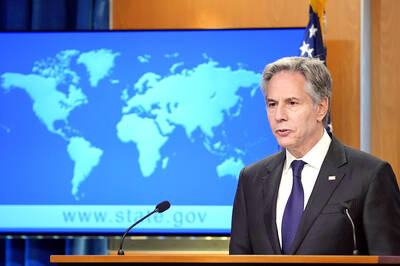
Beijing is continuing to commit genocide and crimes against humanity against Uyghurs and other Muslim minorities in its western Xinjiang province, U.S. Secretary of State Antony Blinken said in a report published on Monday, ahead of his planned visit to China this week. The State Department’s annual human rights report, which documents abuses recorded all over the world during the previous calendar year, repeated language from previous years on the treatment of Muslims in Xinjiang, but the publication raises the issue ahead of delicate talks, including on the war in Ukraine and global trade, between the top U.S. diplomat and Chinese


 RSS
RSS