


As much of the world marked Sept. 11 by remembering those who were killed in the 2001 attacks on the US, India celebrated it as a day of peace -- the 100th anniversary of Mohandas Gandhi's philosophy of peaceful resistance, or Satyagraha.
Most Indians marked Monday's Gandhi anniversary with art exhibitions, charity events and tributes, although some accused the government of failing to live up to Gandhi's spirit.
Over the past century, Gandhi's doctrine of using nonviolent means to strive for justice has been a rallying call for Indians to throw off British colonial rule, an inspiration to Martin Luther King Jr. and an influence on South Africa's peaceful transition from apartheid to democracy.
Many other liberation groups all over the world have based their ideologies on Gandhi's philosophy.
Even today, when India has cast aside its socialist-style economy to firmly embrace capitalism, leaders say Gandhi's values -- which also promoted a frugal lifestyle -- are relevant.
"By the force of moral example and restraint in the face of vicious provocation, Gandhi and his followers were able to effect a change of heart in their oppressors," said a statement from the governing Congress party, which ordered a year of events to mark the occasion.
On Sept. 11, 1906, Gandhi, then a young and little-known lawyer working in South Africa, joined a meeting of fellow Indians at a theater in the South African capital to protest a proposed law that would force Indians to carry identity documents and be fingerprinted.
Indians had initially been brought to South Africa as indentured workers by the British, who ruled both countries at the time.
Gandhi convinced those present to resist or ignore the law -- but without resorting to violence.
He called the idea Satyagraha, which literally translates as "insistence on truth."
Thousands of Indians were jailed, including Gandhi, for refusing to cooperate and burning their identity booklets.
In the end, the government eventually agreed to some of Gandhi's demands.
In 1916, Gandhi returned to India to set up an ashram, a Hindu spiritual center, where he taught his philosophy.
He also stressed ending caste differences, relieving poverty and ousting the British.
Gandhi then successfully led a farmers' protest against feudal landlords and unjust taxes.
His efforts earned him the name "Mahatma" or "Great Soul," and his reputation began to spread.
As his fame grew, he took a greater role in leading the campaign to force out the British, famously leading a 400km march to the sea to protest salt taxes.
Gandhi's great success, however, was to provide the Indian masses with a way to join the struggle for independence.
But throughout his life he never wavered from his position that those aims could be achieved without resorting to violence, said Pran Chopra, a New Delhi-based political analyst.
Before Gandhi, opponents of British rule were either isolated intellectuals or small violent groups.
"This platform offered by Gandhi ... gave them an opening so they could participate in boycotts and protests," he said.
Finally, Gandhi spearheaded the Quit India campaign, which forced the British, exhausted by World War II, from India in 1947.
His influence is also felt in South Africa, where he is credited with inspiring the peaceful change to majority rule in 1994.
Visiting South African Deputy President Phumzile Mlambo-Nckuka placed a wreath at Gandhi's main New Delhi memorial on Monday morning.
But as many praised Gandhi's legacy, it wasn't clear how relevant his legacy was for many young Indians.
In a survey published on Sunday by the Economic Times newspaper, young Indian business leaders and students were asked who was the biggest icon of today's times.
Microsoft founder Bill Gates won with 37 percent -- beating out Gandhi who only received 30 percent.
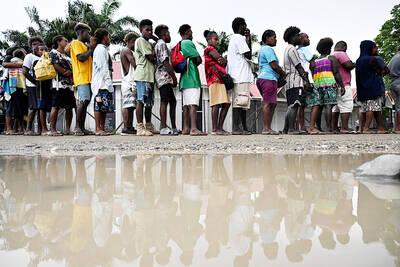
SEEKING CHANGE: A hospital worker said she did not vote in previous elections, but ‘now I can see that maybe my vote can change the system and the country’ Voting closed yesterday across the Solomon Islands in the south Pacific nation’s first general election since the government switched diplomatic allegiance from Taiwan to Beijing and struck a secret security pact that has raised fears of the Chinese navy gaining a foothold in the region. The Solomon Islands’ closer relationship with China and a troubled domestic economy weighed on voters’ minds as they cast their ballots. As many as 420,000 registered voters had their say across 50 national seats. For the first time, the national vote also coincided with elections for eight of the 10 local governments. Esther Maeluma cast her vote in the
Nearly half of China’s major cities are suffering “moderate to severe” levels of subsidence, putting millions of people at risk of flooding, especially as sea levels rise, according to a study of nationwide satellite data released yesterday. The authors of the paper, published by the journal Science, found that 45 percent of China’s urban land was sinking faster than 3mm per year, with 16 percent at more than 10mm per year, driven not only by declining water tables, but also the sheer weight of the built environment. With China’s urban population already in excess of 900 million people, “even a small portion

HYPOCRISY? The Chinese Ministry of Foreign Affairs yesterday asked whether Biden was talking about China or the US when he used the word ‘xenophobic’ US President Joe Biden on Wednesday called for a hike in steel tariffs on China, accusing Beijing of cheating as he spoke at a campaign event in Pennsylvania. Biden accused China of xenophobia, too, in a speech to union members in Pittsburgh. “They’re not competing, they’re cheating. They’re cheating and we’ve seen the damage here in America,” Biden said. Chinese steel companies “don’t need to worry about making a profit because the Chinese government is subsidizing them so heavily,” he said. Biden said he had called for the US Trade Representative to triple the tariff rates for Chinese steel and aluminum if Beijing was

UNSETTLING IMAGES: The scene took place in front of TV crews covering the Trump trial, with a CNN anchor calling it an ‘emotional and unbelievably disturbing moment’ A man who doused himself in an accelerant and set himself on fire outside the courthouse where former US president Donald Trump is on trial has died, police said yesterday. The New York City Police Department (NYPD) said the man was declared dead by staff at an area hospital. The man was in Collect Pond Park at about 1:30pm on Friday when he took out pamphlets espousing conspiracy theories, tossed them around, then doused himself in an accelerant and set himself on fire, officials and witnesses said. A large number of police officers were nearby when it happened. Some officers and bystanders rushed


 RSS
RSS