


■ Philippines
Three killed in shootings
Gunmen killed a tabloid newspaper photographer and two leftwing activists in three separate shootings in the Philippines, the national police said yesterday. Nearly 1,000 leftist activists, community organisers, lawyers and journalists have either gone missing or been murdered since President Gloria Macapagal Arroyo came to power in 2001 and her government has been criticized for failing to stop the killings. Photojournalist Vic Melendrez was walking down a narrow alley outside his house in a suburb north of Manila yesterday morning when three gunmen shot him in the chest and the back, the ninth murder of a journalist this year. "We're still verifying the motive for the killing," Moises Guevarra, the city police chief, told reporters.
■ China
Town in mercury nightmare
A town in southwest China is wrestling with a serious pollution problem after a thermometer factory contaminated its vegetable fields and rivers with mercury, local media said on Sunday. The residents of Dongyang town in Chongqing municipality may face the loss of 20 hectares of farmland because the mercury has seeped into the soil, the Chongqing Evening Post said. Farmers had for a long time used the water from nearby rivers, which are contaminated by the factory pollution, to irrigate their vegetables, corn and melons, the report said. The factory, which closed yesterday after filing for bankruptcy, had a section that produced mercury and droplets of the chemical can still be seen around the grounds of the complex, the report said.
■ New Zealand
Costly cash phased out
Small change got smaller yesterday with the official launch of the nation's new, leaner 50, 20 and 10 cent pieces -- and the elimination of the five cent piece. From Nov. 1, the old, larger 50, 20, 10 and five cent pieces will no longer be legal tender, said Reserve Bank project manager Alan Boaden. New Zealand phased out its one and two cent coins some years ago. The bank has distributed 83 million of the new coins. Low-value coins made from nickel and copper are beginning to cost more to make than their face value.
■ Australia
Police hunt cruel beggar
Police were hunting yesterday for a beggar who jabbed his burning cigarette into an 18-month old child's eye. New South Wales police said the random attack took place on Friday morning in Sydney's western suburbs. The man approached a woman with two children on a street corner and chatted briefly, before removing the cigarette from his mouth and pushing it into the boy's eye. The child was treated at the Sydney Children's Hospital and is not expected to have suffered long-term damage to his sight.
■ China
County orders death to dogs
A southwest county has ordered all 50,546 dogs to be killed in an effort to fight a rabies outbreak that has killed three people, state media said yesterday. Around 90 percent of the dogs in Muding County, Yunnan Province, had already been killed since the campaign began on July 25, the Beijing News said. Owners were ordered to kill their pets or face having teams of local police kill them, it said. From January through July, 360 people in the county had been bitten by dogs, with the three human deaths occurring since April, the Beijing Times said. Some owners have used methods including hanging their dogs, electrocuting them and clubbing them to death, while others used drugs, the Beijing News said.
■ China
Beijing to build new airport
Beijing plans to start building a second international airport after the 2008 Olympics, a news report said yesterday. Officials are looking for a site for the second airport, which could be as far away as neighboring Hebei Province, the China Daily said. It said officials were recently told to speed up the selection process so that other planning can begin. The Chinese capital is in the midst of a massive expansion of its first international airport to cope with booming passenger numbers and an influx of tourists expected for the 2008 Summer Games.
■ South Korea
Freed men may go home
Eight South Korean fishermen released after being held for months by Somali pirates could return home as early as this weekend, a company official said yesterday. The South Koreans were set free along with nine Indonesians, five Vietnamese and three Chinese after paying more than US$800,000 in ransom to the Somali militant group. The South Koreans are scheduled to arrive at Mombasa, Kenya on Thursday and receive medical checkups before flying on Saturday to Seoul, a spokesman for Dongwon Fisheries said.
■ Seychelles
Opposition accepts defeat
Aides of the main opposition leader, Anglican priest Wavel Ramkalawan, conceded defeat on Sunday in a presidential race against incumbent President James Michel for rule over the Indian Ocean archipelago. "I think we have lost. We're running behind with 46 percent of the vote to their 54," said Roger Mancienne, secretary general of Ramkalawan's Seychelles National Party. The electoral commission declined to comment on the result until counting is finished but a ruling party official called the election for Michel.
■ United Kingdom
Anti-smoker gets cancer
The world's most formidable anti-smoking campaigner, Allen Carr, who used to smoke 100 cigarettes a day, has been told he has lung cancer. Doctors have confirmed a preliminary diagnosis on the 73-year-old, whose Easyway system has sold millions of books and provides extraordinarily successful clinics in 30 countries. Carr, who kicked the habit 23 years ago, said he was in good spirits and determined to use his condition to help more people give up smoking.
■ United States
Police probe Gibson arrest
A stunned Hollywood debated the future of one of its biggest stars as a sheriff's watchdog launched an investigation into a possible cover up of a leaked report that quoted Mel Gibson unleashing a tirade of anti-Semitic remarks during a drunken driving arrest. The entertainment Web site TMZ posted what it said were four pages from the original arrest report, which quoted Gibson as launching an expletive-laden "barrage of anti-Semitic remarks" after he was stopped. The report has not been made public, but the Los Angeles Times reported Sunday that it had independently verified its authenticity. The Office of Independent Review, a police department watchdog panel, has opened an investigation into whether authorities gave Gibson preferential treatment by covering up his alleged inflammatory comments, said its chief attorney, Mike Gennaco.
■ Gibraltar
Deal on The Rock close
Britain and Spain are on the point of reaching a historic agreement over Gibraltar that will resolve many of the problems that have blighted relations over The Rock for the past few decades. The agreement will see the airport opened up to flights from Spain and the rest of Europe, while border controls will also be eased. Other measures will increase the number of phone lines into Gibraltar and solve a long-running row over British pension payments to former Spanish workers on The Rock. Most importantly, however, it will be the first three-way agreement in the history of The Rock, with Britain, Spain and Gibraltar shaking hands together over the deal.
■ Iran
Chavez given medal
Iran awarded Venezuelan President Hugo Chavez its highest state medal on Sunday for supporting Tehran in its nuclear standoff, while the fiery leader urged the world to rise up and defeat the US, state-run television in both countries reported. Chavez said US President George W. Bush is so evil he must talk to the devil, and he condemned Israel for what he called the "terrorism" and "madness" of its attacks in Lebanon, Venezuelan state television reported. Iran awarded the medal to show its gratitude for Chavez's support, "especially its opposition to a resolution by the International Atomic Energy Agency," the Iranian station said.
■ United Kingdom
Bond set goes up in flames
The set of the latest James Bond film, Casino Royale, was destroyed on Sunday in a blaze which left the 007 stage at Pinewood Studios, north of London, a blackened ruin. Firefighters took almost two hours to bring the fire under control, hampered by the presence of gas cylinders, two of which exploded when the fire broke out at around 11am. Both the fictional spy and the actor who plays him were unscathed, as filming for Casino Royale had finished, and Daniel Craig and the other cast were absent. The cause of the fire is still being investigated. Witnesses said smoke from the blaze could be seen 16km away and 60 firefighters were drafted in to tackle the blaze.
■ Iraq
Cleric warns US on Lebanon
Iraq's top Shiite cleric, Grand Ayatollah Ali al-Sistani, has warned that the Muslim world will not forgive countries which stand in the way of a ceasefire between Israel and Hezbollah guerrillas in Lebanon. "The Islamic world and peace loving people will not excuse sides which hinder a ceasefire. It will have harmful consequences in the whole region," he said in a statement issued late on Sunday, in a clear reference to the US. The US has opposed calling for an immediate ceasefire.
■ United Kingdom
Drug system `failing'
The nation's system of classifying drugs is failing and needs to be completely overhauled and replaced by a scale which assesses harm, a critical report by a committee of lawmakers said yesterday. The current system of rating substances in A, B or C categories has "significant anomalies" and is "not fit for purpose," the Science and Technology Select Committee said. It called for a new scientifically-based scale which took into account the harm that each drug caused, rather than one based on historical assumptions and on the penalties incurred for possessing or trafficking a substance. The lawmakers said they had found no convincing evidence that using the system had worked as a deterrent.

Republican US lawmakers on Friday criticized US President Joe Biden’s administration after sanctioned Chinese telecoms equipment giant Huawei unveiled a laptop this week powered by an Intel artificial intelligence (AI) chip. The US placed Huawei on a trade restriction list in 2019 for contravening Iran sanctions, part of a broader effort to hobble Beijing’s technological advances. Placement on the list means the company’s suppliers have to seek a special, difficult-to-obtain license before shipping to it. One such license, issued by then-US president Donald Trump’s administration, has allowed Intel to ship central processors to Huawei for use in laptops since 2020. China hardliners

Conjoined twins Lori and George Schappell, who pursued separate careers, interests and relationships during lives that defied medical expectations, died this month in Pennsylvania, funeral home officials said. They were 62. The twins, listed by Guinness World Records as the oldest living conjoined twins, died on April 7 at the Hospital of the University of Pennsylvania, obituaries posted by Leibensperger Funeral Homes of Hamburg said. The cause of death was not detailed. “When we were born, the doctors didn’t think we’d make 30, but we proved them wrong,” Lori said in an interview when they turned 50, the Philadelphia Inquirer reported. The
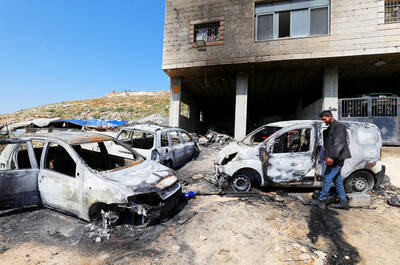
RAMPAGE: A Palestinian man was left dead after dozens of Israeli settlers searching for a missing 14-year-old boy stormed a village in the Israeli-occupied West Bank US President Joe Biden on Friday said he expected Iran to attack Israel “sooner, rather than later” and warned Tehran not to proceed. Asked by reporters about his message to Iran, Biden simply said: “Don’t,” underscoring Washington’s commitment to defend Israel. “We are devoted to the defense of Israel. We will support Israel. We will help defend Israel and Iran will not succeed,” he said. Biden said he would not divulge secure information, but said his expectation was that an attack could come “sooner, rather than later.” Israel braced on Friday for an attack by Iran or its proxies as warnings grew of
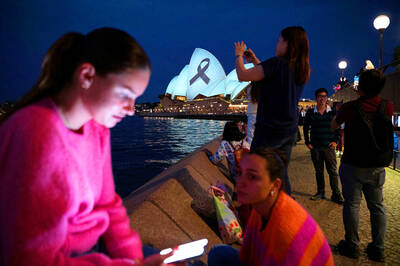
A prominent Christian leader has allegedly been stabbed at the altar during a Mass yesterday in southwest Sydney. Bishop Mar Mari Emmanuel was saying Mass at Christ The Good Shepherd Church in Wakeley just after 7pm when a man approached him at the altar and allegedly stabbed toward his head multiple times. A live stream of the Mass shows the congregation swarm forward toward Emmanuel before it was cut off. The church leader gained prominence during the COVID-19 pandemic, amassing a large online following, Officers attached to Fairfield City police area command attended a location on Welcome Street, Wakeley following reports a number


 RSS
RSS