


It is hard to place the inhabitants of this unusual village in the web of identities that make up the Balkans.
They are neither Serbs nor Albanians, the main ethnic groups vying for control of the internationally administered province of Kosovo. Perhaps the closest match -- and this is how these Slavic-speaking Muslims who form a minority here in Kosovo describe themselves -- would be to call them Bosnians.
But the language spoken here, a sprawling mixture of Macedonian and Serbian sprinkled with a few Turkish words thrown in, is not the same as any other in the Balkans, including Bosnia. And Gornje Lubinje's customs, as well as those of its neighboring village, Donje Lubinje, are unlike those of any other people in Kosovo.
Every five years, the inhabitants of the two villages, high up in Kosovo's Shar mountain range, which is close to the boundary with Macedonia, come together for an extraordinary festival -- a version of a Muslim rite of passage. For three days, more than 3,000 people gather here to feast, sing and dance and take part in traditional Turkish sports like wrestling. In a region sharply divided along ethnic lines, Gornje Lubinje's festival this year has attracted Serbs, Albanians and members of Kosovo's diaspora from as far away as Switzerland and Germany.
But the distinguishing feature of this festival is the Sunet ceremony, or circumcision, that takes place in one day for all of the host village's boys that are age 5 or younger -- 111 of them this year in Gornje Lubinje (Donje Lubinje will perform the rite next year).
The tradition, with origins dating from beyond living memory, is viewed with pride by almost all residents because it symbolizes this place's special identity.
"It gives us a sense of unity," said Rafik Kasi, a local journalist from Gornje Lubinje, whose nephew was being circumcised.
Zaber Kaplani, who had traveled from Donje Lubinje, farther down the Zupa Valley, to join the ceremonies, said: "When parents have a boy, they spend months and years preparing for this ceremony. This is one of the greatest traditions we have."
Some parents chose to send their children to be circumcised at the village's clinic, where this year, on Saturday, two surgeons and a doctor performed operations on 24 boys under local anesthetic. But the vast majority opted to put their children in the care of the nimble hands of Zulfikar Shishko, 69, who normally works in the Ekspres barber shop in the nearby city of Prizen.
For 25 euros each, Shishko performed the operation in the boys' homes, without anesthetic. He was accompanied by two burly assistants dressed in red aprons who were tasked with restraining the boys during the operation.
"We have a special technique," explained Hajrulla Osmani, one of the assistants.
Armed with just one scalpel, a bottle of iodine and some scouring powder to help clean his hands after each operation, Shishko had the air of man possessed, as he proceeded to circumcise 87 boys in just over 12 hours on Saturday. At that pace, Shishko spoke hardly a word as he scurried from house to house.
"I would work even faster if they let me," he said, explaining that too many people wanted to talk to him.
Villagers here say the performing of the circumcisions on one day has a simple explanation: poverty.
"It dates from a period of crisis when people had no money. It was simpler for everybody to come together and share the expenses," Kasi said.
Nobody here could say when the ceremonies were first held in such large numbers. But villagers said they had on occasion been interrupted, by the Balkan wars of 1912 and 1913 and then by World War I.
There are other Bosnian Muslim villages in the Zupa Valley that once held mass Sunet ceremonies, but now only Gornje Lubinje and Donje Lubinje keep the custom going.
In each house the scene was virtually identical. Shishko entered and was followed by his assistants and a young imam. In the next room, the mother, grandmother, aunts and sisters stood dressed in white dresses and waistcoats embroidered in gold and waited for the operation to finish.
When the job was done, a band struck up outside, and relatives squeezed their way to give money to the boy, who was lying covered on the floor or a bed.
Screams of pain and loud music punctuated the day, but Kasi said, "Our trust in God gives the boys strength to overcome the pain."
It was hard to find anyone who would offer any criticism about the pace or the skill of the practitioner. "He's better than a surgeon," said Ibrahim Bilibane, a construction foreman from Donje Lubinje.
In the Bajrami household, Sehizada Bajrami, 23, was distressed as Shishko approached Selhan, her two-and-a-half-year-old son.
With tears running down her cheeks, she whimpered, "I can't decide what I feel."

‘IN A DIFFERENT PLACE’: The envoy first visited Shanghai, where he attended a Chinese basketball playoff match, and is to meet top officials in Beijing tomorrow US Secretary of State Antony Blinken yesterday arrived in China on his second visit in a year as the US ramps up pressure on its rival over its support for Russia while also seeking to manage tensions with Beijing. The US diplomat tomorrow is to meet China’s top brass in Beijing, where he is also expected to plead for restraint as Taiwan inaugurates president-elect William Lai (賴清德), and to raise US concerns on Chinese trade practices. However, Blinken is also seeking to stabilize ties, with tensions between the world’s two largest economies easing since his previous visit in June last year. At the
Nearly half of China’s major cities are suffering “moderate to severe” levels of subsidence, putting millions of people at risk of flooding, especially as sea levels rise, according to a study of nationwide satellite data released yesterday. The authors of the paper, published by the journal Science, found that 45 percent of China’s urban land was sinking faster than 3mm per year, with 16 percent at more than 10mm per year, driven not only by declining water tables, but also the sheer weight of the built environment. With China’s urban population already in excess of 900 million people, “even a small portion

UNSETTLING IMAGES: The scene took place in front of TV crews covering the Trump trial, with a CNN anchor calling it an ‘emotional and unbelievably disturbing moment’ A man who doused himself in an accelerant and set himself on fire outside the courthouse where former US president Donald Trump is on trial has died, police said yesterday. The New York City Police Department (NYPD) said the man was declared dead by staff at an area hospital. The man was in Collect Pond Park at about 1:30pm on Friday when he took out pamphlets espousing conspiracy theories, tossed them around, then doused himself in an accelerant and set himself on fire, officials and witnesses said. A large number of police officers were nearby when it happened. Some officers and bystanders rushed
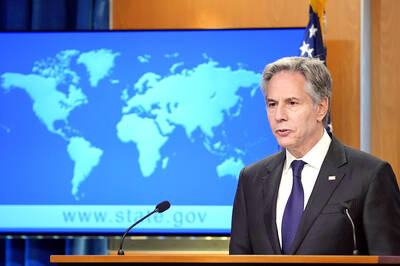
Beijing is continuing to commit genocide and crimes against humanity against Uyghurs and other Muslim minorities in its western Xinjiang province, U.S. Secretary of State Antony Blinken said in a report published on Monday, ahead of his planned visit to China this week. The State Department’s annual human rights report, which documents abuses recorded all over the world during the previous calendar year, repeated language from previous years on the treatment of Muslims in Xinjiang, but the publication raises the issue ahead of delicate talks, including on the war in Ukraine and global trade, between the top U.S. diplomat and Chinese


 RSS
RSS