


Only a lucky few humans are allowed each summer to get up close and personal with the McNeil River bears, but thanks to the wilderness equivalent of the Big Brother show, the animals can be seen by the world.
A bear cam set up in their favorite spot at the 45,760-hectare McNeil River State Game Sanctuary shows them brawling over salmon, cooling off in the falls, sunbathing on the rocks and fattening up for the long Alaska winter. The bear cam can be seen on the Web at www.ngm.com/wildcamgrizzlies.
The state holds a lottery for about 250 people each year to visit the sanctuary 400km southwest of Anchorage to view the bears.
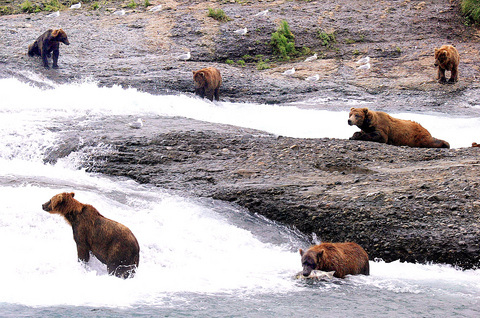
PHOTO: AP
The bear cam allows the less lucky to get a look, too, said Mike O'Meara, project manager for the Pratt Museum in Homer across Cook Inlet from the sanctuary.
"The first thing they have to say is `Oh, this is live.' That intrigues them. Then they really get wrapped up in watching the bears. A lot of them are struck in how the bears interact and communicate with each other," he said.
The bear cam is turned on from 5am until 11pm and has eight presets to zoom in on where the animals are likely to be at any given hour. During the afternoon, an interpreter at the museum controls the solar-powered camera to get the best views.
O'Meara expects 20,000 museum visitors to use the bear cam this summer.
In the peak weeks in July, the falls draw more brown bears than anywhere else in the world. While numbers have been decreasing in recent years, the bears still put on a good show. The record was 72 observed at one time in 1999.
What makes McNeil truly extraordinary is how close visitors can get to the bears, which sometimes come to within 3 meters of a viewing platform as they use steps built into the hillside to get down to the falls.
relayed worldwide
The camera is hidden in a fake boulder at the falls. The microwave signal travels from the camera to the museum through a series of repeater stations. From the museum, the video feed is relayed to servers in Seattle, and from there is broadcast on the National Geographic Web site, where viewers can access it live.
Two grants from the National Park Service totaling about US$40,000 and a US$20,000 grant from the Mead Foundation paid for installing the bear cam and setting up the high-quality video and audio stream to the museum. Alaska Conservation Foundation contributed US$5,000.
National Geographic is covering the costs of maintaining the Web site to bring the bears to an international audience, O'Meara said.
Real Networks of Seattle contributed servers that allow the audio and video to be streamed onto the Internet. The camera, which went online early last month, will likely be shut off for the season late next month, when most of the bears leave and prepare for winter.
O'Meara and Michael Yourkowski, general manager of SeeMore Wildlife Systems in Homer, which first set up the bear cam in 1999, said they hope it raises public awareness about the bears and how recent changes have made them more vulnerable to being hunted.
thinning numbers
Last year, the Alaska Board of Game decided to allow brown bear hunting on state land just south and southeast of the sanctuary, beginning on July 1 next year. That decision places the McNeil bears at greater risk because they often roam outside the borders of the sanctuary.
They also aren't as likely as other wild bears to run off when encountering humans, O'Meara and Yourkowski said.
"The bears that come to the falls are somewhat habituated to humans because the humans are sitting there and watching them all the time. That makes them not leery of hunters," Yourkowski said.
O'Meara, a longtime Alaskan who likes to hunt, said there's no challenge in killing a McNeil River bear.
Nearly half of China’s major cities are suffering “moderate to severe” levels of subsidence, putting millions of people at risk of flooding, especially as sea levels rise, according to a study of nationwide satellite data released yesterday. The authors of the paper, published by the journal Science, found that 45 percent of China’s urban land was sinking faster than 3mm per year, with 16 percent at more than 10mm per year, driven not only by declining water tables, but also the sheer weight of the built environment. With China’s urban population already in excess of 900 million people, “even a small portion

UNSETTLING IMAGES: The scene took place in front of TV crews covering the Trump trial, with a CNN anchor calling it an ‘emotional and unbelievably disturbing moment’ A man who doused himself in an accelerant and set himself on fire outside the courthouse where former US president Donald Trump is on trial has died, police said yesterday. The New York City Police Department (NYPD) said the man was declared dead by staff at an area hospital. The man was in Collect Pond Park at about 1:30pm on Friday when he took out pamphlets espousing conspiracy theories, tossed them around, then doused himself in an accelerant and set himself on fire, officials and witnesses said. A large number of police officers were nearby when it happened. Some officers and bystanders rushed
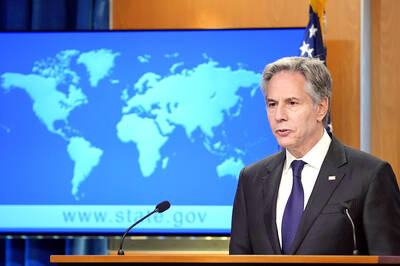
Beijing is continuing to commit genocide and crimes against humanity against Uyghurs and other Muslim minorities in its western Xinjiang province, U.S. Secretary of State Antony Blinken said in a report published on Monday, ahead of his planned visit to China this week. The State Department’s annual human rights report, which documents abuses recorded all over the world during the previous calendar year, repeated language from previous years on the treatment of Muslims in Xinjiang, but the publication raises the issue ahead of delicate talks, including on the war in Ukraine and global trade, between the top U.S. diplomat and Chinese

HYPOCRISY? The Chinese Ministry of Foreign Affairs yesterday asked whether Biden was talking about China or the US when he used the word ‘xenophobic’ US President Joe Biden on Wednesday called for a hike in steel tariffs on China, accusing Beijing of cheating as he spoke at a campaign event in Pennsylvania. Biden accused China of xenophobia, too, in a speech to union members in Pittsburgh. “They’re not competing, they’re cheating. They’re cheating and we’ve seen the damage here in America,” Biden said. Chinese steel companies “don’t need to worry about making a profit because the Chinese government is subsidizing them so heavily,” he said. Biden said he had called for the US Trade Representative to triple the tariff rates for Chinese steel and aluminum if Beijing was


 RSS
RSS