


Inside a well-furnished apartment in a village on the outskirts of Tyre, with shelves of books piled from floor to ceiling, a black turbaned cleric and three men sit sipping bitter coffee. By the door is a pile of Kalashnikovs and ammunition boxes; handguns are tucked into the men's trousers. The four are Hezbollah fighters, waiting for the Israelis.
"Patience is our main virtue, we can wait for days, weeks, months before we attack. The Israelis are always impatient in battle and in strategy," says the cleric, Sayed Ali, who claims to be a descendant of the prophet. "I know them very well."
As if to make his point, the sound of Israeli shells blasting the surrounding hills shakes the door and shutters every few minutes. Ali does know the Israelis. He started fighting them at the age of 17 when they invaded Lebanon in 1982. Three years later he was arrested with two of his comrades and spent a few months in an Israeli prison.
Within weeks of his release he was fighting them again. That's what he did for the next six years.
For the last five years he has been finishing his theology studies in Tehran. A month ago, he was asked by Hezbollah to return to southern Lebanon. He arrived a week before the fighting began.
Standing at the window, he points to the banana plantations between us and the Mediterranean.
"I have fought for years in these groves. We used to sit and wait for them [the Israelis] to make a move and then we would hit. They always moved too quickly, too soon," he says.
All over the hills of south Lebanon hundreds of men like Sayed Ali and his comrades are waiting -- some in bunkers, some in farm houses -- for the Israeli troops to arrive. Sayed Ali and his men spend most of their time in the building where his apartment is, moving only at night.
"We stay put and we don't move till we get our orders, and this is why we are not like any other militia. A militiaman will fire whenever he likes at whatever he likes," explains one of the men, who says he has been involved in firing Katyusha rockets into northern Israel.
"We have specific orders," he says. "Even when we fire rockets we know when and where [to fire] and each of the men manning the launchers runs to a specific hiding place after firing the rockets."
He says Hezbollah fighters expect the site of a rocket launch to be hit by an Israeli airstrike or shell within 10 to 15 minutes.
Another of the men, who says he is Sayed Ali's brother, explains how Hezbollah teaches its fighters patience.
"During our training we spend days in empty buildings without talking to anyone or doing anything. They tell me go and sit in that building, and I go and sit there and wait," he says.
hospitals
According to Ali, Hezbollah operates as "a state within the state," with its own hospitals, social organizations and social security system.
"But we are also an Islamic resistance movement, an indoctrinated army," he says. "I would go and knock at the door of someone and say we need US$50,000, he would give me [that] because they trust us."
The organization's fighting force is divided into two: the "active" group, whose task is to serve in Hezbollah, and the reserve, or Ta'abi'a, as it is known in Arabic. The active fighters get monthly pay. The reserves are called on only in time of war, and receive bonuses but no regular pay. A third section, the Ansar, comprises people who support or are supported by the organization.
Ali, the commander of Hezbollah in his village, and his men are part of the active force, and their orders are to wait for further orders.
"Hezbollah hasn't even mobilized all its active fighters, and the Israelis are calling their reserve units," he says.
Hezbollah prides itself on its secretiveness and discipline.
"We don't take anyone who knocks at our door and says `I want to join.'" he says. "We raise our fighters. We take them when they are young kids and raise them to become Hezbollah fighters. Every fighter we have believes that the ultimate form of being is martyrdom." The three men nod their assent.
Shia symbols and mythology play a big role in the ideology of Hezbollah, especially the tragedy of Imam Hussein, the grandson of the prophet who in the 7th century led a few hundred men against the well-organized army of the caliph in Damascus. He was slain in Karbala, and Shia around the world commemorate these events in Ashura.
Ali and his fellow fighters have been preparing for the latest conflict with the Israelis for years and he acknowledges the support received from Iran as the TV blares patriotic songs and pictures of destroyed bridges, houses and buildings. The men are feeling confident -- only a day earlier the Israelis suffered heavy casualties in the village of Bint Jbeil.
"Our strategy is to hit the commandos and the Golani units like we did in Bint Jbeil," Ali says. "Those are their best units. If they can't do anything, the morale of the reserve units will sink."
battle for survival
For Ali and his comrades, the latest conflict is a war of survival not only for Hezbollah but for the whole Shia community. It is not only a war with Israel, their enemy for decades, but also with the Sunni community. Saudi Arabia, Jordan and Egypt have all expressed fears of Iranian domination over the Middle East.
"If Israel comes out victorious from this conflict, this will be a victory for the Sunnis and they will take the Shia community back in history dozens of years to the time when we were only allowed to work as garbage collectors in this country. The Shia will all die before letting this happen again," he says.
And even when the battle with the Israelis is over, he adds menacingly, Hezbollah will have other battles to fight.
"The real battle is after the end of this war," he says.
"We will have to settle scores with the Lebanese politicians. We also have the best security and intelligence apparatus in this country, and we can reach any of those people who are speaking against us now. Let's finish with the Israelis and then we will settle scores later," he says.

Republican US lawmakers on Friday criticized US President Joe Biden’s administration after sanctioned Chinese telecoms equipment giant Huawei unveiled a laptop this week powered by an Intel artificial intelligence (AI) chip. The US placed Huawei on a trade restriction list in 2019 for contravening Iran sanctions, part of a broader effort to hobble Beijing’s technological advances. Placement on the list means the company’s suppliers have to seek a special, difficult-to-obtain license before shipping to it. One such license, issued by then-US president Donald Trump’s administration, has allowed Intel to ship central processors to Huawei for use in laptops since 2020. China hardliners
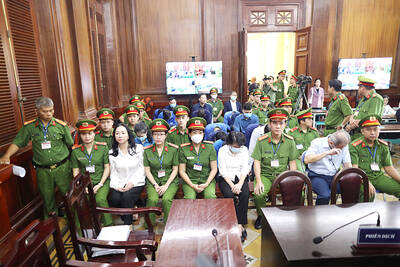
A top Vietnamese property tycoon was on Thursday sentenced to death in one of the biggest corruption cases in history, with an estimated US$27 billion in damages. A panel of three hand-picked jurors and two judges rejected all defense arguments by Truong My Lan, chair of major developer Van Thinh Phat, who was found guilty of swindling cash from Saigon Commercial Bank (SCB) over a decade. “The defendant’s actions ... eroded people’s trust in the leadership of the [Communist] Party and state,” read the verdict at the trial in Ho Chi Minh City. After the five-week trial, 85 others were also sentenced on

‘DELUSIONAL’: Targeting the families of Hamas’ leaders would not push the group to change its position or to give up its demands for Palestinians, Ismail Haniyeh said Israeli aircraft on Wednesday killed three sons of Hamas’ top political leader in the Gaza Strip, striking high-stakes targets at a time when Israel is holding delicate ceasefire negotiations with the militant group. Hamas said four of the leader’s grandchildren were also killed. Ismail Haniyeh’s sons are among the highest-profile figures to be killed in the war so far. Israel said they were Hamas operatives, and Haniyeh accused Israel of acting in “the spirit of revenge and murder.” The deaths threatened to strain the internationally mediated ceasefire talks, which appeared to gain steam in recent days even as the sides remain far
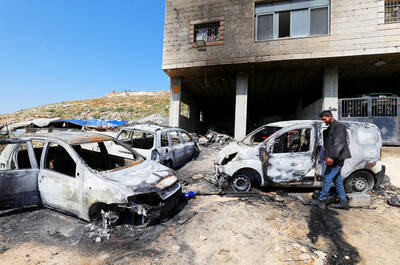
RAMPAGE: A Palestinian man was left dead after dozens of Israeli settlers searching for a missing 14-year-old boy stormed a village in the Israeli-occupied West Bank US President Joe Biden on Friday said he expected Iran to attack Israel “sooner, rather than later” and warned Tehran not to proceed. Asked by reporters about his message to Iran, Biden simply said: “Don’t,” underscoring Washington’s commitment to defend Israel. “We are devoted to the defense of Israel. We will support Israel. We will help defend Israel and Iran will not succeed,” he said. Biden said he would not divulge secure information, but said his expectation was that an attack could come “sooner, rather than later.” Israel braced on Friday for an attack by Iran or its proxies as warnings grew of


 RSS
RSS