


Indonesia, the world's latest hot spot for bird flu, appears to be taking steps at last to beat back the spread of the disease in its poultry flocks.
In just six months, teams of veterinarians marching along dusty, twisting paths in the remote villages of this sprawling country have uncovered more flu outbreaks among birds than experts had even imagined.
"It's still just the tip of the iceberg," said Jeff Mariner, an animal health expert from Tufts University who has been working with the effort since it began in January.
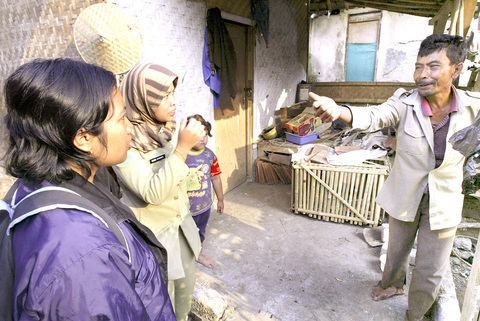
PHOTO: AP
This new but still limited cooperation through a pilot project has somewhat heartened world health officials, who have watched with dread as Indonesia's human bird flu cases quietly mounted while the government did little.
With 42 deaths since last July, Indonesia is now tied with Vietnam as the world's hardest-hit country in human deaths from the H5N1 bird flu virus. But there have been no deaths from the disease in Vietnam since last year.
Indonesia's new effort to gain control of the disease has dozens of veterinarians and other health workers doing detective work -- going door-to-door to uncover hidden outbreaks in poultry flocks. They've found about 90 so far, and look for key tip-offs.
In Cangkurah, government veterinarians Wiwin Aprianti and Maria Dewi spot a telling clue: empty bird cages. Could it be a new bird flu outbreak? The two young women start knocking on doors, asking residents if they've heard of poultry dying off around here. Nothing.
FAMILIAR STORIES
In their tan uniforms, wearing backpacks loaded with protective gear and testing tools, they move on down the street, trying again at each house. They jot down details in their notebooks as they go.
Eventually, they hear a story -- one that is becoming all too familiar in the country that has reported the most bird flu cases this year.
"It started and infected other chickens -- south to north -- all through the village," says Zaenudin, who like many Indonesians uses one name. "During the daytime they looked healthy, but during the nighttime, the heads became very black."
A half-dozen neighbors chime in, saying the same thing happened to their birds last month. They all looked fine and then suddenly -- just keeled over dead. Now, nearly everyone's chickens are gone.
So far, Cangkurah has been lucky: No humans have fallen ill.
DETECTIVE SKILLS
When it comes to sleuthing out bird flu, Aprianti, 27, and Dewi, 31, have the skills of Sherlock Holmes.
They carry out five-minute tests on sick or dead birds. If the H5N1 virus is found, they notify a response team that helps with slaughtering and vaccinating.
Eventually, hundreds of similar detectives will form community-based surveillance and response teams. The project is a cooperative one between Indonesia's government and the UN Food and Agriculture Organization (FAO).
The task is mind-boggling in an archipelago that roughly stretches the width of the US, with 220 million people and billions of backyard chickens. Health workers hope to reach a third of Indonesia's nearly 450 districts by next spring.
Indonesia grabbed world attention in May when seven out of eight infected members of a single family died. The WHO concluded that limited human-to-human transmission was likely to blame, but the virus did not spread beyond the blood family members -- the world's largest cluster.
At least 134 people have died worldwide since the disease began spreading in Asia in late 2003. Most human cases have been linked to contact with infected birds.
"We have to control it in animals because the transmission is not human-to-human," says Douglas Klaucke, of the US Centers for Disease Control and Prevention, who recently met with Aprianti and Dewi's surveillance team. "The transmission is coming from the animals."
LOCAL INPUT
While Vietnam's mass poultry slaughter helped nip the threat there, circumstances are very different in Indonesia. Vietnam has a strong centralized government, but the power to fight bird flu in Indonesia lies largely at local level. Jakarta's recommendations mean little unless community officials are on board.
The surveillance and response teams can reach those leaders by empowering local vets to work directly with backyard farmers.
"Through this ... early detection can be improved and response can be improved," said Elly Sudiana, who oversees the program for the Ministry of Agriculture.
MORE MONEY NEEDED
So far, the program has received more than US$8 million from international donors, but the FAO has said it needs at least US$50 million for a nationwide system.
"It's making a huge difference," said Lisa Kramer of the US Agency for International Development. "It's a great way to get information out for prevention and a great way to understand how disease is moving through communities and a great way to control it and to contain it."
More help is expected soon, but for now, Aprianti and Dewi are covering 440 villages over an area of about 2,000km2. They ride motorbikes between villages and rely on text messages and calls to their mobile phones to direct them to bird die-offs.
There are an estimated 10 million poultry in their territory, roughly half of them in backyards.
In Cangkurah, the women follow a trail of empty coops looking for birds to confirm their suspicions that H5N1 has struck. But they're too late, and their clues hit a dead end near a rice field and a textile factory. But their efforts weren't fruitless. They spread the word about the dangers of bird flu, passed out their business cards and gathered more tips to check out.
"They say, `I'm glad you're here because we know more about this disease,'" Dewi says, smiling. "They change their opinion about raising chickens."
Nearly half of China’s major cities are suffering “moderate to severe” levels of subsidence, putting millions of people at risk of flooding, especially as sea levels rise, according to a study of nationwide satellite data released yesterday. The authors of the paper, published by the journal Science, found that 45 percent of China’s urban land was sinking faster than 3mm per year, with 16 percent at more than 10mm per year, driven not only by declining water tables, but also the sheer weight of the built environment. With China’s urban population already in excess of 900 million people, “even a small portion

‘IN A DIFFERENT PLACE’: The envoy first visited Shanghai, where he attended a Chinese basketball playoff match, and is to meet top officials in Beijing tomorrow US Secretary of State Antony Blinken yesterday arrived in China on his second visit in a year as the US ramps up pressure on its rival over its support for Russia while also seeking to manage tensions with Beijing. The US diplomat tomorrow is to meet China’s top brass in Beijing, where he is also expected to plead for restraint as Taiwan inaugurates president-elect William Lai (賴清德), and to raise US concerns on Chinese trade practices. However, Blinken is also seeking to stabilize ties, with tensions between the world’s two largest economies easing since his previous visit in June last year. At the

UNSETTLING IMAGES: The scene took place in front of TV crews covering the Trump trial, with a CNN anchor calling it an ‘emotional and unbelievably disturbing moment’ A man who doused himself in an accelerant and set himself on fire outside the courthouse where former US president Donald Trump is on trial has died, police said yesterday. The New York City Police Department (NYPD) said the man was declared dead by staff at an area hospital. The man was in Collect Pond Park at about 1:30pm on Friday when he took out pamphlets espousing conspiracy theories, tossed them around, then doused himself in an accelerant and set himself on fire, officials and witnesses said. A large number of police officers were nearby when it happened. Some officers and bystanders rushed

Beijing is continuing to commit genocide and crimes against humanity against Uyghurs and other Muslim minorities in its western Xinjiang province, U.S. Secretary of State Antony Blinken said in a report published on Monday, ahead of his planned visit to China this week. The State Department’s annual human rights report, which documents abuses recorded all over the world during the previous calendar year, repeated language from previous years on the treatment of Muslims in Xinjiang, but the publication raises the issue ahead of delicate talks, including on the war in Ukraine and global trade, between the top U.S. diplomat and Chinese


 RSS
RSS