


British Prime Minister Tony Blair was due to arrive in Washington yesterday to discuss strategies for ending the Middle East crisis, amid growing pressure at home for Britain to distance itself from its longtime ally and call for an immediate end to violence between Israel and Hezbollah.
Talks between Blair and US President George W. Bush were to focus on building momentum for a cease-fire, Blair's spokesman said, as well as a plan for an international peacekeeping force.
But Blair is aware that many in Britain believe he should align himself with the UN and EU and call for an immediate end to the fighting in Lebanon, using the White House meeting to press Bush to add his support to such a move.
An open letter published yesterday in Britain's Independent newspaper and signed by former British Cabinet ministers and ambassadors urged Blair to help broker a swift cease-fire. It warned that any continuing support for Israel's military action could become as unpopular with the public as the 2003 US-led invasion of Iraq.
"The prime minister is going into the trip with some very serious issues to discuss. He is extremely focused on trying to solve these issues," said a spokesman for Blair's Downing Street office, on customary condition of anonymity.
Bush is likely to have opted for a different greeting than on the last occasion the two leaders met.
At the G8 summit in St Petersburg, Russia, the President hailed his colleague with a hearty, "Yo, Blair!" -- a salutation that led to more domestic criticism for Blair.
The comment, made in an overheard conversation, has had British citizens, lawmakers and columnists wondering aloud if there is substance to the view that Blair is the junior partner in an unequal trans-Atlantic relationship.
During his US visit, Blair must also take account of an uproar in Britain over allegations that two US-chartered planes carrying missiles to Israel stopped to refuel at a Scottish airport without providing authorities with details of their hazardous cargo.
That pitstop has provoked new criticism from those who question what Britain receives in return for its "special relationship" with the US, particularly in light of divisions between the nations over international trade and climate change.
While the visit to Washington is likely to be challenging for Blair, experts worry little may be accomplished considering.
"I don't think there will be great achievement," said Yossi Mekelberg, a Middle East foreign policy expert at the London-based think tank Chatham House. "They just met at the G8 summit. They are meeting to show a certain level of unity in their approach to international affairs."
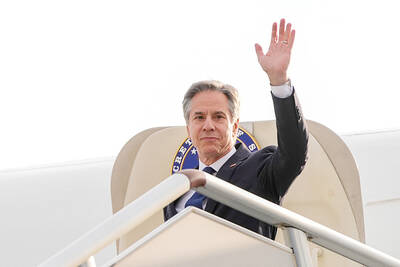
‘IN A DIFFERENT PLACE’: The envoy first visited Shanghai, where he attended a Chinese basketball playoff match, and is to meet top officials in Beijing tomorrow US Secretary of State Antony Blinken yesterday arrived in China on his second visit in a year as the US ramps up pressure on its rival over its support for Russia while also seeking to manage tensions with Beijing. The US diplomat tomorrow is to meet China’s top brass in Beijing, where he is also expected to plead for restraint as Taiwan inaugurates president-elect William Lai (賴清德), and to raise US concerns on Chinese trade practices. However, Blinken is also seeking to stabilize ties, with tensions between the world’s two largest economies easing since his previous visit in June last year. At the
Nearly half of China’s major cities are suffering “moderate to severe” levels of subsidence, putting millions of people at risk of flooding, especially as sea levels rise, according to a study of nationwide satellite data released yesterday. The authors of the paper, published by the journal Science, found that 45 percent of China’s urban land was sinking faster than 3mm per year, with 16 percent at more than 10mm per year, driven not only by declining water tables, but also the sheer weight of the built environment. With China’s urban population already in excess of 900 million people, “even a small portion

UNSETTLING IMAGES: The scene took place in front of TV crews covering the Trump trial, with a CNN anchor calling it an ‘emotional and unbelievably disturbing moment’ A man who doused himself in an accelerant and set himself on fire outside the courthouse where former US president Donald Trump is on trial has died, police said yesterday. The New York City Police Department (NYPD) said the man was declared dead by staff at an area hospital. The man was in Collect Pond Park at about 1:30pm on Friday when he took out pamphlets espousing conspiracy theories, tossed them around, then doused himself in an accelerant and set himself on fire, officials and witnesses said. A large number of police officers were nearby when it happened. Some officers and bystanders rushed
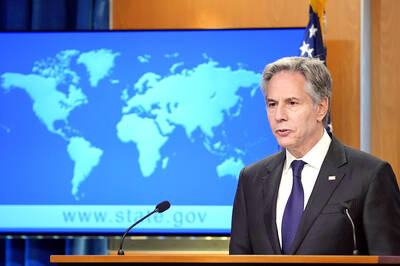
Beijing is continuing to commit genocide and crimes against humanity against Uyghurs and other Muslim minorities in its western Xinjiang province, U.S. Secretary of State Antony Blinken said in a report published on Monday, ahead of his planned visit to China this week. The State Department’s annual human rights report, which documents abuses recorded all over the world during the previous calendar year, repeated language from previous years on the treatment of Muslims in Xinjiang, but the publication raises the issue ahead of delicate talks, including on the war in Ukraine and global trade, between the top U.S. diplomat and Chinese


 RSS
RSS