


Israeli jets pounded suspected Hezbollah positions across Lebanon yesterday, extending its air campaign a day after suffering its highest one-day casualty toll. An Israeli Cabinet minister said lack of agreement on a ceasefire gave Israel a green light to press deeper to wipe out the Islamic militant group.
The airstrikes also hit a Lebanese army base and a radio relay station and destroyed several roads. The series of raids in northern, eastern and southern Lebanon, which killed at least one person and wounded others, came as the Israeli government was to meet yesterday to decide whether to broaden the military offensive, now in its third week, against Hezbollah guerrillas.
On Wednesday, a high-level Middle East conference in Rome ended in disagreement, with most European leaders urging an immediate cease-fire, but the US willing to give Israel more time to punish the guerrilla group.

PHOTO: EPA
Justice Minister Haim Ramon, who is close to Israeli Prime Minister Ehud Olmert, said Israel interprets this as a green light to continue its offensive.
"We received yesterday at the Rome conference permission from the world ... to continue the operation, this war, until Hezbollah won't be located in Lebanon and until it is disarmed," he told Israel Army Radio. "Everyone understands that a victory for Hezbollah is a victory for world terror."
The call for greater firepower came as Israel suffered its heaviest casualty toll in a single battle in the 16-day campaign, with nine soldiers killed and 25 wounded in house-to-house fighting in Hezbollah strongholds in Lebanon on Wednesday.
The crisis began July 12 when Hezbollah fighters staged a cross-border attack that led to the deaths of eight Israeli soldiers and left two captured.
Israeli army commanders have said troops would seize additional towns and villages in south Lebanon to force out Hezbollah gunmen.
Israeli warplanes struck a road in Rayak, a few kilometers from the Lebanese-Syrian border early yesterday, wounding two soldiers and a civilian, Lebanese officials said, speaking on condition of anonymity because they were not authorized to make statements to the media.
intense bombardment
Israeli fighter jets also carried out more than 30 bombing runs in Iqlim al-Tuffah, a highland region where Hezbollah is believed to have offices and bases, the officials and witnesses said.
The airstrikes, which targeted mostly deserted houses allegedly belonging to Hezbollah activists, and roads linking villages in the region, caused a number of casualties, the officials said. Ambulances and civil defense crews were unable to reach the targeted areas because of intense bombardment, witnesses said.
A Lebanese policeman, Mo-hammed Abu Hamdan, was killed when an Israeli missile struck his car as he drove in the eastern city of Zahle, security officials said.
At least 423 other people have been killed in Lebanon -- including 376 civilians reported by the Health Ministry and security officials. The deaths of the soldiers on Wednesday brought to 51 the number of Israelis killed in the campaign, according to the military.
Israeli planes also attacked targets near the southern market town of Nabatiyeh, wounding at least three people.
And a missile hit a four-story building belonging to the Shiite Muslim Amal Movement in the southern port city of Tyre, a day after a strike in the city devastated an empty seven-story building where Hezbollah's top commander in the south has offices. The strike on Wednesday wounded 13 people, including six children, nearby. But a Hezbollah official in Tyre denied Israeli reports that the group's commander in south Lebanon, Sheik Nabil Kaouk, was killed.

Republican US lawmakers on Friday criticized US President Joe Biden’s administration after sanctioned Chinese telecoms equipment giant Huawei unveiled a laptop this week powered by an Intel artificial intelligence (AI) chip. The US placed Huawei on a trade restriction list in 2019 for contravening Iran sanctions, part of a broader effort to hobble Beijing’s technological advances. Placement on the list means the company’s suppliers have to seek a special, difficult-to-obtain license before shipping to it. One such license, issued by then-US president Donald Trump’s administration, has allowed Intel to ship central processors to Huawei for use in laptops since 2020. China hardliners
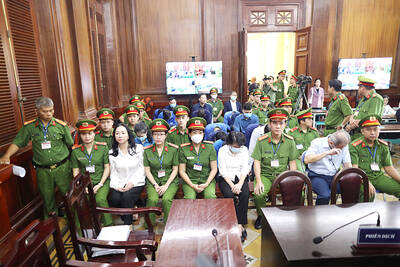
A top Vietnamese property tycoon was on Thursday sentenced to death in one of the biggest corruption cases in history, with an estimated US$27 billion in damages. A panel of three hand-picked jurors and two judges rejected all defense arguments by Truong My Lan, chair of major developer Van Thinh Phat, who was found guilty of swindling cash from Saigon Commercial Bank (SCB) over a decade. “The defendant’s actions ... eroded people’s trust in the leadership of the [Communist] Party and state,” read the verdict at the trial in Ho Chi Minh City. After the five-week trial, 85 others were also sentenced on

‘DELUSIONAL’: Targeting the families of Hamas’ leaders would not push the group to change its position or to give up its demands for Palestinians, Ismail Haniyeh said Israeli aircraft on Wednesday killed three sons of Hamas’ top political leader in the Gaza Strip, striking high-stakes targets at a time when Israel is holding delicate ceasefire negotiations with the militant group. Hamas said four of the leader’s grandchildren were also killed. Ismail Haniyeh’s sons are among the highest-profile figures to be killed in the war so far. Israel said they were Hamas operatives, and Haniyeh accused Israel of acting in “the spirit of revenge and murder.” The deaths threatened to strain the internationally mediated ceasefire talks, which appeared to gain steam in recent days even as the sides remain far
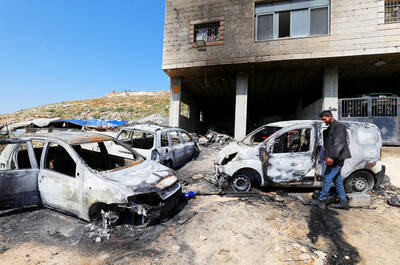
RAMPAGE: A Palestinian man was left dead after dozens of Israeli settlers searching for a missing 14-year-old boy stormed a village in the Israeli-occupied West Bank US President Joe Biden on Friday said he expected Iran to attack Israel “sooner, rather than later” and warned Tehran not to proceed. Asked by reporters about his message to Iran, Biden simply said: “Don’t,” underscoring Washington’s commitment to defend Israel. “We are devoted to the defense of Israel. We will support Israel. We will help defend Israel and Iran will not succeed,” he said. Biden said he would not divulge secure information, but said his expectation was that an attack could come “sooner, rather than later.” Israel braced on Friday for an attack by Iran or its proxies as warnings grew of


 RSS
RSS