


The US State Department's top South Asia official said on Monday that a US plan to share civilian nuclear technology with India was on track and could receive final approval by the end of the year.
"Our Congress has been very supportive," US Assistant Secretary of State Richard Boucher told reporters.
"The legislation is moving forward quickly," he said.
Boucher spoke on the eve of the first anniversary of a landmark agreement signed by US President George W. Bush and Indian Prime Minister Manmohan Singh to establish a new relationship in civilian nuclear energy.
Those efforts got a huge boost last month when the nuclear cooperation accord won overwhelming endorsement by two major congressional panels. Congress is crucial to the deal's completion, because lawmakers must exempt India from US laws that restrict nuclear trade with countries, such as India, that have not submitted to full nuclear inspections.
Boucher said the administration believed votes on the measure by the full House of Representatives could happen in about a week, and the Senate would take up the initiative "soon after."
The plan, which would change decades of US anti-proliferation policy, would send nuclear fuel and technology to India in return for the opening of 14 civilian nuclear reactors to international inspections and safeguards; eight reactors that India identified as military would remain off-limits.
Critics say the extra nuclear fuel that the deal would provide could free India's domestic uranium for use in its weapons program. India developed its nuclear weapons outside the Nuclear Non-Proliferation Treaty, which it has refused to sign.
While Boucher was optimistic about the deal's outlook, several steps remain before the US could begin sending nuclear shipments to India.
Once the legislation is passed by the House of Representatives and the Senate, the two chambers would meet to reconcile the versions into a single bill, which would be sent to Bush for ratification.
The plan must also be approved by the Nuclear Suppliers Group, an assembly of nations that export nuclear material; and India must negotiate a safeguards agreement with the UN nuclear watchdog agency.
"If all those pieces come together, and we have the legislation, you know, it's conceivable that all this could be done by the end of the year," Boucher said.
Separately, Indian officials announced on Monday that a military explosive favored by Islamic militants in India's part of Kashmir was used in last week's train attacks in Mumbai. It was seen as further evidence of a link between Pakistan-based militants and the attack that killed 182 people and wounded more than 800.
Boucher told reporters that the bombings "were obviously well-prepared by somebody with evil intent," but he cautioned against jumping to conclusions.
"Let's find the evidence. Let's find out who is responsible," he said.
Then, Boucher said, "let's look together at what we can do to stop any groups or organizations -- or support these organizations might be getting -- to make sure that people can't carry out such actions in the future."
India's suspicions of Pakistani involvement in the bombing caused suspension of a two-year-old peace process.

Republican US lawmakers on Friday criticized US President Joe Biden’s administration after sanctioned Chinese telecoms equipment giant Huawei unveiled a laptop this week powered by an Intel artificial intelligence (AI) chip. The US placed Huawei on a trade restriction list in 2019 for contravening Iran sanctions, part of a broader effort to hobble Beijing’s technological advances. Placement on the list means the company’s suppliers have to seek a special, difficult-to-obtain license before shipping to it. One such license, issued by then-US president Donald Trump’s administration, has allowed Intel to ship central processors to Huawei for use in laptops since 2020. China hardliners
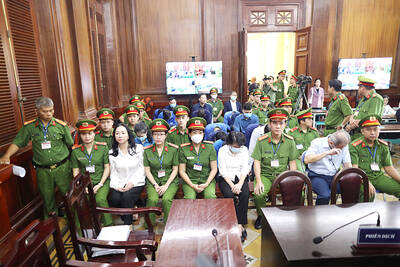
A top Vietnamese property tycoon was on Thursday sentenced to death in one of the biggest corruption cases in history, with an estimated US$27 billion in damages. A panel of three hand-picked jurors and two judges rejected all defense arguments by Truong My Lan, chair of major developer Van Thinh Phat, who was found guilty of swindling cash from Saigon Commercial Bank (SCB) over a decade. “The defendant’s actions ... eroded people’s trust in the leadership of the [Communist] Party and state,” read the verdict at the trial in Ho Chi Minh City. After the five-week trial, 85 others were also sentenced on

Conjoined twins Lori and George Schappell, who pursued separate careers, interests and relationships during lives that defied medical expectations, died this month in Pennsylvania, funeral home officials said. They were 62. The twins, listed by Guinness World Records as the oldest living conjoined twins, died on April 7 at the Hospital of the University of Pennsylvania, obituaries posted by Leibensperger Funeral Homes of Hamburg said. The cause of death was not detailed. “When we were born, the doctors didn’t think we’d make 30, but we proved them wrong,” Lori said in an interview when they turned 50, the Philadelphia Inquirer reported. The

RAMPAGE: A Palestinian man was left dead after dozens of Israeli settlers searching for a missing 14-year-old boy stormed a village in the Israeli-occupied West Bank US President Joe Biden on Friday said he expected Iran to attack Israel “sooner, rather than later” and warned Tehran not to proceed. Asked by reporters about his message to Iran, Biden simply said: “Don’t,” underscoring Washington’s commitment to defend Israel. “We are devoted to the defense of Israel. We will support Israel. We will help defend Israel and Iran will not succeed,” he said. Biden said he would not divulge secure information, but said his expectation was that an attack could come “sooner, rather than later.” Israel braced on Friday for an attack by Iran or its proxies as warnings grew of


 RSS
RSS