


A unanimous UN Security Council vote to condemn North Korea's missile launches has set an important precedent and strengthened the powerful UN body as it turns to its next challenge: confronting Iran's suspect nuclear program, diplomats said.
Sometime this week, the council will take up Iran's continued refusal to respond formally to Western incentives to stop enriching uranium. Council members will be united like they have rarely been since 2003, when the US decision to invade Iraq opened up deep suspicions that still linger.
Diplomats said the success on delivering a tough message on North Korea will carry over when the Iran talks begin.
"We need unity of the council on these nonproliferation issues," French UN Ambassador Jean-Marc de La Sabliere said after the North Korea vote on Saturday. "So the fact that we have -- my view -- we have reached unity on the North Korean issue in the council I think will help us on Iran."
Diplomats negotiated the North Korea resolution over 11 tension-filled days, avoiding a threatened veto from China, which opposed any mention of the UN Charter's Chapter 7. Chapter 7 makes such resolutions legally binding and enforceable with military action.
Britain came up with compromise language that dropped the reference to Chapter 7 and allowed the 15 council members to vote for the resolution unanimously.
A Chinese veto would have soured the tone of negotiations over Iran, and widened divisions among the five permanent members -- the US, Britain, France, China and Russia. That likely would have banished any desire to compromise by either side.
The resolution on North Korea was weakened during the negotiations but still took crucial steps. It imposes limited sanctions, and diplomats believe it will strengthen nations' authority to interdict weapons shipments to and from North Korea.
Saturday's resolution was the first that the council passed on North Korea since 1993, a fact that US Ambassador John Bolton said Iran should remember.
"It's been 13 years since the Security Council got its act together sufficiently to act on North Korea and it's going to do so today in a unanimous fashion," he said before the vote on Saturday. "That's a very, very important political signal for any would-be proliferators."
Back in March, the council demanded that Iran suspend uranium enrichment. That requirement was conveyed in a simple council statement that was not legally binding -- the result of Chinese and Russian refusal to consider issuing a resolution, which would have been stronger.
After Iran refused to obey, Western powers presented the package of incentives last month meant to draw Iran back to negotiations and suspend enrichment.
Yet Iran said it needed more time to respond, leading frustrated world powers to agree last week to send Iran to the council for a firmer, perhaps legally binding, demand to suspend enrichment.
In a sign that Iran may fear a newly unified council, Tehran said on Sunday that the Western incentives to halt its nuclear program were an "acceptable basis" for talks, and it is ready for detailed negotiations.
That could be an attempt to sow new divisions in the council. Diplomats have said recent meetings with Iran have gone nowhere, and Tehran may want to buy time or exploit potential rifts.
There is also a danger of a different sort of precedent. The question of whether Pyongyang would obey any council demands hovered over the North Korea talks.
The answer came minutes after the resolution passed. Ambassador Pak Gil-yon took told the council that the North rejected the resolution and would continue with missile tests. He accused the council of acting in an "unjustifiable and gangster-like" way, and abruptly left the council chamber before the meeting was over -- a breach of diplomatic protocol.
Iran could be emboldened by the North's angry response. It already has warned that council sanctions against Tehran would only exacerbate tensions in the Middle East.
"Now is an appropriate opportunity for Iran and Europe to enter detailed negotiations," Iranian Foreign Ministry spokesman Hamid Reza Asefi said.
"Sending the dossier to the UN Security Council means blocking and rejecting talks," he said.

Republican US lawmakers on Friday criticized US President Joe Biden’s administration after sanctioned Chinese telecoms equipment giant Huawei unveiled a laptop this week powered by an Intel artificial intelligence (AI) chip. The US placed Huawei on a trade restriction list in 2019 for contravening Iran sanctions, part of a broader effort to hobble Beijing’s technological advances. Placement on the list means the company’s suppliers have to seek a special, difficult-to-obtain license before shipping to it. One such license, issued by then-US president Donald Trump’s administration, has allowed Intel to ship central processors to Huawei for use in laptops since 2020. China hardliners
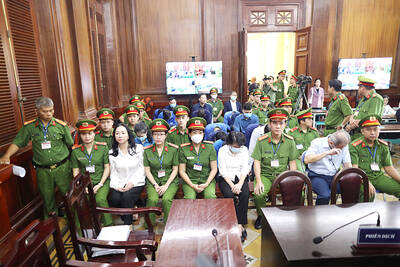
A top Vietnamese property tycoon was on Thursday sentenced to death in one of the biggest corruption cases in history, with an estimated US$27 billion in damages. A panel of three hand-picked jurors and two judges rejected all defense arguments by Truong My Lan, chair of major developer Van Thinh Phat, who was found guilty of swindling cash from Saigon Commercial Bank (SCB) over a decade. “The defendant’s actions ... eroded people’s trust in the leadership of the [Communist] Party and state,” read the verdict at the trial in Ho Chi Minh City. After the five-week trial, 85 others were also sentenced on

‘DELUSIONAL’: Targeting the families of Hamas’ leaders would not push the group to change its position or to give up its demands for Palestinians, Ismail Haniyeh said Israeli aircraft on Wednesday killed three sons of Hamas’ top political leader in the Gaza Strip, striking high-stakes targets at a time when Israel is holding delicate ceasefire negotiations with the militant group. Hamas said four of the leader’s grandchildren were also killed. Ismail Haniyeh’s sons are among the highest-profile figures to be killed in the war so far. Israel said they were Hamas operatives, and Haniyeh accused Israel of acting in “the spirit of revenge and murder.” The deaths threatened to strain the internationally mediated ceasefire talks, which appeared to gain steam in recent days even as the sides remain far
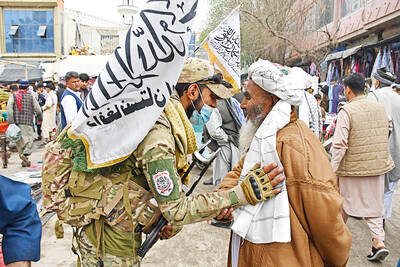
The Taliban’s reclusive supreme leader made a rare public appearance yesterday, an Afghan government spokesman said, leading thousands of worshipers in prayers marking Eid al-Fitr. Hibatullah Akhundzada has made only a handful of public appearances since inheriting the leadership of the Taliban in 2016 and leading the movement back to power with the withdrawal of US forces in 2021. Taliban government spokesman Zabihullah Mujahid said prayer in the largest mosque in Kandahar was “performed under the leadership of the supreme leader.” In a statement on X, he said the early-morning service “was attended by thousands of compatriots” in the southern province considered the


 RSS
RSS