


The calls come through nearly every two hours, always from a satellite phone and usually with some new claim of an attack that the reporter must check with the US-led coalition force in Afghanistan.
Sometimes they turn out to be false. Many times, they are true but exaggerated.
"I get between six to 10 calls a day from one or the other of the two Taliban spokesmen," said a journalist based in the southern city of Kandahar, a focus of the movement's insurgency launched after it was ousted in 2001.
"It is mainly them who tell us first of incidents," he said.
This more sophisticated propaganda strategy now used by the Taliban marks a remarkable departure from one of the pillars of the movement when it ruled most of Afghanistan from 1996 until 2001.
Under the Pakistan-backed regime, movies, videos, TV or photographs of any living creature, even animals, were taboo, as they were seen as idolatrous.
But today the religious students not only watch such material, they produce and distribute it for free -- usually high-quality video CDs of rousing speeches and Taliban attacks and what they call sacrifice for a "holy cause."
More than a dozen VCDs obtained by reporters during the past 10 months all carry the logos of one of three film studios -- Omat [Nation] productions, Manbaul-Jihad [Source of Jihad] or Abdullah videos.
These shadowy outfits produce videos for the Taliban -- and probably also for al-Qaeda -- in the Arabic, Urdu and Pashto languages that are aimed at Arab extremists and potential sympathizers in southern Afghanistan and the adjoining Pakistan tribal belt.
The emotionally charged videos play on deep ethnic and religious pride to win recruits, showing horrific images of Muslims killed in war or of alleged spies "confessing" before their throats are slit.
One kind preaches the religious rhetoric of the anti-foreigner jihad [holy war] that brought the Soviet army to its knees in Afghanistan in the 1980s and is now being used against the US-led coalition and NATO forces.
Another plays to Arab extremists who despise the US and the West for their attitude towards the Islamic world, including Afghanistan, the Palestinian territories, Iran and Iraq.
There are images of sophisticated US military planes and armored vehicles juxtaposed with others of the Taliban's low-tech small arms and homemade bombs stuffed with nails, nuts and bolts.
New Taliban recruits are shown training in difficult terrain and under harsh conditions, while messages from al-Qaeda leaders Osama bin Laden and Ayman al-Zawahiri boom out promising success and, for "martyrs," paradise.
Every film includes interviews with purported Taliban commanders who claim to have shot down US helicopters or to have killed US or Afghan soldiers.
Some films show gruesome documentary footage of what are called civilian casualties of US bombings in Afghanistan, Iraq and Pakistan, or of Christians chopping off the heads and arms of Muslims in Indonesia's religiously tense Poso district.
"Their targeted audience is a less-educated section of people with little power of political analysis who react religiously and emotionally," said member of parliament and journalist Shukria Barikzai.
The images often work well to arouse passions, firing up feeling for the militants' cause, she said, noting the Afghan government itself should be making better use of such an obvious strategy.
"It would help to balance things out and help people understand the Taliban if the government showed what Taliban do -- the schools and clinics burned, people slaughtered, scholars, teachers and civilians killed," Barikzai said.

Republican US lawmakers on Friday criticized US President Joe Biden’s administration after sanctioned Chinese telecoms equipment giant Huawei unveiled a laptop this week powered by an Intel artificial intelligence (AI) chip. The US placed Huawei on a trade restriction list in 2019 for contravening Iran sanctions, part of a broader effort to hobble Beijing’s technological advances. Placement on the list means the company’s suppliers have to seek a special, difficult-to-obtain license before shipping to it. One such license, issued by then-US president Donald Trump’s administration, has allowed Intel to ship central processors to Huawei for use in laptops since 2020. China hardliners
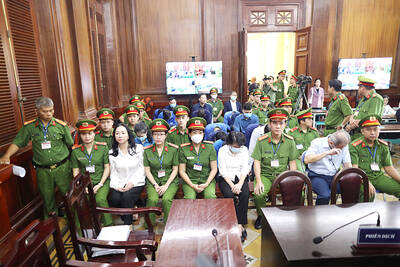
A top Vietnamese property tycoon was on Thursday sentenced to death in one of the biggest corruption cases in history, with an estimated US$27 billion in damages. A panel of three hand-picked jurors and two judges rejected all defense arguments by Truong My Lan, chair of major developer Van Thinh Phat, who was found guilty of swindling cash from Saigon Commercial Bank (SCB) over a decade. “The defendant’s actions ... eroded people’s trust in the leadership of the [Communist] Party and state,” read the verdict at the trial in Ho Chi Minh City. After the five-week trial, 85 others were also sentenced on

Conjoined twins Lori and George Schappell, who pursued separate careers, interests and relationships during lives that defied medical expectations, died this month in Pennsylvania, funeral home officials said. They were 62. The twins, listed by Guinness World Records as the oldest living conjoined twins, died on April 7 at the Hospital of the University of Pennsylvania, obituaries posted by Leibensperger Funeral Homes of Hamburg said. The cause of death was not detailed. “When we were born, the doctors didn’t think we’d make 30, but we proved them wrong,” Lori said in an interview when they turned 50, the Philadelphia Inquirer reported. The
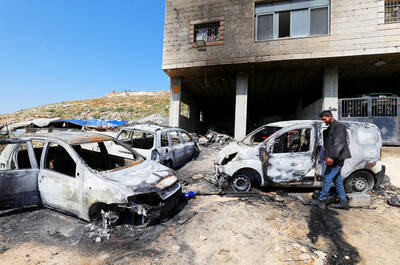
RAMPAGE: A Palestinian man was left dead after dozens of Israeli settlers searching for a missing 14-year-old boy stormed a village in the Israeli-occupied West Bank US President Joe Biden on Friday said he expected Iran to attack Israel “sooner, rather than later” and warned Tehran not to proceed. Asked by reporters about his message to Iran, Biden simply said: “Don’t,” underscoring Washington’s commitment to defend Israel. “We are devoted to the defense of Israel. We will support Israel. We will help defend Israel and Iran will not succeed,” he said. Biden said he would not divulge secure information, but said his expectation was that an attack could come “sooner, rather than later.” Israel braced on Friday for an attack by Iran or its proxies as warnings grew of


 RSS
RSS