


Iraqi officials say they want her to stand trial. Many Jordanians say she's a guest of their royal family. So far, the effort to extradite former Iraqi president Saddam Hussein's eldest daughter, Raghad, to Iraq is shaping up as more of a political tiff than a legal battle.
Jordan and Iraq do share an extradition treaty. But most political analysts say they never expect the case of Raghad to get anywhere close to that step, regardless of how much pressure Iraq's Shiite-led government applies.
"Raghad is a guest in Jordan under King Abdullah II's protec-tion," political commentator Fahd Fanek told reporters this week. "The king cannot ignore Arab traditions by surrendering someone under his care."

PHOTO: AP
A Jordanian judge, who spoke on condition of anonymity, agreed that the matter of Raghad's extradition is "a higher political decision" rather than a legal issue.
In part, the struggle over Raghad is a sign of the growing political tensions between Iraq's Shiite-led government and its largely Sunni-dominated Arab neighbors, including Jordan. On a trip last week to the Gulf, Iraq's new prime minister repeatedly urged Arab countries to stop any support for the country's deadly Sunni-led insurgency.
Raghad herself -- while clearly an annoyance to the Iraqi government -- had lived mostly in obscurity in Jordan except for her work on her father's legal defense, until Iraq last week put her on a list of its 41 most wanted.
Iraqi officials went out of their way to say they would ask countries to extradite those on the list, or at least prevent them from supporting the insurgency.
"We will work toward demanding their extradition or at least silencing them and not allowing them to make some Arab ... country a base for their terrorist activities," said Iraqi Prime Minister Nouri al-Maliki, a Shiite.
Iraqi national security adviser Mouwafak al-Rubaie echoed those remarks, saying: "Any person whose name is mentioned in this list is wanted, no matter in what country they are staying ... those countries have been contacted and the government is serious and doing all it can to bring them back."
Jordan, however, says it has not yet received an extradition re-quest. Jordanian government spokesman Nasser Judeh said: "Our position is very clear: Once we receive something official through the proper channels, then we will study it."
Judeh refused to say whether Jordan would be obliged to comply with an extradition request, when and if it is made by Iraq.
Jordan's king granted Raghad and her sister, Rana, asylum on humanitarian grounds after the 2003 US-led invasion of Iraq.
Saddam's wife, Sajida Khairallah Tulfah, also on the list, lives in Qatar.
Raghad, known as "Little Saddam" because she shares her father's strident temperament, was ranked No. 16 on the list of 41 most wanted. The Iraqi government accuses her and other Baathists of using millions stolen by Saddam to help finance the insurgency.
Raghad lives in Jordan under the condition that she not engage in political activities or make public statements, officials have said.
Yet she has very publicly organized her father's legal defense in his trial, ongoing in Baghdad, for crimes against humanity.
The extradition issue has become something of a "hot potato" even inside the Iraqi government.
One senior Sunni official criticized the most-wanted list, saying its timing was not convenient and "could create problems with neighboring countries."
"We should put aside everything that has to do with the former regime. We have to care about the present," Deputy Prime Minister Salam Zikam Ali al-Zubaie said.
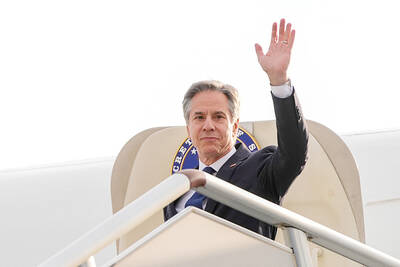
‘IN A DIFFERENT PLACE’: The envoy first visited Shanghai, where he attended a Chinese basketball playoff match, and is to meet top officials in Beijing tomorrow US Secretary of State Antony Blinken yesterday arrived in China on his second visit in a year as the US ramps up pressure on its rival over its support for Russia while also seeking to manage tensions with Beijing. The US diplomat tomorrow is to meet China’s top brass in Beijing, where he is also expected to plead for restraint as Taiwan inaugurates president-elect William Lai (賴清德), and to raise US concerns on Chinese trade practices. However, Blinken is also seeking to stabilize ties, with tensions between the world’s two largest economies easing since his previous visit in June last year. At the
Nearly half of China’s major cities are suffering “moderate to severe” levels of subsidence, putting millions of people at risk of flooding, especially as sea levels rise, according to a study of nationwide satellite data released yesterday. The authors of the paper, published by the journal Science, found that 45 percent of China’s urban land was sinking faster than 3mm per year, with 16 percent at more than 10mm per year, driven not only by declining water tables, but also the sheer weight of the built environment. With China’s urban population already in excess of 900 million people, “even a small portion

UNSETTLING IMAGES: The scene took place in front of TV crews covering the Trump trial, with a CNN anchor calling it an ‘emotional and unbelievably disturbing moment’ A man who doused himself in an accelerant and set himself on fire outside the courthouse where former US president Donald Trump is on trial has died, police said yesterday. The New York City Police Department (NYPD) said the man was declared dead by staff at an area hospital. The man was in Collect Pond Park at about 1:30pm on Friday when he took out pamphlets espousing conspiracy theories, tossed them around, then doused himself in an accelerant and set himself on fire, officials and witnesses said. A large number of police officers were nearby when it happened. Some officers and bystanders rushed

Beijing is continuing to commit genocide and crimes against humanity against Uyghurs and other Muslim minorities in its western Xinjiang province, U.S. Secretary of State Antony Blinken said in a report published on Monday, ahead of his planned visit to China this week. The State Department’s annual human rights report, which documents abuses recorded all over the world during the previous calendar year, repeated language from previous years on the treatment of Muslims in Xinjiang, but the publication raises the issue ahead of delicate talks, including on the war in Ukraine and global trade, between the top U.S. diplomat and Chinese


 RSS
RSS