


A terrorist plot to flood lower Manhattan by attacking train tunnels under the Hudson River used by tens of thousands of commuters was thwarted before the conspirators could travel to the US, authorities said.
Eight suspects -- including an al-Qaeda loyalist arrested in Lebanon and two others in custody elsewhere -- had hoped to pull off the attack in October or November, federal officials said on Friday. But federal investigators working with their counterparts in six other countries intervened. The other five suspects remained at large.
"It was never a concern that this would actually be executed," Homeland Security Secretary Michael Chertoff said in Boston. "We were, as I say, all over this."

PHOTO: AP
Initial reports said that the terrorists wanted to attack the Holland Tunnel, a major thoroughfare for cars entering the island of Manhattan. But officials said the group had specifically mentioned only the train tunnels under the Hudson River used by commuters on their way to New York and New Jersey.
"This is a plot that involved martyrdom and explosives" and focused on the "tubes that connect Jersey and lower Manhattan," FBI Assistant Director Mark Mershon said.
The men believed that by bombing the train tunnels they could unleash massive flooding in lower Manhattan, where Wall Street and the World Trade Center site are located, New York Police Department Commissioner Ray Kelly said.
A federal law enforcement official, who spoke on condition of anonymity because the investigation is ongoing, said investigators believe that an attack on a train tunnel, unlike the Holland Tunnel, could have achieved that goal. The official said the suspects hoped to inflict damage on the US economy.
Investigators decided in recent weeks that the "plotting for this attack had matured to a point where it appeared that the individuals were about to move forward," Mershon said. "They were about to go to a phase where they would attempt to survey targets, establish a regimen of attack and acquire the resources necessary to effectuate the attacks."
Details of the plot -- first reported by New York newspaper the Daily News -- emerged on the one-year anniversary of the attacks on the London transportation system that killed 52 people. Officials said the timing of Friday's report in relation to the anniversary was coincidental.
A federal official said FBI agents monitoring Internet chat rooms used by extremists learned of the plot in recent months and determined that tunnels were possibly being targeted after investigators pieced together code words from their conversations.
Another US official, also speaking on condition of anonymity because the investigation is ongoing, called the plot "largely aspirational" and described the Internet conversations as mostly extremists discussing and conceptualizing the plot. The official said no money had been transferred, nor had other similar operational steps been taken.
Officials cited the arrest of the Lebanese suspect, described as the scheme's mastermind, as a significant break in the investigation.
A Lebanese official said the Beirut man confessed to plotting to attack New York City tunnels later this year, and that he was acting on Osama bin Laden's orders.
Police arrested the man on April 27, acting on information from the FBI. The 31-year-old suspect uses the alias Amir Andalousli, but his real name is Assem Hammoud.
The suspect's family denied any al-Qaeda links and his mother, Nabila Qotob, said that Hammoud taught economics at a local university.
"His morale is high because he is confident he is innocent," she said.

Republican US lawmakers on Friday criticized US President Joe Biden’s administration after sanctioned Chinese telecoms equipment giant Huawei unveiled a laptop this week powered by an Intel artificial intelligence (AI) chip. The US placed Huawei on a trade restriction list in 2019 for contravening Iran sanctions, part of a broader effort to hobble Beijing’s technological advances. Placement on the list means the company’s suppliers have to seek a special, difficult-to-obtain license before shipping to it. One such license, issued by then-US president Donald Trump’s administration, has allowed Intel to ship central processors to Huawei for use in laptops since 2020. China hardliners
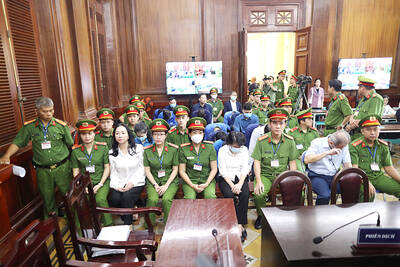
A top Vietnamese property tycoon was on Thursday sentenced to death in one of the biggest corruption cases in history, with an estimated US$27 billion in damages. A panel of three hand-picked jurors and two judges rejected all defense arguments by Truong My Lan, chair of major developer Van Thinh Phat, who was found guilty of swindling cash from Saigon Commercial Bank (SCB) over a decade. “The defendant’s actions ... eroded people’s trust in the leadership of the [Communist] Party and state,” read the verdict at the trial in Ho Chi Minh City. After the five-week trial, 85 others were also sentenced on

Conjoined twins Lori and George Schappell, who pursued separate careers, interests and relationships during lives that defied medical expectations, died this month in Pennsylvania, funeral home officials said. They were 62. The twins, listed by Guinness World Records as the oldest living conjoined twins, died on April 7 at the Hospital of the University of Pennsylvania, obituaries posted by Leibensperger Funeral Homes of Hamburg said. The cause of death was not detailed. “When we were born, the doctors didn’t think we’d make 30, but we proved them wrong,” Lori said in an interview when they turned 50, the Philadelphia Inquirer reported. The
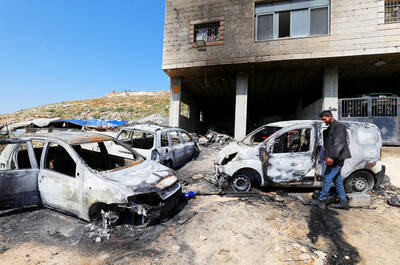
RAMPAGE: A Palestinian man was left dead after dozens of Israeli settlers searching for a missing 14-year-old boy stormed a village in the Israeli-occupied West Bank US President Joe Biden on Friday said he expected Iran to attack Israel “sooner, rather than later” and warned Tehran not to proceed. Asked by reporters about his message to Iran, Biden simply said: “Don’t,” underscoring Washington’s commitment to defend Israel. “We are devoted to the defense of Israel. We will support Israel. We will help defend Israel and Iran will not succeed,” he said. Biden said he would not divulge secure information, but said his expectation was that an attack could come “sooner, rather than later.” Israel braced on Friday for an attack by Iran or its proxies as warnings grew of


 RSS
RSS