


Placido Domingo's eyes welled with tears as he sang at a concert in Berlin, thinking of his Three Tenors colleague Luciano Pavarotti, who was recovering from surgery for pancreatic cancer at a New York hospital.
Friday marked the 16th anniversary of the first concert that Pavarotti, Domingo and Jose Carreras sang together -- before a World Cup final in Rome.
"When I was singing the last aria, I couldn't help being quite sad, thinking that Luciano is in this moment suffering," Domingo said after the Berlin performance on Friday night. "It was very, very emotional."
Pavarotti, 70, is battling a kind of cancer that is often considered a death sentence.
But he is recovering well, his manager said, and two cancer experts said surgery offered improved odds for survival.
Pavarotti was preparing to leave New York last week to resume a farewell tour when doctors discovered a malignant pancreatic mass, manager Terri Robson said. All his remaining concerts this year have been canceled.
"Fortunately, the mass was able to be completely removed at surgery," Robson said.
She said he underwent surgery within the past week at a New York hospital that she declined to identify. He remained hospitalized on Friday.
Because pancreatic cancer is usually diagnosed at an advanced stage, it has one of the worst prognoses of all types of malignancies. Fewer than 4 percent of patients are still alive five years after diagnosis, and the majority die within a year.
But when the cancer is contained and can be surgically removed -- as was Pavarotti's -- "that means he has a chance for long-term survival," said Dan Laheru, an oncologist at the Johns Hopkins Kimmel Cancer Center in Baltimore.
Current studies show that 15 percent to 20 percent of patients with pancreatic cancer who have had surgery are still alive five years after being diagnosed, Laheru said. Of such patients, 63 percent survive one year and 42 percent two years.
At an age when most tenors have retired, Pavarotti's infrequent performances in recent years capped a four-decade career at the pinnacle of the music industry.
Instantly recognizable due to his smiling bearded face and heavy bulk, Pavarotti became the most popular opera tenor since fellow-Italian Enrico Caruso.
In his heyday, he was known as the "King of the High Cs" for the ease with which he tossed off difficult top notes, and he turned Nessun Dorma, an aria from Puccini's Turandot, into a universally recognized signature piece.
He took advantage of the television age to become a widely marketed artist -- especially as one of the Three Tenors who sang together at four World Cup soccer finals.
Domingo said he last saw Pavarotti in May, when he visited him in the New York hospital where Pavarotti was recovering from back treatment.
"His innate strength seemed to have conquered those troubles and I hope that the same inner fortitude will make him overcome his current troubles," Domingo said.
The Three Tenors gave their first concert after Carreras overcame leukemia, and Domingo said that Pavarotti's illness might spark a reunion.
"Once we did it when Jose was feeling bad. It would be very nice to be able to do it for Luciano," Domingo said.
While Pavarotti's active career in operas was over, fans around the world anticipated his concerts. His last performance was at the opening ceremony of the Turin Winter Olympics.
Pavarotti then canceled eight concerts in April to undergo back treatment, and postponed five dates last month because of complications from back surgery.

Republican US lawmakers on Friday criticized US President Joe Biden’s administration after sanctioned Chinese telecoms equipment giant Huawei unveiled a laptop this week powered by an Intel artificial intelligence (AI) chip. The US placed Huawei on a trade restriction list in 2019 for contravening Iran sanctions, part of a broader effort to hobble Beijing’s technological advances. Placement on the list means the company’s suppliers have to seek a special, difficult-to-obtain license before shipping to it. One such license, issued by then-US president Donald Trump’s administration, has allowed Intel to ship central processors to Huawei for use in laptops since 2020. China hardliners

DISADVANTAGE: Erin O’Toole, who led the Conservatives during the election campaign in 2021, estimated that the interference cost his party as many as nine legislative seats Canada’s domestic spy agency on Monday concluded that China interfered in the past two elections, an official probe heard, the firmest evidence so far of suspected Chinese meddling in Canadian politics. Canadian Prime Minister Justin Trudeau’s Liberal Party won both the elections, held in 2019 and 2021. Under pressure from opposition lawmakers unhappy about media reports on China’s possible role, Trudeau set up a commission into foreign interference. The commission was shown a slide on Monday containing an extract of a briefing in February last year from the Canadian Security Intelligence Service (CSIS). “We know that the PRC [People’s Republic of China] clandestinely
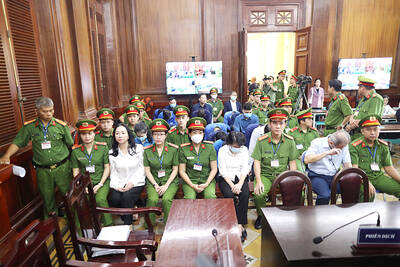
A top Vietnamese property tycoon was on Thursday sentenced to death in one of the biggest corruption cases in history, with an estimated US$27 billion in damages. A panel of three hand-picked jurors and two judges rejected all defense arguments by Truong My Lan, chair of major developer Van Thinh Phat, who was found guilty of swindling cash from Saigon Commercial Bank (SCB) over a decade. “The defendant’s actions ... eroded people’s trust in the leadership of the [Communist] Party and state,” read the verdict at the trial in Ho Chi Minh City. After the five-week trial, 85 others were also sentenced on

‘DELUSIONAL’: Targeting the families of Hamas’ leaders would not push the group to change its position or to give up its demands for Palestinians, Ismail Haniyeh said Israeli aircraft on Wednesday killed three sons of Hamas’ top political leader in the Gaza Strip, striking high-stakes targets at a time when Israel is holding delicate ceasefire negotiations with the militant group. Hamas said four of the leader’s grandchildren were also killed. Ismail Haniyeh’s sons are among the highest-profile figures to be killed in the war so far. Israel said they were Hamas operatives, and Haniyeh accused Israel of acting in “the spirit of revenge and murder.” The deaths threatened to strain the internationally mediated ceasefire talks, which appeared to gain steam in recent days even as the sides remain far


 RSS
RSS