


Locals call it the "desert of death" -- a stark landscape of burned flats, furnace-like heat and choking dust storms that sprawls across Helmand Province. But the wry nickname for the neighborhood around Camp Bastion, Britain's main military camp, has started to acquire a more sinister meaning.
At dawn on Thursday, a Chinook helicopter returned to base carrying a mournful cargo -- the remains of Private Damien Jackson, a cheery 19-year-old paratrooper who died in a Taliban firefight hours earlier. Commanders shut down the camp's satellite Internet system to prevent word of the fatality leaking out before his parents were informed.
Still, the bad news gusted across the camp as fast as the scorching desert wind. Six British deaths in three weeks -- the previous fatalities just four days earlier -- brought home the perilous reality of "peacekeeping," Helmand style, to many British soldiers.
"This latest one has hit the lads quite hard," said Corporal Kelly Buckley, 27. "They know it's part of their job, what they signed up for. But nothing really prepares you for when it happens."
The bloodshed also sealed the formidable reputation of Sangin, where full-blooded battles between Taliban and British forces involving rockets, mortars, machine guns and warplanes, erupt almost every day.
A battle-frazzled group flew out of the riverside town on Thursday. Many were exhausted after two weeks with little sleep and nightly gunbattles, according to fellow soldiers.
"Yes, we are rough, tough soldiers, but this is one of our mates," Captain Darryl Ochse said.
Helmand is stubbornly refusing to follow the script imagined by British ministers and generals when they agreed to send more than 3,000 troops last January.
Plans to woo villagers with development projects have been frozen because outside the two largest towns, Lashkar Gah and Goreshk, much of the province is under Taliban control.
Paratroopers deployed to four northern corners -- Sangin, Kajaki, Musa Qala and Naw Zad -- to break the insurgents' stranglehold have been welcomed with the rattle of gunfire. At one stage this week the Taliban simultaneously attacked three of the small bases.
But the hostility also appears to come from local villagers. Patrolling soldiers are greeted with sullen looks, spy vehicles that shadow their vehicles and passers-by who run their fingers across their throats in a slitting motion.
The attacks have not reached Camp Bastion, safe behind a long razor wire fence that cuts through the forbidding desert. Here the biggest battle is against the heat, which hovers around 50?C.
Even with air conditioning, the tents are swelteringly hot.
The mood among the paratroopers is mixed. After Iraq -- where their battalion was posted to peaceful Maysan province -- many were enthusiastic about coming to a theater with the possibility of action.
"The only casualties in Iraq were guys who injured themselves in the gym," Corporal Buckley said.
But Afghanistan has offered a more potent challenge than many wished.
"That place is like hell on earth," said one paratrooper, speaking to fellow soldiers about to leave for Sangin. "Just expect the worst. There's no other way to describe it."
Others were more phlegmatic about the possibility of casualties.
"You can't just go walking into the Taliban's back garden and not expect to get a punch," said Private Kyle Deerans, a 23-year-old South African sniper who recently fought a two-hour battle.
Many soldiers complain about their putative allies, the Afghan police. Untrained and notoriously corrupt, the police flee in the face of battle, one officer said privately, and some are suspected of siding with the Taliban by night.
And some say they are confused about how to achieve their laudable mandate -- winning hearts and minds -- using deadly force.
"I tell you one thing," one said. "We need to decide what our mission out here is -- because we can't do hearts and minds and this [fighting]. It just won't work."

Republican US lawmakers on Friday criticized US President Joe Biden’s administration after sanctioned Chinese telecoms equipment giant Huawei unveiled a laptop this week powered by an Intel artificial intelligence (AI) chip. The US placed Huawei on a trade restriction list in 2019 for contravening Iran sanctions, part of a broader effort to hobble Beijing’s technological advances. Placement on the list means the company’s suppliers have to seek a special, difficult-to-obtain license before shipping to it. One such license, issued by then-US president Donald Trump’s administration, has allowed Intel to ship central processors to Huawei for use in laptops since 2020. China hardliners

A top Vietnamese property tycoon was on Thursday sentenced to death in one of the biggest corruption cases in history, with an estimated US$27 billion in damages. A panel of three hand-picked jurors and two judges rejected all defense arguments by Truong My Lan, chair of major developer Van Thinh Phat, who was found guilty of swindling cash from Saigon Commercial Bank (SCB) over a decade. “The defendant’s actions ... eroded people’s trust in the leadership of the [Communist] Party and state,” read the verdict at the trial in Ho Chi Minh City. After the five-week trial, 85 others were also sentenced on

Conjoined twins Lori and George Schappell, who pursued separate careers, interests and relationships during lives that defied medical expectations, died this month in Pennsylvania, funeral home officials said. They were 62. The twins, listed by Guinness World Records as the oldest living conjoined twins, died on April 7 at the Hospital of the University of Pennsylvania, obituaries posted by Leibensperger Funeral Homes of Hamburg said. The cause of death was not detailed. “When we were born, the doctors didn’t think we’d make 30, but we proved them wrong,” Lori said in an interview when they turned 50, the Philadelphia Inquirer reported. The
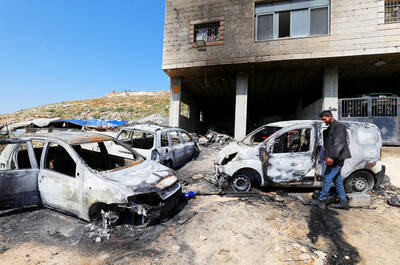
RAMPAGE: A Palestinian man was left dead after dozens of Israeli settlers searching for a missing 14-year-old boy stormed a village in the Israeli-occupied West Bank US President Joe Biden on Friday said he expected Iran to attack Israel “sooner, rather than later” and warned Tehran not to proceed. Asked by reporters about his message to Iran, Biden simply said: “Don’t,” underscoring Washington’s commitment to defend Israel. “We are devoted to the defense of Israel. We will support Israel. We will help defend Israel and Iran will not succeed,” he said. Biden said he would not divulge secure information, but said his expectation was that an attack could come “sooner, rather than later.” Israel braced on Friday for an attack by Iran or its proxies as warnings grew of


 RSS
RSS