


They call themselves the "penguins" for their white-on-dark school uniforms, but what 700,000 Chilean high school kids have pulled off in recent days signals the emergence of a new generation in a nation transformed from dictatorship to democracy.
Marching in the streets and occupying schools, the teenagers' three-week revolt against their decrepit education system became known as the "Penguin Revolution," Chile's biggest protest since democracy was restored in 1990.
Chile's teenagers, the first generation born in the twilight of General Augusto Pinochet's 17-year military dictatorship, have discovered strength in numbers, winning US$200 million in new spending -- a 2.78 percent increase in the annual education budget -- and representation on a council that will propose sweeping reforms.
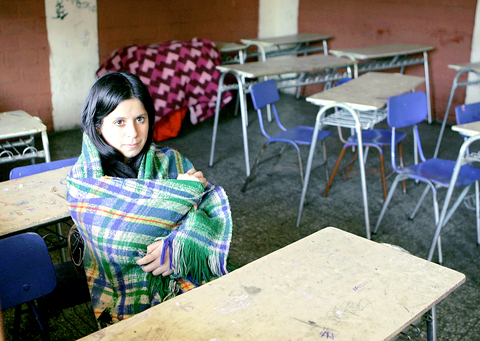
PHOTO: AP
"The students have learned the power of having a voice," sociologist Manuel Antonio Garreton said.
It is all the more striking in a nation that had been cowed into silence by a dictatorship during which 3,100 people died or disappeared. The student protests have emboldened other groups -- health care workers staging a one-day nationwide strike on Tuesday for better working conditions, victims of violence demanding justice, even drivers upset about gasoline prices.
Felipe Anabalon, 18, says his parents were at school during the dictatorship and could not demonstrate "because they could have been killed."
Chile is an economic success story whose free-market foundations were laid during the dictatorship, and fewer than 20 percent live in poverty.
But inequalities linger, most noticeably in its education system: schools lack books or winter heating, teachers are underpaid and indifferent, and even the poorest students must pay US$40 to take the high school exams that decide whether they will get into college.
The students targeted a particularly unpopular law from the final days of the dictatorship that shifted most responsibility for funding education from government to municipalities, causing big gaps in quality between rich and poor areas.
During the 15 years of post-dictatorship government, the students say, no one listened to their demands. Then Michelle Bachelet was elected president and they hoped that the mother of three would heed their pleas.
Small-scale student demonstrations became national, drawing in college students, then teachers and even education ministry employees. Ubiquitous cellphones spread the word by text messages.
The protests were peaceful at first, then spun out of control, with sporadic stone-throwing and police in the capital firing water cannons and tear gas.
Bachelet initially appeared unresponsive, then went on live television promising more money. Critics accused her of being hesitant and vulnerable to pressure. Her three-month-old government's political honeymoon was over.
The adults may have been conditioned by the years under Pinochet, but the kids were outspoken.
"Education should be a right," said Luis Quiroz, 18, his plaid tie loosened and blue tongue ring flashing.
"And it should be equal," said his friend Camila Gordillo, whose parents dropped out of high school, unable to afford the fees.
Studies show that fewer than 10 percent of Chile's poorest students go to college, compared with 65 percent of the richest, and test scores are embarrassingly low -- Chile came 35th out of 38 nations in the 1999 Trends in International Mathematics and Science Study.
Chile has taxpayer-funded public schools, schools subsidized by a voucher-like system, and elite private schools where a month's tuition costs an average month's salary. But even in many private schools, students complain of few books, graffiti-covered desks, filthy bathrooms and peeling paint.
"If Chile continues with a high level of inequality, there will be no social mobility, and there will not be opportunities for 90 percent of our children. That means simply having a pressure cooker without an escape valve, and it will explode," warned Dante Contreras, an economics professor at the University of Chile, who was named to Bachelet's new 73-member education advisory council, which includes 12 students.
And like the penguins that return to nest along Chile's frigid coastline each year, the students say they will be back on the streets to protest if real reforms are not made.
"We are not going to stop just like that" Gordillo said. "This is not a game."

Republican US lawmakers on Friday criticized US President Joe Biden’s administration after sanctioned Chinese telecoms equipment giant Huawei unveiled a laptop this week powered by an Intel artificial intelligence (AI) chip. The US placed Huawei on a trade restriction list in 2019 for contravening Iran sanctions, part of a broader effort to hobble Beijing’s technological advances. Placement on the list means the company’s suppliers have to seek a special, difficult-to-obtain license before shipping to it. One such license, issued by then-US president Donald Trump’s administration, has allowed Intel to ship central processors to Huawei for use in laptops since 2020. China hardliners
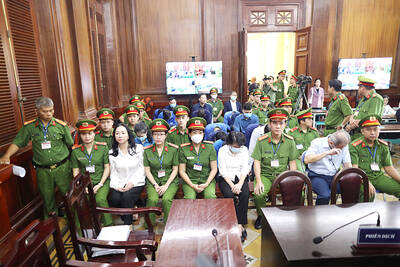
A top Vietnamese property tycoon was on Thursday sentenced to death in one of the biggest corruption cases in history, with an estimated US$27 billion in damages. A panel of three hand-picked jurors and two judges rejected all defense arguments by Truong My Lan, chair of major developer Van Thinh Phat, who was found guilty of swindling cash from Saigon Commercial Bank (SCB) over a decade. “The defendant’s actions ... eroded people’s trust in the leadership of the [Communist] Party and state,” read the verdict at the trial in Ho Chi Minh City. After the five-week trial, 85 others were also sentenced on

‘DELUSIONAL’: Targeting the families of Hamas’ leaders would not push the group to change its position or to give up its demands for Palestinians, Ismail Haniyeh said Israeli aircraft on Wednesday killed three sons of Hamas’ top political leader in the Gaza Strip, striking high-stakes targets at a time when Israel is holding delicate ceasefire negotiations with the militant group. Hamas said four of the leader’s grandchildren were also killed. Ismail Haniyeh’s sons are among the highest-profile figures to be killed in the war so far. Israel said they were Hamas operatives, and Haniyeh accused Israel of acting in “the spirit of revenge and murder.” The deaths threatened to strain the internationally mediated ceasefire talks, which appeared to gain steam in recent days even as the sides remain far
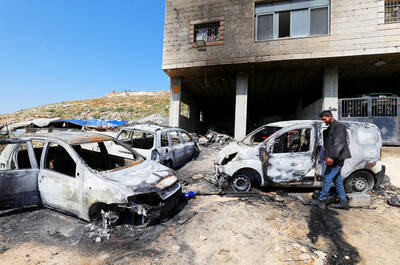
RAMPAGE: A Palestinian man was left dead after dozens of Israeli settlers searching for a missing 14-year-old boy stormed a village in the Israeli-occupied West Bank US President Joe Biden on Friday said he expected Iran to attack Israel “sooner, rather than later” and warned Tehran not to proceed. Asked by reporters about his message to Iran, Biden simply said: “Don’t,” underscoring Washington’s commitment to defend Israel. “We are devoted to the defense of Israel. We will support Israel. We will help defend Israel and Iran will not succeed,” he said. Biden said he would not divulge secure information, but said his expectation was that an attack could come “sooner, rather than later.” Israel braced on Friday for an attack by Iran or its proxies as warnings grew of


 RSS
RSS