


Military planners dubbed their Gaza attack plan "Summer Rain." It's also a fitting image for how many Israelis have followed the operations to shake Hamas: watching closely as the storm gathered, then losing interest as it rolled on.
The bombardment of the Gaza Strip -- so far bringing lots of noise but few casualties -- tells as much about the defiance of Hamas militants as it does the ambivalence of many Israelis.
The offensive waged to free a kidnapped teenage soldier has not come close to stirring Israel's collective spirit in the way of the Lebanon invasion in the 1980s or during the wave of Palestinian suicide bombings that tailed off last year.
The search for explanations has gone in several directions. Among them: a general weariness of conflict, the fading of Israel's sense of common purpose and questions over whether there's too much firepower and not enough diplomatic imagination. There's also the irony of Gaza itself.
Last year, Israel endured a painful and divisive withdrawal of troops and soldiers from Gaza. Now, tanks and artillery are back on the border and warplanes are blasting sites including former Israeli outposts believed used as militant camps.
"Expectations for anything positive are very, very low these days," said Yosi Sarid, a well-known commentator on Israeli affairs. "There's indifference to the current situation because people are not very sure what is the right track to follow."
The only real consensus is that the 19-year-old captive, Corporal Gilad Shalit, cannot be left to his fate. The pledge to never abandon a soldier, dead or alive, is deeply ingrained in Israel's military creed and spills over into a society where nearly everyone has had some days in uniform.
Israeli authorities have rejected any possible deals with Hamas, which won Palestinian elections in January but has refused to significantly soften its anti-Israeli views. Hamas' military wing claimed it kidnapped Shalit on June 25 in an ambush that also killed two soldiers.
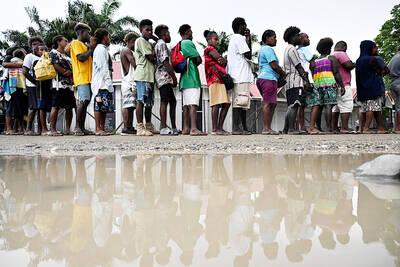
SEEKING CHANGE: A hospital worker said she did not vote in previous elections, but ‘now I can see that maybe my vote can change the system and the country’ Voting closed yesterday across the Solomon Islands in the south Pacific nation’s first general election since the government switched diplomatic allegiance from Taiwan to Beijing and struck a secret security pact that has raised fears of the Chinese navy gaining a foothold in the region. The Solomon Islands’ closer relationship with China and a troubled domestic economy weighed on voters’ minds as they cast their ballots. As many as 420,000 registered voters had their say across 50 national seats. For the first time, the national vote also coincided with elections for eight of the 10 local governments. Esther Maeluma cast her vote in the
Nearly half of China’s major cities are suffering “moderate to severe” levels of subsidence, putting millions of people at risk of flooding, especially as sea levels rise, according to a study of nationwide satellite data released yesterday. The authors of the paper, published by the journal Science, found that 45 percent of China’s urban land was sinking faster than 3mm per year, with 16 percent at more than 10mm per year, driven not only by declining water tables, but also the sheer weight of the built environment. With China’s urban population already in excess of 900 million people, “even a small portion

UNSETTLING IMAGES: The scene took place in front of TV crews covering the Trump trial, with a CNN anchor calling it an ‘emotional and unbelievably disturbing moment’ A man who doused himself in an accelerant and set himself on fire outside the courthouse where former US president Donald Trump is on trial has died, police said yesterday. The New York City Police Department (NYPD) said the man was declared dead by staff at an area hospital. The man was in Collect Pond Park at about 1:30pm on Friday when he took out pamphlets espousing conspiracy theories, tossed them around, then doused himself in an accelerant and set himself on fire, officials and witnesses said. A large number of police officers were nearby when it happened. Some officers and bystanders rushed

HYPOCRISY? The Chinese Ministry of Foreign Affairs yesterday asked whether Biden was talking about China or the US when he used the word ‘xenophobic’ US President Joe Biden on Wednesday called for a hike in steel tariffs on China, accusing Beijing of cheating as he spoke at a campaign event in Pennsylvania. Biden accused China of xenophobia, too, in a speech to union members in Pittsburgh. “They’re not competing, they’re cheating. They’re cheating and we’ve seen the damage here in America,” Biden said. Chinese steel companies “don’t need to worry about making a profit because the Chinese government is subsidizing them so heavily,” he said. Biden said he had called for the US Trade Representative to triple the tariff rates for Chinese steel and aluminum if Beijing was


 RSS
RSS