


"We don't have any choice," says a squatter gesturing to the new home he has made for his family in a Christian cemetery in Iraqi Kurdistan, after fleeing violence-plagued Baghdad.
"We are afraid of the snakes and scorpions, especially with the children, but it's better than sleeping without a roof," says Imad Matti who has just moved his wife and children into the Inkawa necropolis outside the Kurdish regional capital of Arbil.
Iraq and the rest of the world are rightly worried about Shiite and Sunni Muslims forced to flee their homes around the country because of raging communal violence.
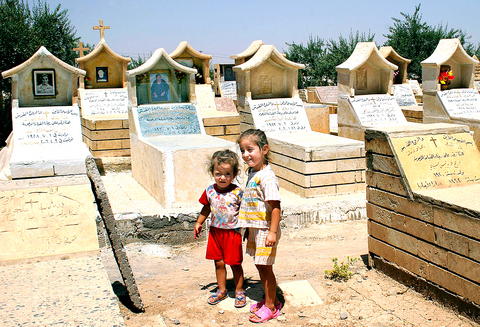
PHOTO: AFP
But the exodus of Christians from the capital, which Kurdish officials say has seen 70 families arrive in Inkawa in recent weeks, has not received the same attention.
The families cite the same dire situation in Baghdad, where threats from armed groups and attacks on businesses from drinks shops to hairdressing salons are rife.
Now Matti lives in a room that was previously the cemetery watchman's hut, while nearby Haval Emmanuel's family has improvised their home in adobe among the tombs.
"Living in an adobe hut in oil-rich Iraq," says Emmanuel, observing the irony of his family's predicament. "But as difficult as the conditions are we accept them -- because we can't endanger the lives of our loved ones."
But Christian leaders are reluctant to speak out about the problems faced by their congregations.
It was the Arab League's representative in the war-torn country, Mokhtar Lamani of Morocco, who drew attention to a problem which he said affected all of Iraq's religious minorities, not just Christians.
"During a recent visit to Kurdistan, I found out that all members of the Mandaean community in Baghdad ... have asked for mass migration to the region," Lamani said.
The Mandaeans, followers of a monotheistic religion which reveres John the Baptist but does not recognize Jesus, Mohammed or Moses, once lived mainly in southern Iraq and neighboring Iran but many fled to Baghdad after Saddam Hussein suppressed a Shiite uprising in the marshlands in the early 1990s.
Lamani said that 3,500 Christian families who had received threats had also fled the capital for the relative safety of Kurdistan.
The sudden influx of Christians to Inkawa has made it increasingly difficult for families of modest means to rent accommodation. A two-room apartment now costs at least US$500 a month, with more spacious properties costing double.
Kurdish authorities give some families US$100 a month, but that is not enough for Imad Matti to rent a home.
Mazen Francis has an apartment, thanks to getting his son to work in the blacksmith's he has just opened rather than sending him to school.
Other families share a single apartment, while demand for even meagre homes from Inkawa estate agents remains high in the town of 30,000, almost all Christians.
"Three to six heads of families come here every day looking for lodging, and it's more and more difficult to find something for them," says estate agent Kameran Matti.

Republican US lawmakers on Friday criticized US President Joe Biden’s administration after sanctioned Chinese telecoms equipment giant Huawei unveiled a laptop this week powered by an Intel artificial intelligence (AI) chip. The US placed Huawei on a trade restriction list in 2019 for contravening Iran sanctions, part of a broader effort to hobble Beijing’s technological advances. Placement on the list means the company’s suppliers have to seek a special, difficult-to-obtain license before shipping to it. One such license, issued by then-US president Donald Trump’s administration, has allowed Intel to ship central processors to Huawei for use in laptops since 2020. China hardliners

Conjoined twins Lori and George Schappell, who pursued separate careers, interests and relationships during lives that defied medical expectations, died this month in Pennsylvania, funeral home officials said. They were 62. The twins, listed by Guinness World Records as the oldest living conjoined twins, died on April 7 at the Hospital of the University of Pennsylvania, obituaries posted by Leibensperger Funeral Homes of Hamburg said. The cause of death was not detailed. “When we were born, the doctors didn’t think we’d make 30, but we proved them wrong,” Lori said in an interview when they turned 50, the Philadelphia Inquirer reported. The
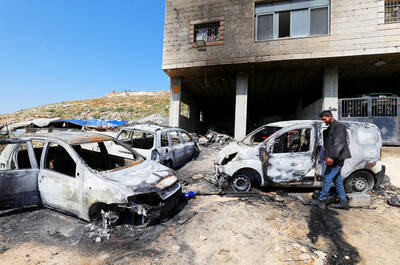
RAMPAGE: A Palestinian man was left dead after dozens of Israeli settlers searching for a missing 14-year-old boy stormed a village in the Israeli-occupied West Bank US President Joe Biden on Friday said he expected Iran to attack Israel “sooner, rather than later” and warned Tehran not to proceed. Asked by reporters about his message to Iran, Biden simply said: “Don’t,” underscoring Washington’s commitment to defend Israel. “We are devoted to the defense of Israel. We will support Israel. We will help defend Israel and Iran will not succeed,” he said. Biden said he would not divulge secure information, but said his expectation was that an attack could come “sooner, rather than later.” Israel braced on Friday for an attack by Iran or its proxies as warnings grew of

IN PURSUIT: Israel’s defense minister said the revenge attacks by Israeli settlers would make it difficult for security forces to find those responsible for the 14-year-old’s death Israeli Prime Minister Benjamin Netanyahu on Saturday condemned the “heinous murder” of an Israeli teenager in the occupied West Bank as attacks on Palestinian villages intensified following news of his death. After Benjamin Achimeir, 14, was reported missing near Ramallah on Friday, hundreds of Jewish settlers backed by Israeli forces raided nearby Palestinian villages, torching vehicles and homes, leaving at least one villager dead and dozens wounded. The attacks escalated in several villages on Saturday after Achimeir’s body was found near the Malachi Hashalom outpost. Agence France-Presse correspondents saw smoke rising from burned houses and fields. Mayor Amin Abu Alyah, of the


 RSS
RSS