


A trash collector and the head of security for Baghdad University were slain yesterday, targets of the unrelenting violence in Iraq.
And at least six other deaths were reported in the capital, including two merchants, a baker, an electrical worker and a woman sitting in her car with three of her sons, who were wounded. Police also found the body of a man who had been blindfolded, handcuffed and shot in western Baghdad.
The violence came a day after insurgent and government officials said 11 militant groups have offered an immediate halt to all attacks -- including those on US troops -- if the US agrees to withdraw foreign forces from Iraq in two years.
Withdrawal is the centerpiece of a set of demands from the groups, which operate north of Baghdad in the heavily Sunni Arab provinces of Salahuddin and Diyala. Although much of the fighting has been to the west, those provinces are increasingly violent and attacks there have crippled oil and commerce routes.
The trash collector was gunned down in a drive-by shooting yesterday in western Baghdad, police Captain Jamil Hussein said. Gunmen in a civilian car also intercepted a car carrying Kadhim Challoub, who was in charge of the guards at Baghdad University, ordered his driver and his guard out, then killed the security chief on the eastern side of the capital, according to police Lieutenant Mohammad Khayoun.
A roadside bomb aimed at a police patrol in northern Baghdad missed its target but killed a civilian and wounded another.
Elsewhere, gunmen on a motorcycle killed a policeman and attackers firing from a car shot to death a 34-year-old man working in a construction equipment shop in separate attacks in the Shiite holy city of Karbala, south of Baghdad, health officials said.
Iraqi police in the northern city of Kirkuk found the body of a 15-year-old girl who had been kidnapped five days ago, Brigadier Sarhat Qadir said.
The insurgent groups who have made contact with the government have largely shunned attacks on Iraqi civilians, focusing instead on US-led coalition forces.
Their offer coincides with al-Maliki's decision to reach out to the Sunni insurgency with a reconciliation plan that includes an amnesty for fighters. The Islamic Army in Iraq, the Mohammmed Army and the Mujahedeen Shura Council -- the umbrella group that covers eight militant groups including al-Qaeda in Iraq -- were not party to any offers to the government.
Naseer al-Ani, a Sunni Arab politician and official with the largest Sunni political group, the Iraqi Islamic Party, said al-Maliki should seek to encourage the process by guaranteeing security for those making the offer and by not immediately rejecting their demands.
"The government should prove its goodwill and not establish red lines," al-Ani said.
"If the initiative is implemented in a good way, 70 percent of the insurgent groups will respond positively," he said.

Republican US lawmakers on Friday criticized US President Joe Biden’s administration after sanctioned Chinese telecoms equipment giant Huawei unveiled a laptop this week powered by an Intel artificial intelligence (AI) chip. The US placed Huawei on a trade restriction list in 2019 for contravening Iran sanctions, part of a broader effort to hobble Beijing’s technological advances. Placement on the list means the company’s suppliers have to seek a special, difficult-to-obtain license before shipping to it. One such license, issued by then-US president Donald Trump’s administration, has allowed Intel to ship central processors to Huawei for use in laptops since 2020. China hardliners
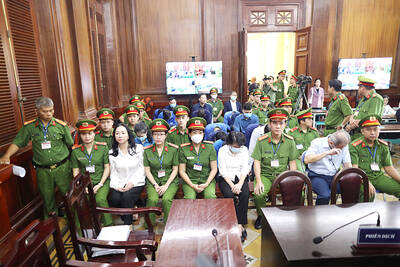
A top Vietnamese property tycoon was on Thursday sentenced to death in one of the biggest corruption cases in history, with an estimated US$27 billion in damages. A panel of three hand-picked jurors and two judges rejected all defense arguments by Truong My Lan, chair of major developer Van Thinh Phat, who was found guilty of swindling cash from Saigon Commercial Bank (SCB) over a decade. “The defendant’s actions ... eroded people’s trust in the leadership of the [Communist] Party and state,” read the verdict at the trial in Ho Chi Minh City. After the five-week trial, 85 others were also sentenced on

Conjoined twins Lori and George Schappell, who pursued separate careers, interests and relationships during lives that defied medical expectations, died this month in Pennsylvania, funeral home officials said. They were 62. The twins, listed by Guinness World Records as the oldest living conjoined twins, died on April 7 at the Hospital of the University of Pennsylvania, obituaries posted by Leibensperger Funeral Homes of Hamburg said. The cause of death was not detailed. “When we were born, the doctors didn’t think we’d make 30, but we proved them wrong,” Lori said in an interview when they turned 50, the Philadelphia Inquirer reported. The
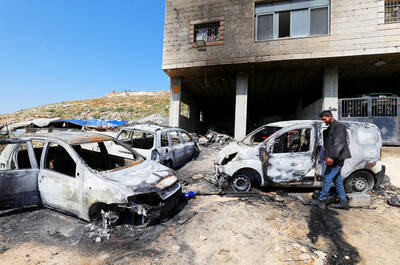
RAMPAGE: A Palestinian man was left dead after dozens of Israeli settlers searching for a missing 14-year-old boy stormed a village in the Israeli-occupied West Bank US President Joe Biden on Friday said he expected Iran to attack Israel “sooner, rather than later” and warned Tehran not to proceed. Asked by reporters about his message to Iran, Biden simply said: “Don’t,” underscoring Washington’s commitment to defend Israel. “We are devoted to the defense of Israel. We will support Israel. We will help defend Israel and Iran will not succeed,” he said. Biden said he would not divulge secure information, but said his expectation was that an attack could come “sooner, rather than later.” Israel braced on Friday for an attack by Iran or its proxies as warnings grew of


 RSS
RSS