


From the African bush to the shores of Indonesia, the number of wars worldwide has dropped to a new low, peace researchers report. But the face of conflict is changing, they say, and free-for-all violence is becoming more prevalent.
The Stockholm International Peace Research Institute's newly released Yearbook 2006, drawing from data maintained by Sweden's Uppsala University, reports the number of active major armed conflicts worldwide stood at 17 in 2005, the lowest point in a steep slide from a high of 31 in 1991.
The Uppsala experts added one conflict to their list in 2005: the resurgent war that pits the four-year-old Afghan government and its US-led allies against fighters of the ousted Taliban. But they also subtracted three conflicts: those that ended in Rwanda, southern Sudan and Algeria, joining such other recent additions to the "peace" column as Liberia and Indonesia's Aceh province.
The deadliest war of 2005 was the complex conflict in Iraq, where estimates say a minimum of 50,000 people have been killed since the US-British invasion of 2003. The oldest conflict, dating to 1948, is the separatist struggle of the Karen people in Myanmar, or Burma.
Academics attribute war's long decline to multiple trends.
The era of decolonization, wars of independence and resulting civil wars has faded. The end of the Cold War halted US-Soviet "proxy" wars like Angola's of the 1970s and 1980s and enabled US-Russian cooperation on UN peacekeeping in the 1990s. Economic growth, especially in Asia, also quieted dissent that can produce wars.
"Research shows that the difference between US$1,000 per capita income and US$5,000 per capita income is huge as far as the risk of war," said Andrew Mack, director of the University of British Columbia's Human Security Center, which did an in-depth analysis of world conflict.
Mack and others point to "an explosion of international activism" as a key pacifying factor since the early 1990s -- the peacemaking and peacekeeping diplomatic and military missions mounted by the United Nations and other multinational organizations, such as the African Union. As a result, major African conflicts dropped from 11 in 1998 to three in 2005.
Despite this, Mack said, the "nature of media reporting" leads many people to believe war is on the rise.

Republican US lawmakers on Friday criticized US President Joe Biden’s administration after sanctioned Chinese telecoms equipment giant Huawei unveiled a laptop this week powered by an Intel artificial intelligence (AI) chip. The US placed Huawei on a trade restriction list in 2019 for contravening Iran sanctions, part of a broader effort to hobble Beijing’s technological advances. Placement on the list means the company’s suppliers have to seek a special, difficult-to-obtain license before shipping to it. One such license, issued by then-US president Donald Trump’s administration, has allowed Intel to ship central processors to Huawei for use in laptops since 2020. China hardliners

A top Vietnamese property tycoon was on Thursday sentenced to death in one of the biggest corruption cases in history, with an estimated US$27 billion in damages. A panel of three hand-picked jurors and two judges rejected all defense arguments by Truong My Lan, chair of major developer Van Thinh Phat, who was found guilty of swindling cash from Saigon Commercial Bank (SCB) over a decade. “The defendant’s actions ... eroded people’s trust in the leadership of the [Communist] Party and state,” read the verdict at the trial in Ho Chi Minh City. After the five-week trial, 85 others were also sentenced on

Conjoined twins Lori and George Schappell, who pursued separate careers, interests and relationships during lives that defied medical expectations, died this month in Pennsylvania, funeral home officials said. They were 62. The twins, listed by Guinness World Records as the oldest living conjoined twins, died on April 7 at the Hospital of the University of Pennsylvania, obituaries posted by Leibensperger Funeral Homes of Hamburg said. The cause of death was not detailed. “When we were born, the doctors didn’t think we’d make 30, but we proved them wrong,” Lori said in an interview when they turned 50, the Philadelphia Inquirer reported. The
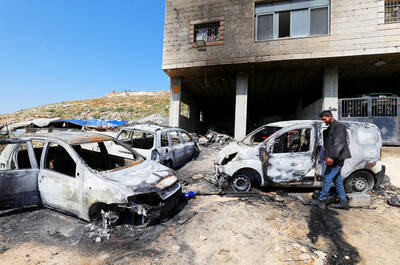
RAMPAGE: A Palestinian man was left dead after dozens of Israeli settlers searching for a missing 14-year-old boy stormed a village in the Israeli-occupied West Bank US President Joe Biden on Friday said he expected Iran to attack Israel “sooner, rather than later” and warned Tehran not to proceed. Asked by reporters about his message to Iran, Biden simply said: “Don’t,” underscoring Washington’s commitment to defend Israel. “We are devoted to the defense of Israel. We will support Israel. We will help defend Israel and Iran will not succeed,” he said. Biden said he would not divulge secure information, but said his expectation was that an attack could come “sooner, rather than later.” Israel braced on Friday for an attack by Iran or its proxies as warnings grew of


 RSS
RSS