


■ Malaysia
Ex-PM expects to be ejected
Former prime minister Mahathir Mohamad said yesterday he expected to be expelled from the ruling United Malays National Organization (UMNO) party following his unbridled criticism of the government that has roiled politics and raised fears of instability. Mahathir's relations with the government have plummeted in recent months in the wake of his stinging attacks on Prime Minister Abdullah Ahmad Badawi. Although UMNO has backed Abdullah in the row, Mahathir is believed to have some supporters in the party, creating fears that he could split the party and destabilize the government. Government ministers have said in the past that there is no plan to expel Mahathir. But by making his claim, the ex-prime minister seemed to challenge Abdullah to fire him and test his support.
■ United Nations
SE Asia nearly opium-free
Opium poppy cultivation has been almost eradicated in Asia's Golden Triangle, the border zone between Burma, Thailand and Laos that was once the world's most prolific supplier of opium, according to a report published by the UN on Monday. The area of land being used for poppy farming has fallen by 22 percent worldwide, reflecting declines in the world's three biggest producers of opium: Afghanistan, Burma and Laos. The UN's 2006 World Drug Report described south-east Asia as an "overlooked success story," where governments had succeeded in slashing poppy cultivation. Laos, once the world's third biggest heroin producer, declared itself free of poppy cultivation in February. The Burmese government reduced the area under cultivation by 26 percent to 32,800 hectares last year.
■ Indonesia
Scientists find new snake
Scientists have discovered a new species of snake in Borneo with the ability to change color, a conservation group said yesterday. The half-meter long snake was collected by a WWF consultant and a German reptile expert in the wetlands along the Kapuas River in West Kalimantan more than a year ago, since when it has been established as a new species. "The peculiar thing with this snake, is that it can change color ... That is relatively rare among snakes," the WWF's Iwan Wibisono said.
■ India
Record divorce settlement
A court has ordered the grandson of the last ruler of the princely state of Hyderabad, Mukarram Jah Bahadur, to pay US$3 million as alimony and maintenance to his divorced third wife, news reports said yesterday. A family court in Hyderabad ruled that Jah's four palaces would be used to recover the amount due to Manolya Onur, 52, a former Miss Turkey. The court orders make it the largest-ever divorce settlement in India, local media reported. Onur's lawyer, SS Prasad, told the Times of India newspaper that she could auction the palaces if the money was not recovered. Jah, 73, married Onur in 1989 but they divorced five years later.
■ East Timor
Ex-PM's supporters gather
President Xanana Gusmao yesterday extended his emergency powers and warned of possible early elections amid fresh fears of violence as thousands of supporters of former prime minister Mari Alkatiri massed on the edge of the capital. Alkatiri resigned on Monday, sparking jubilation in Dili, where many had blamed him for weeks of political and civil unrest. But his own angry supporters gathered on the outskirts of Dili. Gusmao will extend his sole control of the army for another 30 days, his office said in a statement. Meanwhile, addressing supporters outside the city, Alkatiri said: "We must enter Dili -- but not today." Protest organizers said they may still march on the city today.
■ Japan
Court rejects shrine appeals
The nation's top court yesterday threw out two appeals challenging the constitutionality of Prime Minister Junichiro Koizumi's controversial visits to a Tokyo war shrine, officials said. The Supreme Court will not rule on the suits, filed between 2001 and 2003 by relatives of Japan's war dead and religious leaders, according to court spokesman Katsunori Fujioka. The decision is final, Fujioka said, refusing to elaborate on the reasons for the decision. The plaintiffs claimed Koizumi's visits to d Yasukuni shrine violated the constitutional separation of religion and state. Yasukuni honors Japan's war dead, including war criminals. The plaintiffs also alleged that his visits had caused them emotional distress.
■ Mauritius
Dodo's past unearthed
Scientists have unearthed a wealth of dodo bones which could contain clues about how the giant bird became extinct. Most theories blame early settlers who found the plump flightless bird on the Indian Ocean island in the 16th century and hunted it relentlessly. A group of researchers this month excavated a site on a sugarcane estate, where a layer of dodo bones were found last October. "The chances of a single [intact] bone being preserved is a remarkable event. And here we have a whole collection of them." said Julian Hume, a scientist on the Dodo Research Program.
■ United Kingdom
Harry Potter could die
Children's author J.K. Rowling has revealed that at least two characters will die in the seventh and final instalment of her bestselling Harry Potter series, but was careful not to say who. Children and adults are expected to rush and buy the final Harry Potter novel in their tens of millions when it is complete, and if the publication of the sixth book is anything to go by, secrecy surrounding the plot will be tight. Rowling has already said that the final chapter of the seventh book was written long ago. "The final chapter is hidden away, although it's now changed very slightly," she said in an interview broadcast on Monday. "One character got a reprieve, but I have to say two die that I didn't intend to die."
■ Austria
European cocaine use rising
Cocaine consumption in Western and Central Europe has reached alarming levels, accounting for 25 percent of the world's estimated cocaine use while the Americas account for 50 percent, the UN Office on Drugs and Crime said on Monday. There are an estimated 3.5 million users in Europe, with the rates of users on the continent increasing by 2 percent a year, the Vienna-based UNODC said. Worldwide, cocaine use affects about 13.4 million people between the ages 15 and 64, about half of that number is in the Americas.
■ Germany
Two sentenced for killing
A court sentenced a 21-year-old woman and a 24-year-old man on Monday to a life in prison for torturing, killing and robbing a 54-year-old man in a wheelchair who was suffering from multiple sclerosis. A 17-year-old youth and a 16-year-old girl who also participated in the murder were sentenced to eight and six years in prison because they were juveniles. The man was stabbed to death in his apartment in Wilhelm-shaven in northern Germany on Oct. 2 last year, according to judge Dietrich Janssen. The man in the wheelchair knew one of the group and invited all of them to his apartment. They had been drinking before they attacked and killed him.
■ Switzerland
Canada blamed
A coalition of indigenous peoples from around the globe on Monday accused Canada of betrayal by campaigning to block a UN declaration asserting their rights after backing it for years. The declaration, in negotiation for the past 24 years and backed by many European, Latin American and Asian states, is up for approval in the next few days by the UN's new Human Rights Council. But Canada's new conservative government announced last week it wanted a delay for at least two years, saying the document could violate its Constitution and wreck talks with its native population over control of land and resources.
■ Algeria
Organized crime targeted
Organized crime is growing fast in Algeria, the gendarmerie paramilitary force said on Monday, in a sign that a long-running Islamist revolt is no longer seen by the authorities as the main security threat. "We have to be ready to counter the dangerous growing criminality in our country, particularly organized crime," the commander of the national gendarmerie school of Les Isser, Colonel Bakchti Rabah, told reporters at a passing-out parade.
■ United States
Drunk birds on rampage
Four pelicans suspected of being drunk on sea algae were being tested at a Southern California wildlife center on Saturday after one of them crashed headlong into a car. Three of the California brown pelicans were found wandering dazed in the streets of Laguna Beach after another pelican struck a vehicle's windshield on a nearby coast road. It suffered internal injuries and a long gash in its pouch and was undergoing toxicology tests. Officials at the Wildlife Care Center said the seabirds may have been under the influence of algae in the ocean that can produce domoic acid poisoning when eaten. Wildlife director Lisa Birkle warned the public to be on the lookout for birds acting "drunk."
■ United States
Friends shrinking away
People are more socially isolated than they were 20 years ago, separated by work, commuting and the single life, researchers reported on Friday. Nearly a quarter of people surveyed said they had "zero" close friends with whom to discuss personal matters. More than 50 percent named two or fewer confidants, most often immediate family members, the researchers said. "This is a big social change, and it indicates something that's not good for our society," said Duke University's Lynn Smith-Lovin, lead author of a new study to be published in the American Sociological Review. Smith-Lovin's group used data from a national survey of 1,500 American adults that has been ongoing since 1972.
■ United States
Pooh copyright decided
The Supreme Court refused on Monday to decide whether the granddaughter of A.A. Milne, British creator of Winnie the Pooh, can recapture control of the copyright for stories featuring the children's book character. Milne wrote the Pooh books between 1924 and 1928 and granted a US license to Stephen Slesinger in 1930. Slesinger, in turn, granted his rights to Stephen Slesinger Inc. The company sublicensed to Walt Disney Productions certain rights to the Pooh works. When Milne died in 1956, he did not bequeath ownership of the copyright to his family but to a trust that later became known as the Pooh Properties Trust.
■ Canada
Siblings affect orientation
The last male child in a family of many boys is likely to be gay, Canadian researchers found in a study published on Monday in the US Proceedings of the National Academy of Sciences online journal. The study, led by Anthony Bogaert of Brock University, found that "the most consistent bio-demographic correlate of sexual orientation in men is the number of older brothers [one has]" and not social influences. "Only biological older brothers, and not any other sibling characteristic, including non-biological older brothers, predicted men's sexual orientation," he said.
■ Brazil
Police foil prison attack bid
Police killed 13 people in Sao Paulo suspected of preparing attacks against prison warders in a new eruption of violence involving criminal gangs, security officials said on Monday. The deaths came in police operations in four Sao Paulo suburbs after officers received information about imminent attacks from monitoring telephone conversations, said a spokesman for the Sao Paulo state security department. The spokesman said police believed attacks were to be carried out Sunday night on jail warders at prisons in the Sao Paulo suburbs.
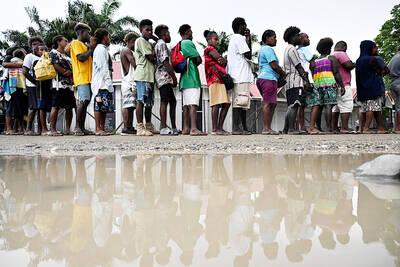
SEEKING CHANGE: A hospital worker said she did not vote in previous elections, but ‘now I can see that maybe my vote can change the system and the country’ Voting closed yesterday across the Solomon Islands in the south Pacific nation’s first general election since the government switched diplomatic allegiance from Taiwan to Beijing and struck a secret security pact that has raised fears of the Chinese navy gaining a foothold in the region. The Solomon Islands’ closer relationship with China and a troubled domestic economy weighed on voters’ minds as they cast their ballots. As many as 420,000 registered voters had their say across 50 national seats. For the first time, the national vote also coincided with elections for eight of the 10 local governments. Esther Maeluma cast her vote in the
Nearly half of China’s major cities are suffering “moderate to severe” levels of subsidence, putting millions of people at risk of flooding, especially as sea levels rise, according to a study of nationwide satellite data released yesterday. The authors of the paper, published by the journal Science, found that 45 percent of China’s urban land was sinking faster than 3mm per year, with 16 percent at more than 10mm per year, driven not only by declining water tables, but also the sheer weight of the built environment. With China’s urban population already in excess of 900 million people, “even a small portion

UNSETTLING IMAGES: The scene took place in front of TV crews covering the Trump trial, with a CNN anchor calling it an ‘emotional and unbelievably disturbing moment’ A man who doused himself in an accelerant and set himself on fire outside the courthouse where former US president Donald Trump is on trial has died, police said yesterday. The New York City Police Department (NYPD) said the man was declared dead by staff at an area hospital. The man was in Collect Pond Park at about 1:30pm on Friday when he took out pamphlets espousing conspiracy theories, tossed them around, then doused himself in an accelerant and set himself on fire, officials and witnesses said. A large number of police officers were nearby when it happened. Some officers and bystanders rushed

HYPOCRISY? The Chinese Ministry of Foreign Affairs yesterday asked whether Biden was talking about China or the US when he used the word ‘xenophobic’ US President Joe Biden on Wednesday called for a hike in steel tariffs on China, accusing Beijing of cheating as he spoke at a campaign event in Pennsylvania. Biden accused China of xenophobia, too, in a speech to union members in Pittsburgh. “They’re not competing, they’re cheating. They’re cheating and we’ve seen the damage here in America,” Biden said. Chinese steel companies “don’t need to worry about making a profit because the Chinese government is subsidizing them so heavily,” he said. Biden said he had called for the US Trade Representative to triple the tariff rates for Chinese steel and aluminum if Beijing was


 RSS
RSS