


Oil-rich Kuwait, where democracy has made more inroads than in any other Gulf Arab state, chooses a new parliament on Thursday in historic elections that will see women taking part for the first time.
The elections take place in the shadow of a political crisis which led to parliament's dissolution last month, triggering the most intense campaign in the emirate's 44 years of parliamentary polling.
Opposition candidates have accused the establishment of corruption and interference in the polls, not sparing the ruling al-Sabah family.
"This campaign has definitely been the fiercest in Kuwait's history, since it came after the dissolution of parliament following popular demands for reform," political analyst Ayed al-Manna said.
Opposition candidates branded the election a "battle between good and evil." Electoral reform, specifically the call to cut the number of constituencies from the current 25 to five, and corruption have dominated the campaign.
"It is a fierce battle between those who want fundamental reform of the election system and those who want a cosmetic change that would virtually maintain the status quo," Manna said.
Parliament was dissolved by the emir on May 21 in a row between the government and opposition MPs over a bill to reduce the number of constituencies.
Opposition candidates have vowed that their priority if elected will be to introduce legislation reducing the number of constituencies to five.
Their fiery rhetoric prompted a stern warning from Emir Sheikh Sabah al-Ahmad al-Sabah, who vowed he would not allow anyone to "sabotage" Kuwaiti democracy.
Twenty-eight women are among 253 hopefuls standing for the 50-seat parliament, which has legislative and monitoring powers and can even unseat the emir on the recommendation of the government. Kuwaiti women won political rights last year, but analysts believe they stand little chance of winning seats under the current election system.
Forty-six outgoing MPs, including 28 of 29 opposition members who walked out of parliament in mid-May over the electoral reform dispute, are seeking a new four-year mandate, many representing political groupings. With a native population of one million, Kuwait has 340,000 eligible voters. They include 195,000 women, or 57 percent of the electorate.
Parliament's importance grew after it voted former emir Sheikh Saad al-Abdullah al-Sabah out of office on health grounds in January amid a row over succession in the ruling family.
It also voted to appoint Sheikh Sabah as new emir.
"The next parliament will play a key role in forming the future political leadership of Kuwait. It certainly won't be an ordinary assembly," writer Ahmad al-Sarraf said.
Opposition candidates have accused their pro-government rivals of vote-buying and charged senior government officials and ruling family members with meddling in the election.
"Huge amounts of money have been pumped into the election ... I think it is part of the fight for a piece of the cake which has become huge," Sarraf said.
OPEC member Kuwait pumps 2.5 million barrels of oil per day, and is estimated to have assets of more than US$150 billion. This figure is expected to grow further as crude prices remain high.
The opposition is a loose alliance of Islamists, liberals, nationalists, former MPs and independents who are united in their call for reform and fighting corruption, but who differ on many other issues.
Islamists pushing for implementation of Sharia (Islamic law) are expected to widen their representation, with some analysts predicting they will win at least 20 seats against the 18 they had in the previous parliament.
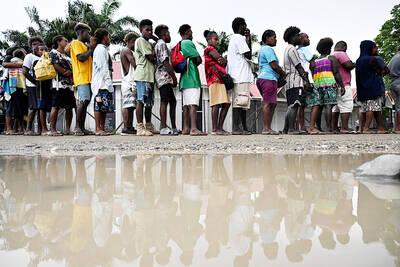
SEEKING CHANGE: A hospital worker said she did not vote in previous elections, but ‘now I can see that maybe my vote can change the system and the country’ Voting closed yesterday across the Solomon Islands in the south Pacific nation’s first general election since the government switched diplomatic allegiance from Taiwan to Beijing and struck a secret security pact that has raised fears of the Chinese navy gaining a foothold in the region. The Solomon Islands’ closer relationship with China and a troubled domestic economy weighed on voters’ minds as they cast their ballots. As many as 420,000 registered voters had their say across 50 national seats. For the first time, the national vote also coincided with elections for eight of the 10 local governments. Esther Maeluma cast her vote in the
Nearly half of China’s major cities are suffering “moderate to severe” levels of subsidence, putting millions of people at risk of flooding, especially as sea levels rise, according to a study of nationwide satellite data released yesterday. The authors of the paper, published by the journal Science, found that 45 percent of China’s urban land was sinking faster than 3mm per year, with 16 percent at more than 10mm per year, driven not only by declining water tables, but also the sheer weight of the built environment. With China’s urban population already in excess of 900 million people, “even a small portion

UNSETTLING IMAGES: The scene took place in front of TV crews covering the Trump trial, with a CNN anchor calling it an ‘emotional and unbelievably disturbing moment’ A man who doused himself in an accelerant and set himself on fire outside the courthouse where former US president Donald Trump is on trial has died, police said yesterday. The New York City Police Department (NYPD) said the man was declared dead by staff at an area hospital. The man was in Collect Pond Park at about 1:30pm on Friday when he took out pamphlets espousing conspiracy theories, tossed them around, then doused himself in an accelerant and set himself on fire, officials and witnesses said. A large number of police officers were nearby when it happened. Some officers and bystanders rushed

HYPOCRISY? The Chinese Ministry of Foreign Affairs yesterday asked whether Biden was talking about China or the US when he used the word ‘xenophobic’ US President Joe Biden on Wednesday called for a hike in steel tariffs on China, accusing Beijing of cheating as he spoke at a campaign event in Pennsylvania. Biden accused China of xenophobia, too, in a speech to union members in Pittsburgh. “They’re not competing, they’re cheating. They’re cheating and we’ve seen the damage here in America,” Biden said. Chinese steel companies “don’t need to worry about making a profit because the Chinese government is subsidizing them so heavily,” he said. Biden said he had called for the US Trade Representative to triple the tariff rates for Chinese steel and aluminum if Beijing was


 RSS
RSS