


Mohamed Abdullahi no longer shoves his cellphone down his trousers when leaving the house. Abdulaziz Mohamed has dismissed the armed men that used to guard his stationery shop. Farh Dir enjoys a restaurant dinner with a childhood friend -- the first time he has been out at night in years.
"What has happened in Mogadishu is a miracle," said Abdi Haji Gobdon, the 62-year-old director of Voice of Peace radio in the Somali capital. "We are still trying to take it all in."
Three weeks ago, the last of Mogadishu's warlords were chased from the city by a combination of Islamist militia firepower and what people here describe as a "societal uprising."
After 16 years of chaos, the world's most lawless city suddenly has a taste of peace and security. Almost overnight, the atmosphere has changed from one of fear and despair to euphoria and even cautious optimism about the future.
"Everybody is happy," said Ahmed Mohamed, a spectacled 41-year- old businessman. "We are only a short time into this revolution, but we all hope this could be the start of a new life."
While the west frets over the motives of the Islamic Courts Union (ICU), which now controls Mogadishu, there have been few, if any, signs of a Taliban-like agenda -- even if the ICU did appoint a cleric wanted by the US to a top post on the weekend. There have been no lustrations -- purification ceremonies, no public floggings, and no move to ban the use of khat, the narcotic leaf that is daily bread to many Somalis.
For now, at least, the courts enjoy huge support -- 95 percent -- according to Gobdon, even if it is based less on their religious bent than on their success in defeating the warlords.
Few in this battered city had expected this to happen. Since the dictator Mohamed Siad Barre was toppled in 1991, the warlords and their heavily armed militias had kept a tight grip on power, amassing huge wealth at the expense of the people. Extortion, kidnappings and theft were so rife that the streets emptied at sundown.
With no justice system to turn to, individual Somali clans started setting up their own courts, with the Koran as their guide.
The courts established some degree of order and their popularity grew. Rich businessmen such as Mohamud Omar Adani, a 42-year-old man with a healthy beard and a potbelly swelling his white jellaba, poured in money and weaponry to strengthen the courts' position. "We supported them because we thought they could bring peace," he said.
"The warlords were making life and business very complicated for everyone."
The warlords in February said they would take on the ICU.
"The warlords made it very clear that they had taken money from the US and that they were looking for al-Qaeda suspects on America's behalf," said Aini Abukar Ga'al, 46, a human rights officer for the Coalition for Grassroots Women's Organizations, in Mogadishu.
Nearly half of China’s major cities are suffering “moderate to severe” levels of subsidence, putting millions of people at risk of flooding, especially as sea levels rise, according to a study of nationwide satellite data released yesterday. The authors of the paper, published by the journal Science, found that 45 percent of China’s urban land was sinking faster than 3mm per year, with 16 percent at more than 10mm per year, driven not only by declining water tables, but also the sheer weight of the built environment. With China’s urban population already in excess of 900 million people, “even a small portion

UNSETTLING IMAGES: The scene took place in front of TV crews covering the Trump trial, with a CNN anchor calling it an ‘emotional and unbelievably disturbing moment’ A man who doused himself in an accelerant and set himself on fire outside the courthouse where former US president Donald Trump is on trial has died, police said yesterday. The New York City Police Department (NYPD) said the man was declared dead by staff at an area hospital. The man was in Collect Pond Park at about 1:30pm on Friday when he took out pamphlets espousing conspiracy theories, tossed them around, then doused himself in an accelerant and set himself on fire, officials and witnesses said. A large number of police officers were nearby when it happened. Some officers and bystanders rushed
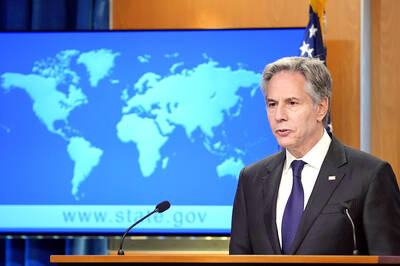
Beijing is continuing to commit genocide and crimes against humanity against Uyghurs and other Muslim minorities in its western Xinjiang province, U.S. Secretary of State Antony Blinken said in a report published on Monday, ahead of his planned visit to China this week. The State Department’s annual human rights report, which documents abuses recorded all over the world during the previous calendar year, repeated language from previous years on the treatment of Muslims in Xinjiang, but the publication raises the issue ahead of delicate talks, including on the war in Ukraine and global trade, between the top U.S. diplomat and Chinese

HYPOCRISY? The Chinese Ministry of Foreign Affairs yesterday asked whether Biden was talking about China or the US when he used the word ‘xenophobic’ US President Joe Biden on Wednesday called for a hike in steel tariffs on China, accusing Beijing of cheating as he spoke at a campaign event in Pennsylvania. Biden accused China of xenophobia, too, in a speech to union members in Pittsburgh. “They’re not competing, they’re cheating. They’re cheating and we’ve seen the damage here in America,” Biden said. Chinese steel companies “don’t need to worry about making a profit because the Chinese government is subsidizing them so heavily,” he said. Biden said he had called for the US Trade Representative to triple the tariff rates for Chinese steel and aluminum if Beijing was


 RSS
RSS