


US President George W. Bush was to head to Europe yesterday to keep pressure on Iran over its nuclear program even as North Korea threatens to divert his attention by preparing for a missile launch.
Buoyed by a wave of good news after months of grim headlines that damaged him politically, Bush was to head to Vienna for an annual US-EU summit and then to Budapest to mark the 50th anniversary of Hungary's uprising against Soviet rule.
On his 15th trip to Europe since taking office in 2001, Bush will be gone from Washington less than 63 hours, returning home late tomorrow.
In Vienna, he plans to stress that the US and Europe must stand firm in pressing Iran to suspend a uranium enrichment program in order to qualify for an incentives package aimed at containing Tehran's nuclear ambitions.
A US-backed package of incentives was offered to Iran early this month, and the US has said it will join European talks with Iran if it agrees to suspend its uranium enrichment program.
"If Iran's leaders reject our offer, it will result in action before the Security Council, further isolation from the world and progressively stronger political and economic sanctions," Bush said on Monday.
Bush's drive for sanctions is opposed by UN Security Council members China and Russia. The White House said he and Russian President Vladimir Putin agreed on the need to work together on the issue in a phone call on Monday.
Bush's task at the summit in Austria, which holds the rotating EU presidency, is to secure European support for sanctions if Iran refuses to suspend enrichment.
North Korea's apparent preparation for a test launch of a missile capable of reaching the US has given the president a new challenge.
US Secretary of State Condoleezza Rice, who is accompanying Bush on the trip, said a North Korean missile test would be a provocative act that Washington would take seriously.
Bush is likely to face more European pressure to close the Guantanamo Bay prison for terrorist suspects after the military announced on June 10 that three detainees had committed suicide.
In Vienna, authorities tightened security ahead of Bush's visit, the first by a US leader in 27 years, cordoning off central parts of the city and stationing police officers on almost every downtown corner.
Police used a remote-control robot to blow up a suitcase and at least two other suspicious packages, including one that had been taped to an electricity junction box and had wires and an antenna poking out of it.
Experts said there were no signs of explosives in the packages.

Republican US lawmakers on Friday criticized US President Joe Biden’s administration after sanctioned Chinese telecoms equipment giant Huawei unveiled a laptop this week powered by an Intel artificial intelligence (AI) chip. The US placed Huawei on a trade restriction list in 2019 for contravening Iran sanctions, part of a broader effort to hobble Beijing’s technological advances. Placement on the list means the company’s suppliers have to seek a special, difficult-to-obtain license before shipping to it. One such license, issued by then-US president Donald Trump’s administration, has allowed Intel to ship central processors to Huawei for use in laptops since 2020. China hardliners

Conjoined twins Lori and George Schappell, who pursued separate careers, interests and relationships during lives that defied medical expectations, died this month in Pennsylvania, funeral home officials said. They were 62. The twins, listed by Guinness World Records as the oldest living conjoined twins, died on April 7 at the Hospital of the University of Pennsylvania, obituaries posted by Leibensperger Funeral Homes of Hamburg said. The cause of death was not detailed. “When we were born, the doctors didn’t think we’d make 30, but we proved them wrong,” Lori said in an interview when they turned 50, the Philadelphia Inquirer reported. The
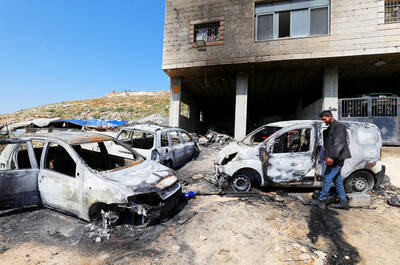
RAMPAGE: A Palestinian man was left dead after dozens of Israeli settlers searching for a missing 14-year-old boy stormed a village in the Israeli-occupied West Bank US President Joe Biden on Friday said he expected Iran to attack Israel “sooner, rather than later” and warned Tehran not to proceed. Asked by reporters about his message to Iran, Biden simply said: “Don’t,” underscoring Washington’s commitment to defend Israel. “We are devoted to the defense of Israel. We will support Israel. We will help defend Israel and Iran will not succeed,” he said. Biden said he would not divulge secure information, but said his expectation was that an attack could come “sooner, rather than later.” Israel braced on Friday for an attack by Iran or its proxies as warnings grew of
A prominent Christian leader has allegedly been stabbed at the altar during a Mass yesterday in southwest Sydney. Bishop Mar Mari Emmanuel was saying Mass at Christ The Good Shepherd Church in Wakeley just after 7pm when a man approached him at the altar and allegedly stabbed toward his head multiple times. A live stream of the Mass shows the congregation swarm forward toward Emmanuel before it was cut off. The church leader gained prominence during the COVID-19 pandemic, amassing a large online following, Officers attached to Fairfield City police area command attended a location on Welcome Street, Wakeley following reports a number


 RSS
RSS