


Murky procedures, lack of oversight and inadequate resources led to mistakes in the way US troops treated Iraqi and Afghan detainees. But two Pentagon reports, released publicly for the first time, found no widespread mistreatment or illegal actions by the military.
A human rights organization called the reports released on Friday a whitewash that ignored countless documented accounts of detainee abuse.
One report detailed several incidents involving US special operations forces in 2003-04. It said interrogators fed some Iraqi detainees only bread and water for up to 17 days, used unapproved interrogation practices such as sleep deprivation and loud music and stripped at least one prisoner.
That report concluded the detainees' treatment was wrong but not illegal and reflected inadequate resources and lack of oversight and proper guidance rather than deliberate abuse. No military personnel were punished as a result of the investigation.
The findings were included in documents the Pentagon released to the American Civil Liberties Union (ACLU) on Friday under a Freedom of Information request. They included two major reports -- one by Army Brigadier General Richard Formica on specials operations forces in Iraq and one by Brigadier General Charles Jacoby on Afghan detainees.
While some of the incidents have been reported previously and reviewed by members of Congress, this was the first time the documents were made public. Many portions of the reports were blacked out, including specific names and locations.
"Both the Formica and the Jacoby reports demonstrate that the government is really not taking the investigation of detainee abuse seriously," said Amrit Singh, an ACLU attorney.
Singh called the reports "a whitewash." In particular, she said, there have been numerous documents showing that special operations forces abused detainees, but Formica only reviewed a few cases.
Pentagon spokesman Lieutenant Colonel Mark Ballesteros said: "We've undertaken significant steps to investigate, hold people accountable and change our operations as appropriate. This is all part of our effort to be transparent and show that we investigate all allegations thoroughly, and we take them seriously."
Less than a week ago, three detainees committed suicide at the Guantanamo Bay detention facility in Cuba, highlighting accusations of abuse. A little more than two years ago, the Abu Ghraib prisoner abuse scandal in Iraq came to light, with its graphic photographs of detainees being sexually humiliated and threatened with dogs.
The US administration has been criticized internationally for abusive treatment of detainees. Late last year, Congress forced Bush to accept a ban on the cruel, inhuman or degrading treatment of prisoners by US troops.
Administration officials have said the US uses legal interrogation techniques -- not torture -- to gain information that could head off terror attacks.
The Formica review recommended better training, new standards for detention centers and updated policies for detainee operations, among other things. The final report is dated November 2004.
Formica reviewed three allegations of abuse by special operations forces who held detainees in temporary facilities, often hastily set up near where they were captured. He found that overall conditions "did not comport with the spirit of the principles set forth in the Geneva Conventions," which require humane treatment of prisoners.
For example, Formica said, the forces used five interrogation techniques that were allowed at one point but had been rescinded by then: sleep or food deprivation, yelling and loud music, forcing detainees to remain in stressful physical positions and changing environmental conditions.
Formica also said stripping prisoners "was unnecessary and inconsistent with the principles of dignity and respect" in the Geneva Conventions. And while one of the prisoners fed just bread and water appeared to be in good condition, he said, 17 days of that diet "is too long."
He said allegations of rape, sodomy and beatings were not substantiated by medical examinations and the accusers' stories changed over time and were not credible.
Jacoby was dispatched in May 2004 to examine the treatment of detainees at facilities in Afghanistan.
His report found "no systematic or widespread mistreatment of detainees," but concluded that the opportunities for mistreatment and the ever-changing battlefield there demanded changes in procedures.
He said there was "a consistent lack of knowledge" regarding the capture, processing, detention and interrogation of detainees, with different policies at facilities across the country. Jacoby also concluded that "inconsistent and unevenly applied" interrogation standards created opportunities for abuse and impeded efforts to gain timely intelligence.
So far, there have been about 600 investigations into detainee-related incidents, including natural deaths and detainee assaults on other detainees, according to Army spokesman Paul Boyce. As a result 267 soldiers have received some type of punishment, including 85 courts-martial and 95 nonjudicial actions.

Republican US lawmakers on Friday criticized US President Joe Biden’s administration after sanctioned Chinese telecoms equipment giant Huawei unveiled a laptop this week powered by an Intel artificial intelligence (AI) chip. The US placed Huawei on a trade restriction list in 2019 for contravening Iran sanctions, part of a broader effort to hobble Beijing’s technological advances. Placement on the list means the company’s suppliers have to seek a special, difficult-to-obtain license before shipping to it. One such license, issued by then-US president Donald Trump’s administration, has allowed Intel to ship central processors to Huawei for use in laptops since 2020. China hardliners

Conjoined twins Lori and George Schappell, who pursued separate careers, interests and relationships during lives that defied medical expectations, died this month in Pennsylvania, funeral home officials said. They were 62. The twins, listed by Guinness World Records as the oldest living conjoined twins, died on April 7 at the Hospital of the University of Pennsylvania, obituaries posted by Leibensperger Funeral Homes of Hamburg said. The cause of death was not detailed. “When we were born, the doctors didn’t think we’d make 30, but we proved them wrong,” Lori said in an interview when they turned 50, the Philadelphia Inquirer reported. The
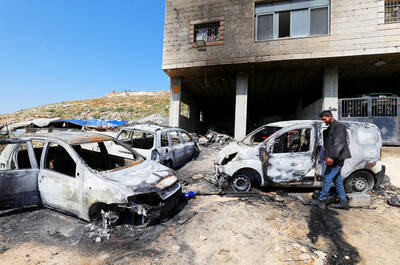
RAMPAGE: A Palestinian man was left dead after dozens of Israeli settlers searching for a missing 14-year-old boy stormed a village in the Israeli-occupied West Bank US President Joe Biden on Friday said he expected Iran to attack Israel “sooner, rather than later” and warned Tehran not to proceed. Asked by reporters about his message to Iran, Biden simply said: “Don’t,” underscoring Washington’s commitment to defend Israel. “We are devoted to the defense of Israel. We will support Israel. We will help defend Israel and Iran will not succeed,” he said. Biden said he would not divulge secure information, but said his expectation was that an attack could come “sooner, rather than later.” Israel braced on Friday for an attack by Iran or its proxies as warnings grew of

A prominent Christian leader has allegedly been stabbed at the altar during a Mass yesterday in southwest Sydney. Bishop Mar Mari Emmanuel was saying Mass at Christ The Good Shepherd Church in Wakeley just after 7pm when a man approached him at the altar and allegedly stabbed toward his head multiple times. A live stream of the Mass shows the congregation swarm forward toward Emmanuel before it was cut off. The church leader gained prominence during the COVID-19 pandemic, amassing a large online following, Officers attached to Fairfield City police area command attended a location on Welcome Street, Wakeley following reports a number


 RSS
RSS