


On the surface, Mexico's presidential election looks a lot like modern campaigns in the US, a battle of image makers wielding television advertisements, sound bites and, at times, attack ads with less truth than venom.
But in one crucial respect it is different: Mexico's referee, the powerful Federal Election Institute, has waded into the fray involving the three candidates, ruling that some television spots are too false to be on the air and others simply too rude.
It has also enforced an order of silence on Mexican President Vicente Fox, telling him not to interfere with the campaign, even to help his party's candidate.
"This council must maintain its tradition of saying yes to freedom of expression, yes to the maximum amount of criticism, but yes to criticism based on truth and yes to legitimate questions," Luis Carlos Ugalde, the president of the institute, said recently.
"We must say no to defamation, no to denigration, no to things taken out of context and to misinformation," he said.
Mexican courts have recently interpreted the broad language of the electoral law to give the institute the authority to ban any speech that besmirches a candidate's reputation or could cause a public disturbance.
A result has been the creation of an electoral referee with enormous power. The institute twice voted to cancel advertisements calling the leftist candidate -- Andres Manuel Lopez Obrador -- "a danger for Mexico," saying they were defamatory.
It has also voted to ban ads from Lopez Obrador's camp branding Felipe Calderon, the candidate backed by Fox, a liar.
Earlier this month, the Mexican election board even fined Fox's National Action Party US$14,000 for its part in encouraging Jose Maria Aznar, Spain's former prime minister, to say during a trip to Mexico in February that he would like to see Calderon win.
The Mexican Congress formed the institute in October 1990, passing a new electoral law designed to eliminate the fraud that had marred past elections.
Lawmakers strengthened the institute's power several times in the 1990s, making it entirely independent of the executive branch in 1996. Those reforms enabled opposition parties to make strong gains in Congress that year and helped the first opposition-party president, Fox, to win in 2000, ending seven decades of one-party rule.
Until this year, the institute had been occupied mostly with registering voters, establishing clean balloting practices and preventing fraud. The no-holds-barred campaign, however, has led to court rulings ordering the institute to start policing the debate.
Its rulings have ignited a furious debate here about the extent of free speech and the purview of the government to curb certain electoral practices, like mudslinging.
The debate also underscores that Mexico's transition from a one-party state six years ago to a modern multiparty democracy has a peculiarly Mexican flavor experts say.
Mexicans are used to a high level of decorum from their elected officials, a vestige of a paternalistic state that ruled here for most of the 20th century. By and large, they also chafe at any hint that the president is grooming a successor, since that is precisely what happened every six years under the one-party system.
"We have a work in progress in terms of what our democracy is, and the Federal Election Institute is one of the constructors," said Rosanna Fuentes-Berain, editor of the Spanish edition of Foreign Affairs.
"We are not used to very strong and open public debate -- this is a country that for 70-odd years was basically debating things internally without witnesses," Fuentes-Berain said. "For some Mexicans it's better to keep your manners and not be too blatant about what you think of a person."
But for many, the institute has gone too far. "My position has been completely against the institute transforming itself into censors," said Sergio Sarmiento, a columnist and radio commentator.
Marco Gomez, a member of the institute's governing council, said the authority's intention was not to censor candidates but to ensure that voters received true information. He said the council was laboring to define the limits of free speech in a society that distrusts government and elections.
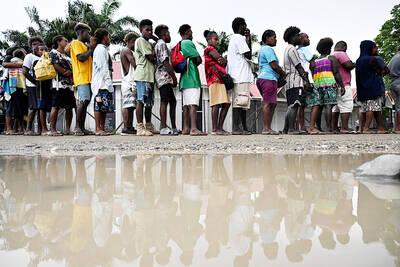
SEEKING CHANGE: A hospital worker said she did not vote in previous elections, but ‘now I can see that maybe my vote can change the system and the country’ Voting closed yesterday across the Solomon Islands in the south Pacific nation’s first general election since the government switched diplomatic allegiance from Taiwan to Beijing and struck a secret security pact that has raised fears of the Chinese navy gaining a foothold in the region. The Solomon Islands’ closer relationship with China and a troubled domestic economy weighed on voters’ minds as they cast their ballots. As many as 420,000 registered voters had their say across 50 national seats. For the first time, the national vote also coincided with elections for eight of the 10 local governments. Esther Maeluma cast her vote in the
Nearly half of China’s major cities are suffering “moderate to severe” levels of subsidence, putting millions of people at risk of flooding, especially as sea levels rise, according to a study of nationwide satellite data released yesterday. The authors of the paper, published by the journal Science, found that 45 percent of China’s urban land was sinking faster than 3mm per year, with 16 percent at more than 10mm per year, driven not only by declining water tables, but also the sheer weight of the built environment. With China’s urban population already in excess of 900 million people, “even a small portion

UNSETTLING IMAGES: The scene took place in front of TV crews covering the Trump trial, with a CNN anchor calling it an ‘emotional and unbelievably disturbing moment’ A man who doused himself in an accelerant and set himself on fire outside the courthouse where former US president Donald Trump is on trial has died, police said yesterday. The New York City Police Department (NYPD) said the man was declared dead by staff at an area hospital. The man was in Collect Pond Park at about 1:30pm on Friday when he took out pamphlets espousing conspiracy theories, tossed them around, then doused himself in an accelerant and set himself on fire, officials and witnesses said. A large number of police officers were nearby when it happened. Some officers and bystanders rushed

HYPOCRISY? The Chinese Ministry of Foreign Affairs yesterday asked whether Biden was talking about China or the US when he used the word ‘xenophobic’ US President Joe Biden on Wednesday called for a hike in steel tariffs on China, accusing Beijing of cheating as he spoke at a campaign event in Pennsylvania. Biden accused China of xenophobia, too, in a speech to union members in Pittsburgh. “They’re not competing, they’re cheating. They’re cheating and we’ve seen the damage here in America,” Biden said. Chinese steel companies “don’t need to worry about making a profit because the Chinese government is subsidizing them so heavily,” he said. Biden said he had called for the US Trade Representative to triple the tariff rates for Chinese steel and aluminum if Beijing was


 RSS
RSS