


The Palestinians' Hamas-dominated parliament mobilized yesterday to try to block President Mahmoud Abbas' efforts to hold a national referendum on a proposal that would implicitly recognize Israel's right to exist.
Hamas' charter calls for Israel's destruction, and the Hamas-led government has resisted Abbas' attempts to persuade it to endorse the proposal, which calls for the establishment of a Palestinian state alongside Israel. The referendum debate is taking place amid escalating violence between Israel and Hamas, complicating Abbas' efforts.
At the parliament session yesterday, Hamas lawmakers challenged the legality of Abbas' decree on Saturday announcing the July 26 referendum, though it was unclear they could muster the necessary two-thirds majority to shoot it down.
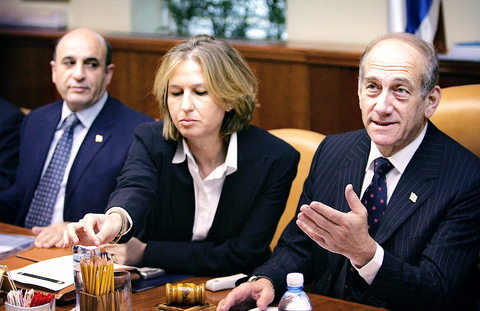
PHOTO: AP
Abbas, of the rival Fatah party, is pushing ahead with the referendum because he hopes that accepting a two-state solution would help the Palestinians to end crushing international economic sanctions against the Hamas government. He also thinks it would promote Palestinian statehood and diminish fighting between Hamas and Fatah that has killed 17 Palestinians over the past month.
Abbas announced the vote despite an explosion on a Gaza beach on Friday that killed eight civilians and inflamed passions against Israel. Palestinian said the deaths were caused by an Israeli artillery shell, but Israel has suggested its army may not be responsible and is conducting an investigation.
Abbas' referendum plans suffered a further setback on Sunday when a Hamas prisoner who co-authored the proposal withdrew his support for the document.
Abdel Khaleq Natche accused Abbas of exploiting the document for political gain. He and other Palestinian prisoners held by Israel enjoy great clout in Palestinian society.
Before the beach attack, opinion polls had shown widespread public support for the referendum. There have been no surveys since.
Israel-Palestinian violence has shot up since the beach explosion and the killing by Israel a day earlier of a senior Palestinian militant, with Hamas officially calling off a 16-month truce.
In the 24 hours that ended at noon yesterday, militants launched 39 rockets at southern Israel, causing no damage or injuries, the Israeli military said.
Military officials said Israeli Defense Minister Amir Peretz postponed a large-scale air offensive against Gaza militants for a day or two to give the Palestinians more time to stop rocket attacks from the coastal territory. The officials spoke on condition of anonymity because the talks were private.
Israel suspended its artillery fire against rocket-launching operations until it winds up its investigation of the killings on the Gaza beach.
Although the Palestinians rockets are inaccurate and often don't cause casualties, they have badly disrupted the lives of residents of Israeli towns near the Gaza.
The sharp spike in rocket attacks have led to renewed Israeli threats to assassinate Hamas's leaders.
Tzahi Hanegbi, chairman of the Israeli parliament's Foreign Affairs and Defense Committee, said yesterday that Palestinian Prime Minister Ismail Haniyeh of Hamas could become a target if he were to begin directing attacks.
Meanwhile, Israeli Prime Minister Ehud Olmert was due to meet his British counterpart, Tony Blair, in London yesterday on the opening leg of his first visit to Europe since winning a general election in March.
Olmert, who is also planning to travel to Paris, is expected to use the tour to build up support for his plan to fix Israel's borders during his four-year term of office, with or without agreement from the Palestinians.
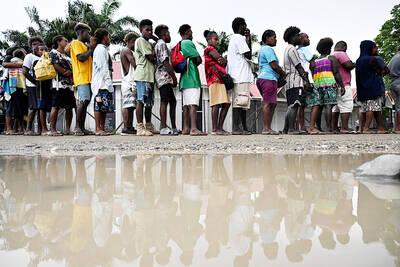
SEEKING CHANGE: A hospital worker said she did not vote in previous elections, but ‘now I can see that maybe my vote can change the system and the country’ Voting closed yesterday across the Solomon Islands in the south Pacific nation’s first general election since the government switched diplomatic allegiance from Taiwan to Beijing and struck a secret security pact that has raised fears of the Chinese navy gaining a foothold in the region. The Solomon Islands’ closer relationship with China and a troubled domestic economy weighed on voters’ minds as they cast their ballots. As many as 420,000 registered voters had their say across 50 national seats. For the first time, the national vote also coincided with elections for eight of the 10 local governments. Esther Maeluma cast her vote in the
Nearly half of China’s major cities are suffering “moderate to severe” levels of subsidence, putting millions of people at risk of flooding, especially as sea levels rise, according to a study of nationwide satellite data released yesterday. The authors of the paper, published by the journal Science, found that 45 percent of China’s urban land was sinking faster than 3mm per year, with 16 percent at more than 10mm per year, driven not only by declining water tables, but also the sheer weight of the built environment. With China’s urban population already in excess of 900 million people, “even a small portion

UNSETTLING IMAGES: The scene took place in front of TV crews covering the Trump trial, with a CNN anchor calling it an ‘emotional and unbelievably disturbing moment’ A man who doused himself in an accelerant and set himself on fire outside the courthouse where former US president Donald Trump is on trial has died, police said yesterday. The New York City Police Department (NYPD) said the man was declared dead by staff at an area hospital. The man was in Collect Pond Park at about 1:30pm on Friday when he took out pamphlets espousing conspiracy theories, tossed them around, then doused himself in an accelerant and set himself on fire, officials and witnesses said. A large number of police officers were nearby when it happened. Some officers and bystanders rushed

HYPOCRISY? The Chinese Ministry of Foreign Affairs yesterday asked whether Biden was talking about China or the US when he used the word ‘xenophobic’ US President Joe Biden on Wednesday called for a hike in steel tariffs on China, accusing Beijing of cheating as he spoke at a campaign event in Pennsylvania. Biden accused China of xenophobia, too, in a speech to union members in Pittsburgh. “They’re not competing, they’re cheating. They’re cheating and we’ve seen the damage here in America,” Biden said. Chinese steel companies “don’t need to worry about making a profit because the Chinese government is subsidizing them so heavily,” he said. Biden said he had called for the US Trade Representative to triple the tariff rates for Chinese steel and aluminum if Beijing was


 RSS
RSS