


US schools are considering emulating math and science teaching systems in Asia that produce better results, amid concerns over a drop in performance of US students in the two key subjects.
Average US math scores trail significantly behind nearly all countries in the Asia Pacific region, studies show.
Adding urgency to this finding is a recently released annual US education report which found that US middle and high school students have shown no improvement in science over the past five years.
"There are grave concerns in the United States about the quality of math and science education in American schools," said a new report by experts at The Asia Society, a US-based institution striving to bridge the US-Asia gap.
It outlined ways in which China, and East Asia more broadly, have been successful in producing higher student achievement in math and science and underlined the US "need to benchmark best practices wherever we can find them."
Many of the successful Asian education systems were seen to have strong core curricula, rigorous teacher preparation, examinations that motivate students and schools that were intensely academically focused.
"The United States can no more afford to isolate itself educationally than it can economically or in terms of national security," said the report compiled after a forum between education leaders from the US and China, and based on research on Asian achievement in math and science.
The report, which largely focused on China's education system, said the country was bound by national standards in math and science, which drove coherent textbook content, teacher preparation and professional development.
In the US, there is a great deal of variation in the rigor and quality of standards across educational jurisdictions, it said.
In China, far higher proportions of science and math teachers have degrees in their disciplines than their US counterparts.
Specialist science teachers are employed to teach students as early as third grade (eight years old), unlike in the US where most primary teachers are "generalists" typically responsible for all subjects.
In China, biology, chemistry, physics, algebra and geometry are mandatory for completion of high school, the report said.
It was also noted that math and science play major roles in entrance exams for Chinese universities.
Other differences: the Chinese school year is a month longer at the secondary level than US schools and overall Chinese students spend twice as many hours studying as their US peers.
The report cited a survey, "Trends in International Mathematics and Science Study," which showed the US trailing Japan, Hong Kong, Taiwan, Singapore, South Korea and Australia for average maths score in the eighth grade.
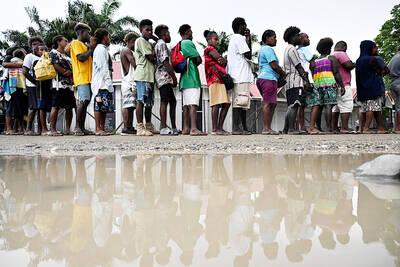
SEEKING CHANGE: A hospital worker said she did not vote in previous elections, but ‘now I can see that maybe my vote can change the system and the country’ Voting closed yesterday across the Solomon Islands in the south Pacific nation’s first general election since the government switched diplomatic allegiance from Taiwan to Beijing and struck a secret security pact that has raised fears of the Chinese navy gaining a foothold in the region. The Solomon Islands’ closer relationship with China and a troubled domestic economy weighed on voters’ minds as they cast their ballots. As many as 420,000 registered voters had their say across 50 national seats. For the first time, the national vote also coincided with elections for eight of the 10 local governments. Esther Maeluma cast her vote in the
Nearly half of China’s major cities are suffering “moderate to severe” levels of subsidence, putting millions of people at risk of flooding, especially as sea levels rise, according to a study of nationwide satellite data released yesterday. The authors of the paper, published by the journal Science, found that 45 percent of China’s urban land was sinking faster than 3mm per year, with 16 percent at more than 10mm per year, driven not only by declining water tables, but also the sheer weight of the built environment. With China’s urban population already in excess of 900 million people, “even a small portion

UNSETTLING IMAGES: The scene took place in front of TV crews covering the Trump trial, with a CNN anchor calling it an ‘emotional and unbelievably disturbing moment’ A man who doused himself in an accelerant and set himself on fire outside the courthouse where former US president Donald Trump is on trial has died, police said yesterday. The New York City Police Department (NYPD) said the man was declared dead by staff at an area hospital. The man was in Collect Pond Park at about 1:30pm on Friday when he took out pamphlets espousing conspiracy theories, tossed them around, then doused himself in an accelerant and set himself on fire, officials and witnesses said. A large number of police officers were nearby when it happened. Some officers and bystanders rushed

HYPOCRISY? The Chinese Ministry of Foreign Affairs yesterday asked whether Biden was talking about China or the US when he used the word ‘xenophobic’ US President Joe Biden on Wednesday called for a hike in steel tariffs on China, accusing Beijing of cheating as he spoke at a campaign event in Pennsylvania. Biden accused China of xenophobia, too, in a speech to union members in Pittsburgh. “They’re not competing, they’re cheating. They’re cheating and we’ve seen the damage here in America,” Biden said. Chinese steel companies “don’t need to worry about making a profit because the Chinese government is subsidizing them so heavily,” he said. Biden said he had called for the US Trade Representative to triple the tariff rates for Chinese steel and aluminum if Beijing was


 RSS
RSS