


Brazilian lawmakers visited a high-security prison to question a jailed gang leader, seeking answers to whether leaks from a secret congressional session on prison transfers sparked violence that killed nearly 200 people last month in Sao Paulo.
Reporters were not allowed to be present on Thursday while a congressional panel questioned Marcos Willians Herbas Camacho, known as Marcola, who is suspected of having ordered the attacks.
Photographers saw Camacho -- leader of the notorious First Capital Command organized-crime group, better known by its Portuguese initials PCC -- led into the room in handcuffs by two prison guards immediately before the closed-door session began.
The PCC on May 12 unleashed a weeklong killing spree in and around Brazil's largest city that included uprisings in more than 70 prisons and attacks against police stations with grenades and automatic weapons. The attacks were triggered after authorities sought to transfer PCC leaders to remote lockdowns.
The lawmakers said they hoped to find out if Camacho was tipped off to the planned police crackdown against his group. Maria Cristina Rachado and Sergio Wesley da Cunha, two of the gang's lawyers, allegedly bought a tape of police telling lawmakers of their plans two days before the attacks began.
Rachado and da Cunha, who deny any wrongdoing, have been ordered to turn in their passports pending an investigation.
The legislators were also investigating whether the PCC leader, currently held in the Presidente Bernardes state penitentiary, 540km west of Sao Paulo, had negotiated an end to the violence with Sao Paulo city and state authorities.
After five hours of questioning, the lawmakers left the prison without revealing any details of the interview.
Led by congressman Moroni Torgan, the nine-member congressional panel also is examining PCC's alleged involvement in arms trafficking.
Camacho "is the leader of a gang that has had ample access to contraband weapons," Raul Jungmann, a member of the investigative commission, told the O Estado de Sao Paulo newspaper. "We want to know the route used to traffic these weapons and the PCC's connection to national and international arms trafficking gangs."
Outside the penitentiary, some 30 prison guards dressed as clowns protested what they said were "insecure and precarious working conditions."
"The clown outfits were to underscore the fact that we are treated like clowns and not like professional prison guards," Joao Ferreira da Silva, of the Sao Paulo State Prison Guards Union, said by telephone.
Nearly half of China’s major cities are suffering “moderate to severe” levels of subsidence, putting millions of people at risk of flooding, especially as sea levels rise, according to a study of nationwide satellite data released yesterday. The authors of the paper, published by the journal Science, found that 45 percent of China’s urban land was sinking faster than 3mm per year, with 16 percent at more than 10mm per year, driven not only by declining water tables, but also the sheer weight of the built environment. With China’s urban population already in excess of 900 million people, “even a small portion

UNSETTLING IMAGES: The scene took place in front of TV crews covering the Trump trial, with a CNN anchor calling it an ‘emotional and unbelievably disturbing moment’ A man who doused himself in an accelerant and set himself on fire outside the courthouse where former US president Donald Trump is on trial has died, police said yesterday. The New York City Police Department (NYPD) said the man was declared dead by staff at an area hospital. The man was in Collect Pond Park at about 1:30pm on Friday when he took out pamphlets espousing conspiracy theories, tossed them around, then doused himself in an accelerant and set himself on fire, officials and witnesses said. A large number of police officers were nearby when it happened. Some officers and bystanders rushed
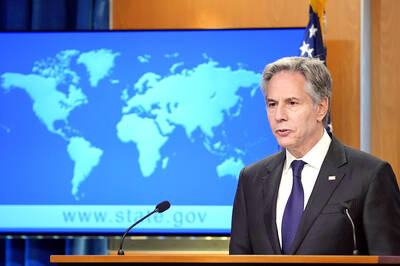
Beijing is continuing to commit genocide and crimes against humanity against Uyghurs and other Muslim minorities in its western Xinjiang province, U.S. Secretary of State Antony Blinken said in a report published on Monday, ahead of his planned visit to China this week. The State Department’s annual human rights report, which documents abuses recorded all over the world during the previous calendar year, repeated language from previous years on the treatment of Muslims in Xinjiang, but the publication raises the issue ahead of delicate talks, including on the war in Ukraine and global trade, between the top U.S. diplomat and Chinese
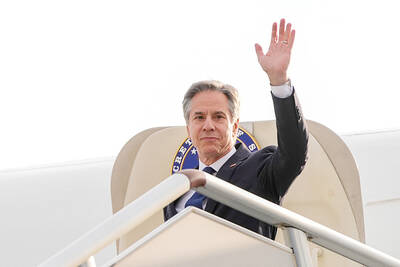
‘IN A DIFFERENT PLACE’: The envoy first visited Shanghai, where he attended a Chinese basketball playoff match, and is to meet top officials in Beijing tomorrow US Secretary of State Antony Blinken yesterday arrived in China on his second visit in a year as the US ramps up pressure on its rival over its support for Russia while also seeking to manage tensions with Beijing. The US diplomat tomorrow is to meet China’s top brass in Beijing, where he is also expected to plead for restraint as Taiwan inaugurates president-elect William Lai (賴清德), and to raise US concerns on Chinese trade practices. However, Blinken is also seeking to stabilize ties, with tensions between the world’s two largest economies easing since his previous visit in June last year. At the


 RSS
RSS