


The UN Security Council has arrived in Sudan with assurances that the UN has no intention of taking over the country and sees the government as a partner in promoting peace.
The government has been very reluctant to allow a UN peacekeeping force to take over from the 7,000-strong African Union force now in conflict-wracked Darfur, and fears of UN intervention were fueled last month when a council resolution to spur planning for a handover was adopted under Chapter 7 of the UN Charter, which allows military action.
Britain's UN ambassador Emyr Jones Parry, who is leading the council mission, said shortly after the delegation arrived at a Khartoum hotel late on Monday that he recognized some Sudanese "took amiss" the last council resolution, which they had hoped would pay tribute to the government for signing a peace agreement with the largest rebel faction in Darfur.
The UN has become increasingly involved in Sudan since November 2003 -- following the eruption of the Darfur conflict -- and is running a massive humanitarian operation in the vast western region as well as a 10,000-strong UN peacekeeping operation to monitor the peace agreement of January last year that ended a 21-year civil war.
At least 180,000 people have been killed and more than 2 million displaced in Darfur since rebel groups made up of ethnic Africans rose up against the Arab-led Khartoum government in early 2003. The government is accused of responding by unleashing Arab militias known as the Janjaweed who have been accused of some of the worst atrocities -- but it denies any involvement.
Jones Parry said the UN was involved in Sudan "because of the responsibility of the international community to alleviate hardship, to avoid the atrocities and so on."
"We're doing it in support of the people of Sudan. We're not doing it for any takeover. We're doing it with the government of Sudan all the time, and we're not seeking in any way to usurp the powers of the government of Sudan," he said.
But many Sudanese feel otherwise, in varying degrees.
An editorial on Monday in the independent opposition paper Rae Al Shaab, called the Security Council mission "a visit by an unwelcome guest."
An editorial in Al-Intibaha, a hard-line daily supporting Sudan's Muslim-dominated north, was entitled "No Welcome for UN Security Council."
"The visit of the council is meant to be a full international siege, a load on the chest of the Sudanese people and a continuation of the pressure to dispatch yet more foreign troops to Darfur, nothing else, nothing more," Rae Al Shaab said.

Republican US lawmakers on Friday criticized US President Joe Biden’s administration after sanctioned Chinese telecoms equipment giant Huawei unveiled a laptop this week powered by an Intel artificial intelligence (AI) chip. The US placed Huawei on a trade restriction list in 2019 for contravening Iran sanctions, part of a broader effort to hobble Beijing’s technological advances. Placement on the list means the company’s suppliers have to seek a special, difficult-to-obtain license before shipping to it. One such license, issued by then-US president Donald Trump’s administration, has allowed Intel to ship central processors to Huawei for use in laptops since 2020. China hardliners
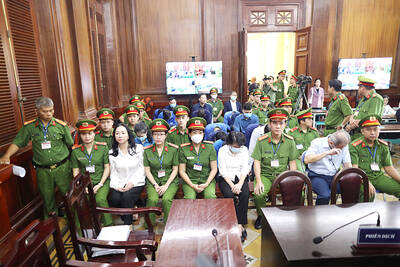
A top Vietnamese property tycoon was on Thursday sentenced to death in one of the biggest corruption cases in history, with an estimated US$27 billion in damages. A panel of three hand-picked jurors and two judges rejected all defense arguments by Truong My Lan, chair of major developer Van Thinh Phat, who was found guilty of swindling cash from Saigon Commercial Bank (SCB) over a decade. “The defendant’s actions ... eroded people’s trust in the leadership of the [Communist] Party and state,” read the verdict at the trial in Ho Chi Minh City. After the five-week trial, 85 others were also sentenced on

Conjoined twins Lori and George Schappell, who pursued separate careers, interests and relationships during lives that defied medical expectations, died this month in Pennsylvania, funeral home officials said. They were 62. The twins, listed by Guinness World Records as the oldest living conjoined twins, died on April 7 at the Hospital of the University of Pennsylvania, obituaries posted by Leibensperger Funeral Homes of Hamburg said. The cause of death was not detailed. “When we were born, the doctors didn’t think we’d make 30, but we proved them wrong,” Lori said in an interview when they turned 50, the Philadelphia Inquirer reported. The

RAMPAGE: A Palestinian man was left dead after dozens of Israeli settlers searching for a missing 14-year-old boy stormed a village in the Israeli-occupied West Bank US President Joe Biden on Friday said he expected Iran to attack Israel “sooner, rather than later” and warned Tehran not to proceed. Asked by reporters about his message to Iran, Biden simply said: “Don’t,” underscoring Washington’s commitment to defend Israel. “We are devoted to the defense of Israel. We will support Israel. We will help defend Israel and Iran will not succeed,” he said. Biden said he would not divulge secure information, but said his expectation was that an attack could come “sooner, rather than later.” Israel braced on Friday for an attack by Iran or its proxies as warnings grew of


 RSS
RSS