


Canada's Federal Court has stayed the deportation of one of China's most-wanted men after the alleged smuggling kingpin claimed in a last-ditch appeal he would be tortured or executed if returned to his homeland.
Justice Carolyn Layden-Stevenson on Thursday ordered that Lai Changxing (
Lai can launch further appeals of his deportation order -- a process likely to take months.
Chinese authorities accuse Lai of masterminding a Xiamen-based network that smuggled as much as US$10 billion in goods with the protection of corrupt government officials. Beijing claims the smuggled goods included cigarettes, vehicles, heating and cooking oil, textiles, chemicals and other raw materials.
He has been described in Chinese news reports as the country's No. 1 fugitive.
"I'm very happy and feel good about the fair Canadian legal system," Lai said through an interpreter. "It seems that Canada is providing protection to me."
The Chinese Foreign Ministry had no immediate comment yesterday morning on the ruling.
Lai, his wife Tsang Mingna and their three children fled China and arrived in Canada in 1999, and then applied for asylum.
They said the refugee board that initially turned down their asylum claim overlooked the nature of political persecution in China.
Lai was scheduled to be deported May 26 but won an appeal. While remaining under house arrest in Vancouver, his lawyers argued in court Wednesday that Lai would surely face torture or execution if forced to return home.
Lai's lawyer, David Matas, argued before Layden-Stevenson that Ottawa was putting more emphasis on diplomatic relations with China than on the rights of his client.
Layden-Stevenson said in her ruling there appeared to be no guarantees that Lai would not face danger or torture if deported.
"The issue of the assurances lies at the heart of the debate," she wrote. "Absent the assurances, the records disclose credible evidence that a serious likelihood of jeopardy to life or safety exists. Removal at this time would cause Mr Lai to face the risk that he alleges is present."
Canadian authorities are technically bound by laws that protect refugees from being deported to countries whose judicial systems apply torture.
Esta Resnick, a lawyer for Canada's federal immigration agency, argued before the court on Wednesday.
"This is a case of a common criminal fugitive from justice, nothing more," she said. "He's asking you to reweigh evidence that was already heard before these various courts and tribunals. The public interest favors enforcement of the law."
Lai's bid for refugee status has already been denied all the way up to the Supreme Court of Canada.

Republican US lawmakers on Friday criticized US President Joe Biden’s administration after sanctioned Chinese telecoms equipment giant Huawei unveiled a laptop this week powered by an Intel artificial intelligence (AI) chip. The US placed Huawei on a trade restriction list in 2019 for contravening Iran sanctions, part of a broader effort to hobble Beijing’s technological advances. Placement on the list means the company’s suppliers have to seek a special, difficult-to-obtain license before shipping to it. One such license, issued by then-US president Donald Trump’s administration, has allowed Intel to ship central processors to Huawei for use in laptops since 2020. China hardliners
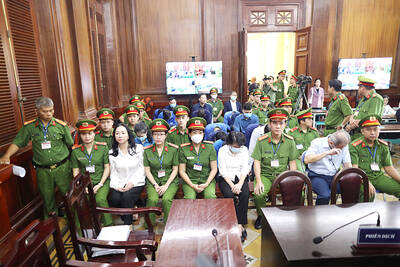
A top Vietnamese property tycoon was on Thursday sentenced to death in one of the biggest corruption cases in history, with an estimated US$27 billion in damages. A panel of three hand-picked jurors and two judges rejected all defense arguments by Truong My Lan, chair of major developer Van Thinh Phat, who was found guilty of swindling cash from Saigon Commercial Bank (SCB) over a decade. “The defendant’s actions ... eroded people’s trust in the leadership of the [Communist] Party and state,” read the verdict at the trial in Ho Chi Minh City. After the five-week trial, 85 others were also sentenced on

‘DELUSIONAL’: Targeting the families of Hamas’ leaders would not push the group to change its position or to give up its demands for Palestinians, Ismail Haniyeh said Israeli aircraft on Wednesday killed three sons of Hamas’ top political leader in the Gaza Strip, striking high-stakes targets at a time when Israel is holding delicate ceasefire negotiations with the militant group. Hamas said four of the leader’s grandchildren were also killed. Ismail Haniyeh’s sons are among the highest-profile figures to be killed in the war so far. Israel said they were Hamas operatives, and Haniyeh accused Israel of acting in “the spirit of revenge and murder.” The deaths threatened to strain the internationally mediated ceasefire talks, which appeared to gain steam in recent days even as the sides remain far

The Taliban’s reclusive supreme leader made a rare public appearance yesterday, an Afghan government spokesman said, leading thousands of worshipers in prayers marking Eid al-Fitr. Hibatullah Akhundzada has made only a handful of public appearances since inheriting the leadership of the Taliban in 2016 and leading the movement back to power with the withdrawal of US forces in 2021. Taliban government spokesman Zabihullah Mujahid said prayer in the largest mosque in Kandahar was “performed under the leadership of the supreme leader.” In a statement on X, he said the early-morning service “was attended by thousands of compatriots” in the southern province considered the


 RSS
RSS