


Investigators say that engine problems were to blame for leaving adrift a boat packed with Europe-bound African migrants that floated for four months across the Atlantic to the Caribbean Sea off the island of Barbados, a voyage with no survivors.
Found on April 29 by a fisherman, the boat contained the bodies of 11 young men who were virtually mummified by the sun and salt spray, while other passengers were apparently lost at sea.
The boat's engine was not working -- although there was still diesel in it -- and there was evidence that someone had tried to repair it, said Colvin Bishop, assistant police superintendent in Barbados, on Thursday.
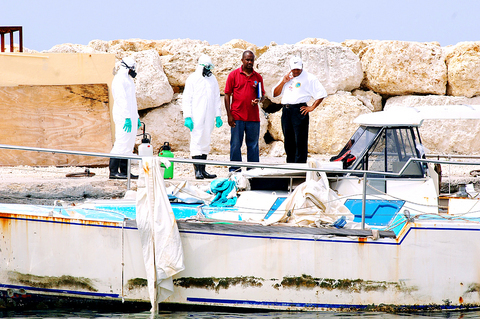
PHOTO: AP
Meanwhile, in Spain, police said that authorities have launched two investigations.
The first was begun by Interior Ministry police in Barcelona on a complaint by El-Hadji Sano, a Senegalese man living in the city whose brother Malang Sano was believed to have died on the boat trip. Another investigation is under way in the Canary Islands.
"I want to know what happened," Sano said. "I want justice. Many people have died. They left people in the middle of the sea as if they were animals, and that cannot happen."
The would-be migrants allegedly paid 1,400 euros (US$1,800) each to reach Spain, said Barbados police spokesman Barry Hunte. Spanish authorities were seeking a Spanish man they believe organized the trip, the Spanish newspaper El Pais has reported.
Barbadian authorities believe 52 Africans were aboard the rusty 6m boat and that it left Senegal on Christmas Eve in a bid to reach Europe. Instead, the boat drifted more than 3,200km west across the Atlantic.
It is unclear where all the passengers were from, though officials presume they were Senegalese, Barbados Attorney General Dale Marshall said.
An Interpol team has examined the boat and the bodies, which have been moved to a Barbados funeral home. Barbados has asked for fingerprint experts, pathologists and a dentist to investigate further, Marshall said.
For his part, Sano said he will continue to seek justice for his brother.
"I think of my brother all the time ... and every time I think about what happened I get very angry," he said.
With transit routes to Europe through Morocco being gradually sealed, migrants are taking to the seas farther down the coast of northwest Africa, some traveling in overcrowded fishing boats more than 1,600km in stages to reach Europe.
The boats often get lost or break down, drifting helplessly in the Atlantic or capsizing in rough seas.
Authorities on the Canary Islands say they have intercepted nearly 7,000 migrants since January, compared to 4,751 last year.
More than 1,000 are believed to have perished attempting the journey from Africa to the Canary Islands since December, according to the Red Cross in Mauritania, a favored departure point for the boats.
Ismaila Diallo, of the Casamance region in southern Senegal, said his 19-year-old brother died last year traveling on a boat that sunk as it headed to the Canary Islands. Weeks passed before the family learned he had died.
"It's horrible. When we heard about the death of my brother, it was unbelievable," he said. "I didn't think he was going to die in this way."
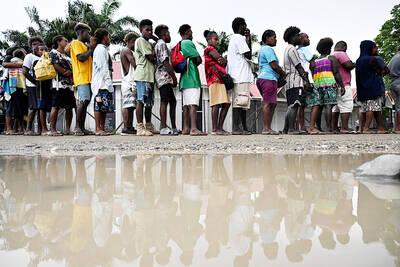
SEEKING CHANGE: A hospital worker said she did not vote in previous elections, but ‘now I can see that maybe my vote can change the system and the country’ Voting closed yesterday across the Solomon Islands in the south Pacific nation’s first general election since the government switched diplomatic allegiance from Taiwan to Beijing and struck a secret security pact that has raised fears of the Chinese navy gaining a foothold in the region. The Solomon Islands’ closer relationship with China and a troubled domestic economy weighed on voters’ minds as they cast their ballots. As many as 420,000 registered voters had their say across 50 national seats. For the first time, the national vote also coincided with elections for eight of the 10 local governments. Esther Maeluma cast her vote in the
Nearly half of China’s major cities are suffering “moderate to severe” levels of subsidence, putting millions of people at risk of flooding, especially as sea levels rise, according to a study of nationwide satellite data released yesterday. The authors of the paper, published by the journal Science, found that 45 percent of China’s urban land was sinking faster than 3mm per year, with 16 percent at more than 10mm per year, driven not only by declining water tables, but also the sheer weight of the built environment. With China’s urban population already in excess of 900 million people, “even a small portion

UNSETTLING IMAGES: The scene took place in front of TV crews covering the Trump trial, with a CNN anchor calling it an ‘emotional and unbelievably disturbing moment’ A man who doused himself in an accelerant and set himself on fire outside the courthouse where former US president Donald Trump is on trial has died, police said yesterday. The New York City Police Department (NYPD) said the man was declared dead by staff at an area hospital. The man was in Collect Pond Park at about 1:30pm on Friday when he took out pamphlets espousing conspiracy theories, tossed them around, then doused himself in an accelerant and set himself on fire, officials and witnesses said. A large number of police officers were nearby when it happened. Some officers and bystanders rushed

HYPOCRISY? The Chinese Ministry of Foreign Affairs yesterday asked whether Biden was talking about China or the US when he used the word ‘xenophobic’ US President Joe Biden on Wednesday called for a hike in steel tariffs on China, accusing Beijing of cheating as he spoke at a campaign event in Pennsylvania. Biden accused China of xenophobia, too, in a speech to union members in Pittsburgh. “They’re not competing, they’re cheating. They’re cheating and we’ve seen the damage here in America,” Biden said. Chinese steel companies “don’t need to worry about making a profit because the Chinese government is subsidizing them so heavily,” he said. Biden said he had called for the US Trade Representative to triple the tariff rates for Chinese steel and aluminum if Beijing was


 RSS
RSS