


Widespread violence eased on Tuesday after five days of attacks on police headquarters, buses and public buildings that paralyzed South America's largest city and left 115 people dead.
But recriminations against the police and the way they handled the attacks are intensifying, fed by indications that irate officers may have sought revenge with a killing rampage that swept up lawbreakers and innocent civilians alike.
"It is barbarity against barbarity, truculence against truculence, firepower against firepower," a group of 10 prominent lawyers, law professors and bar association leaders complained in a recent statement. "Down this path, only chaos can be sowed."
The underlying cause of the outbreak is what political leaders, lawyers and human rights groups describe as endemic corruption and brutality in law enforcement agencies and prisons.
Gangs depend, for example, on cellphones, which are banned in prisons. But the authorities estimate that more than 1,200 of them are circulating in the Sao Paulo prisons, smuggled in by relatives and lawyers, with the complicity of poorly paid prison guards willing to accept bribes.
The news media here said the violence had ceased after the overwhelmed police met on Sunday with the leader of the powerful organized crime group that orchestrated the onslaught, who was reported to have ordered a truce by cellphone from his prison cell.
But both sides later denied striking any deal.
"The government did not submit to any demands of requests," Marco Antonio Desgualdo, director general of the state's civil police force, said in an interview on Tuesday.
Government officials also dismissed local press reports that the police had used the crisis to kill suspects they had previously singled out as gang members.
A police crackdown during the battles led to the arrest of more than 100 suspected gang members and the killing of 71.
While most of the dead were suspected of being criminals, some 40 police officers were also killed and the scale of the fighting has prompted many to question an already shaky faith in the public security forces.
Residents and security experts also criticized police and Sao Paulo's state government, which, they say, was unprepared to manage the crisis and turned away help to avoid political embarrassment.

Republican US lawmakers on Friday criticized US President Joe Biden’s administration after sanctioned Chinese telecoms equipment giant Huawei unveiled a laptop this week powered by an Intel artificial intelligence (AI) chip. The US placed Huawei on a trade restriction list in 2019 for contravening Iran sanctions, part of a broader effort to hobble Beijing’s technological advances. Placement on the list means the company’s suppliers have to seek a special, difficult-to-obtain license before shipping to it. One such license, issued by then-US president Donald Trump’s administration, has allowed Intel to ship central processors to Huawei for use in laptops since 2020. China hardliners

Conjoined twins Lori and George Schappell, who pursued separate careers, interests and relationships during lives that defied medical expectations, died this month in Pennsylvania, funeral home officials said. They were 62. The twins, listed by Guinness World Records as the oldest living conjoined twins, died on April 7 at the Hospital of the University of Pennsylvania, obituaries posted by Leibensperger Funeral Homes of Hamburg said. The cause of death was not detailed. “When we were born, the doctors didn’t think we’d make 30, but we proved them wrong,” Lori said in an interview when they turned 50, the Philadelphia Inquirer reported. The
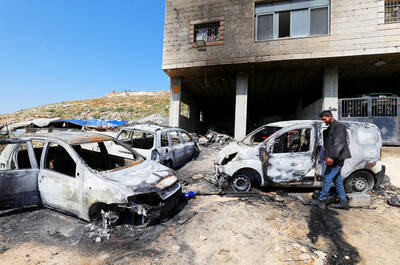
RAMPAGE: A Palestinian man was left dead after dozens of Israeli settlers searching for a missing 14-year-old boy stormed a village in the Israeli-occupied West Bank US President Joe Biden on Friday said he expected Iran to attack Israel “sooner, rather than later” and warned Tehran not to proceed. Asked by reporters about his message to Iran, Biden simply said: “Don’t,” underscoring Washington’s commitment to defend Israel. “We are devoted to the defense of Israel. We will support Israel. We will help defend Israel and Iran will not succeed,” he said. Biden said he would not divulge secure information, but said his expectation was that an attack could come “sooner, rather than later.” Israel braced on Friday for an attack by Iran or its proxies as warnings grew of
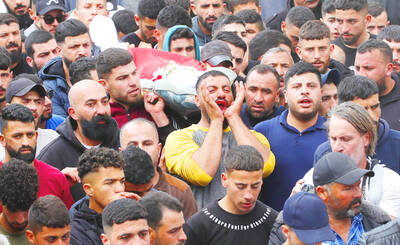
IN PURSUIT: Israel’s defense minister said the revenge attacks by Israeli settlers would make it difficult for security forces to find those responsible for the 14-year-old’s death Israeli Prime Minister Benjamin Netanyahu on Saturday condemned the “heinous murder” of an Israeli teenager in the occupied West Bank as attacks on Palestinian villages intensified following news of his death. After Benjamin Achimeir, 14, was reported missing near Ramallah on Friday, hundreds of Jewish settlers backed by Israeli forces raided nearby Palestinian villages, torching vehicles and homes, leaving at least one villager dead and dozens wounded. The attacks escalated in several villages on Saturday after Achimeir’s body was found near the Malachi Hashalom outpost. Agence France-Presse correspondents saw smoke rising from burned houses and fields. Mayor Amin Abu Alyah, of the


 RSS
RSS