


Britain's largest lecturers' union on Monday voted in favor of a boycott of Israeli lecturers and academic institutions who do not publicly dissociate themselves from Israel's "apartheid policies."
Delegates at the annual conference of the National Association of Teachers in Further and Higher Education (NATFHE) in Blackpool narrowly backed the proposal, despite mounting international pressure from those opposed to a boycott, including a petition from more than 5,000 academics and a plea from the Israeli government.
The decision was greeted with disappointment and anger by anti-boycott campaigners last night, but Palestinian groups issued declarations of support.
Presented on the final day of the conference, the motion criticized "Israeli apartheid policies, including construction of the exclusion wall, and discriminatory educational practices" and invited members to "consider the appropriateness of a boycott of those that do not publicly dissociate themselves from such policies."
After failed efforts to prevent the debate, speakers outlined the litany of difficulties experienced by Palestinian students and lecturers living under occupation, including the number of Palestinian schools shelled by the Israeli army.
"The majority of Israeli academics are either complicit or acquiescent in their government's policies in the occupied territories," said Tom Hickey, a philosophy lecturer from the University of Brighton, member of the union's national executive committee and proposer of the motion. "Turning a blind eye to what an Israeli colleague thinks about the actions of their government is a culpable blindness."
Aharon Ben-Ze'ev of Haifa university said he was "very disappointed," adding: "This ... will only serve to impede the peace process and strengthen extremism on both sides. I never say to British colleagues if you don't subscribe to my beliefs I will boycott you."
The Palestinian Campaign for the Academic and Cultural Boycott of Israel sent its support, saying British academics had "proved once again that they are up to the challenge of meeting injustice."
Stephen Rose of the British Committee for the Universities of Palestine said he was delighted, adding: "We recognize that this has not been an easy decision faced with the extreme pressure put upon the union by outside forces."
He said the vote was "a historic step forward" in "helping persuade our Israeli academic colleagues that it is time to cease silent complicity with the illegal acts of the Israeli state."
But he warned that this was likely to be the start rather than the end of the debate.
"I expect those people who oppose it to mobilize on UK campuses and around the world in the weeks ahead," he said.
Nearly half of China’s major cities are suffering “moderate to severe” levels of subsidence, putting millions of people at risk of flooding, especially as sea levels rise, according to a study of nationwide satellite data released yesterday. The authors of the paper, published by the journal Science, found that 45 percent of China’s urban land was sinking faster than 3mm per year, with 16 percent at more than 10mm per year, driven not only by declining water tables, but also the sheer weight of the built environment. With China’s urban population already in excess of 900 million people, “even a small portion

UNSETTLING IMAGES: The scene took place in front of TV crews covering the Trump trial, with a CNN anchor calling it an ‘emotional and unbelievably disturbing moment’ A man who doused himself in an accelerant and set himself on fire outside the courthouse where former US president Donald Trump is on trial has died, police said yesterday. The New York City Police Department (NYPD) said the man was declared dead by staff at an area hospital. The man was in Collect Pond Park at about 1:30pm on Friday when he took out pamphlets espousing conspiracy theories, tossed them around, then doused himself in an accelerant and set himself on fire, officials and witnesses said. A large number of police officers were nearby when it happened. Some officers and bystanders rushed
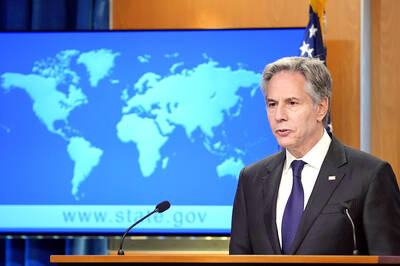
Beijing is continuing to commit genocide and crimes against humanity against Uyghurs and other Muslim minorities in its western Xinjiang province, U.S. Secretary of State Antony Blinken said in a report published on Monday, ahead of his planned visit to China this week. The State Department’s annual human rights report, which documents abuses recorded all over the world during the previous calendar year, repeated language from previous years on the treatment of Muslims in Xinjiang, but the publication raises the issue ahead of delicate talks, including on the war in Ukraine and global trade, between the top U.S. diplomat and Chinese

HYPOCRISY? The Chinese Ministry of Foreign Affairs yesterday asked whether Biden was talking about China or the US when he used the word ‘xenophobic’ US President Joe Biden on Wednesday called for a hike in steel tariffs on China, accusing Beijing of cheating as he spoke at a campaign event in Pennsylvania. Biden accused China of xenophobia, too, in a speech to union members in Pittsburgh. “They’re not competing, they’re cheating. They’re cheating and we’ve seen the damage here in America,” Biden said. Chinese steel companies “don’t need to worry about making a profit because the Chinese government is subsidizing them so heavily,” he said. Biden said he had called for the US Trade Representative to triple the tariff rates for Chinese steel and aluminum if Beijing was


 RSS
RSS