


Mbene Ndiaye says she doesn't know how she'll continue to pay the US$5 a day it costs to keep her four-year-old at the Senegalese hospital that diagnosed his kidney disease.
She's a single mother and she's already borrowing from her parents. She says it would be possible if the charge were just lower -- US$3 a day she could do.
An international aid group called yesterday for rich countries to help Africa abolish such health care fees -- removing token payments that Save the Children says do little to defray the cost of care and often prevent poor families from seeking medical attention.
The charity and advocacy organization said the fees -- encouraged by international donors as a way to offset costs and improve access to care -- fund less than 5 percent of public health services in Africa and sharply increase administrative costs.
"At the same time, when fees have been introduced, take-up of health services has dropped, typically by 40-50 percent," the group wrote in a report. Save the Children said the fees keep many from even entering a clinic, preventing doctors from catching treatable diseases before they become life-threatening.
"Most parents take their children to the hospital when they are almost dying and when they come they expect the doctor to perform miracles," said Christian Pratt, a physician in Sierra Leone's capital of Freetown.
Sierra Leone has the highest infant mortality rates in the world, according to a UNICEF report.
Pratt said he typically treats children for diseases such as typhoid, meningitis, respiratory infections and pneumonia -- conditions that are easily treated if caught early.
Still, an official at Dakar's children's hospital argued that the fees help instill people with a larger sense of responsibility and said that even the smallest fees can help fund hospitals in cash-strapped developing countries.
"The role the state should have is to raise the consciousness of the population so that they take responsibility for their own care," said Demba Sow, chief of nursing at the Albert Royer children's hospital in Dakar. Sow said only a minority of patients cannot pay the fees, and said his hospital never turns away a patient. Ndiaye, for example, was being helped by the hospital's social services arm.
Yet Save the Children said the fees are prohibitively high for the poorest of Africa. Senegal's per capita income is less than US$700 a year, and a while malaria drugs cost less than US$5 in Sierra Leone, the report said that equals about 14 days pay on an average salary.
In Liberia, which has experimented with removing health care fees, other financial constraints still make health care access difficult, doctors say.
"Even when clinics make the treatment of malaria free, people still cannot go for treatment because they don't have money to pay car fares," said Joel Jones, the head of Liberia's malaria control program.
Save the Children estimated that abolishing health care fees in Africa would cost under US$1.9 billion a year and called on Group of Eight nations to help poor countries offer free health care.

Republican US lawmakers on Friday criticized US President Joe Biden’s administration after sanctioned Chinese telecoms equipment giant Huawei unveiled a laptop this week powered by an Intel artificial intelligence (AI) chip. The US placed Huawei on a trade restriction list in 2019 for contravening Iran sanctions, part of a broader effort to hobble Beijing’s technological advances. Placement on the list means the company’s suppliers have to seek a special, difficult-to-obtain license before shipping to it. One such license, issued by then-US president Donald Trump’s administration, has allowed Intel to ship central processors to Huawei for use in laptops since 2020. China hardliners

Conjoined twins Lori and George Schappell, who pursued separate careers, interests and relationships during lives that defied medical expectations, died this month in Pennsylvania, funeral home officials said. They were 62. The twins, listed by Guinness World Records as the oldest living conjoined twins, died on April 7 at the Hospital of the University of Pennsylvania, obituaries posted by Leibensperger Funeral Homes of Hamburg said. The cause of death was not detailed. “When we were born, the doctors didn’t think we’d make 30, but we proved them wrong,” Lori said in an interview when they turned 50, the Philadelphia Inquirer reported. The
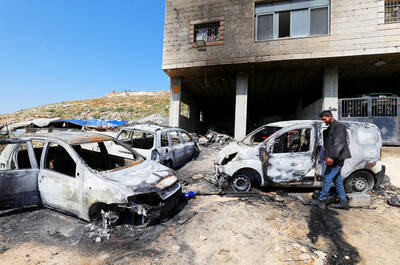
RAMPAGE: A Palestinian man was left dead after dozens of Israeli settlers searching for a missing 14-year-old boy stormed a village in the Israeli-occupied West Bank US President Joe Biden on Friday said he expected Iran to attack Israel “sooner, rather than later” and warned Tehran not to proceed. Asked by reporters about his message to Iran, Biden simply said: “Don’t,” underscoring Washington’s commitment to defend Israel. “We are devoted to the defense of Israel. We will support Israel. We will help defend Israel and Iran will not succeed,” he said. Biden said he would not divulge secure information, but said his expectation was that an attack could come “sooner, rather than later.” Israel braced on Friday for an attack by Iran or its proxies as warnings grew of
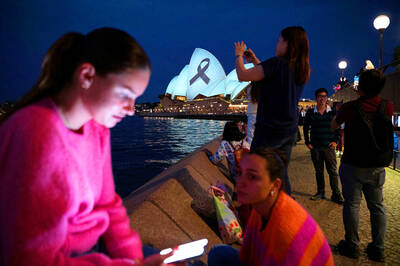
A prominent Christian leader has allegedly been stabbed at the altar during a Mass yesterday in southwest Sydney. Bishop Mar Mari Emmanuel was saying Mass at Christ The Good Shepherd Church in Wakeley just after 7pm when a man approached him at the altar and allegedly stabbed toward his head multiple times. A live stream of the Mass shows the congregation swarm forward toward Emmanuel before it was cut off. The church leader gained prominence during the COVID-19 pandemic, amassing a large online following, Officers attached to Fairfield City police area command attended a location on Welcome Street, Wakeley following reports a number


 RSS
RSS