


Police kept up running gun battles with criminals across Sao Paulo, the latest in a week of gang violence that is casting a shadow over election-year politics.
The death toll of police officers, suspected criminals and bystanders in South America's largest city rose to 170 on Thursday as police shot 14 people dead, authorities said.
Critics said President Luiz Inacio Lula da Silva has not delivered on promises to improve the lives of the poor, who have long been ruled more by heavily armed crime groups than by the government but are often subject to brutal police repression.
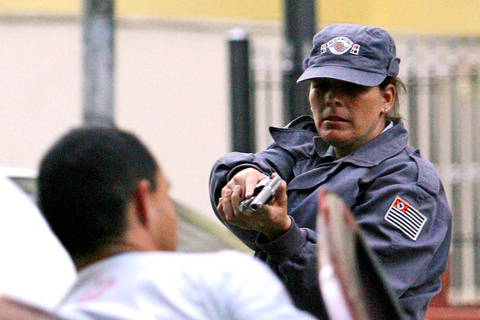
PHOTO: AFP
Silva's main opponent in October elections, former Sao Paulo state Governor Geraldo Alckmin, is also taking heat for failing during his five years in office to stamp out the ruthless "First Capital Command" gang, which launched the attacks across Brazil's most populous state.
Both sides face political repercussions from stark television images of buses torched by gang members, police cruisers riddled with bullets and funerals of police officers and innocents caught in the crossfire. Across Sao Paulo's urban sprawl, police frisked motorists at checkpoints in an unprecedented crackdown in the city of 18 million.
"This will have a nationwide impact," predicted David Fleischer, a political scientist at the University of Brasilia.
Some blame the problems on racism and the profound divide between rich and poor in Latin America's largest economy, home to 182 million.
Brazil will only change when its wealthier white minority lets its riches trickle down to tens of millions of poor Brazilians with darker skin, said Claudio Lembo, who took over for Alckmin as Sao Paulo state governor less than two months ago.
Sao Paulo's elite must "recognize its responsibility and open its wallet," Lembo told the newspaper Folha de S. Paulo. But rather than trying to root out the causes of crime, he said, the city's rich "head out to the best five-star restaurant."
Dozens of poor families who hadn't seen their relatives in days showed up on Thursday at a morgue to see photos of 40 unidentified young men killed by police. Some also hoped to identify the bodies of slain bystanders.
Hamilton Guadino, a 64-year-old real estate agent, dropped off his neighbor, whose daughter had been killed in a carjacking.
"They just came up, smashed the window and shot her," he said. "It doesn't make sense."
Guadino blamed the violence on a decades-old culture of corruption, exemplified by the recent scandal that forced the resignations of Silva's chief of staff and finance minister. Nicknamed the mensalao, or "big allowance," it involved lawmakers who allegedly took bribes to support Silva's Workers Party in Congress.
"They don't have money for social programs or prison security, but they have money for the mensalao," Guadino said.
The rampage began May 12 after the First Capital Command gang unleashed its fury on officers following the transfer of its leaders to a remote prison.
Police struck back, killing some 107 suspected criminals in the following days, including 14 overnight on Wednesday and Thursday. The official six-day death toll of 170 also included 41 police and prison guards, 18 inmates and four civilians, according to a police statement.
Human Rights Watch said some of the killings by police may have been summary executions, and called for an independent probe.

Republican US lawmakers on Friday criticized US President Joe Biden’s administration after sanctioned Chinese telecoms equipment giant Huawei unveiled a laptop this week powered by an Intel artificial intelligence (AI) chip. The US placed Huawei on a trade restriction list in 2019 for contravening Iran sanctions, part of a broader effort to hobble Beijing’s technological advances. Placement on the list means the company’s suppliers have to seek a special, difficult-to-obtain license before shipping to it. One such license, issued by then-US president Donald Trump’s administration, has allowed Intel to ship central processors to Huawei for use in laptops since 2020. China hardliners
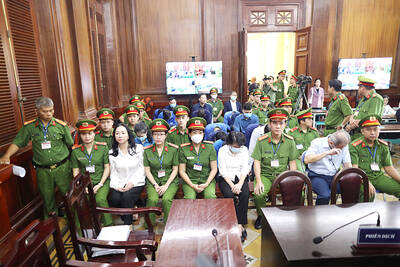
A top Vietnamese property tycoon was on Thursday sentenced to death in one of the biggest corruption cases in history, with an estimated US$27 billion in damages. A panel of three hand-picked jurors and two judges rejected all defense arguments by Truong My Lan, chair of major developer Van Thinh Phat, who was found guilty of swindling cash from Saigon Commercial Bank (SCB) over a decade. “The defendant’s actions ... eroded people’s trust in the leadership of the [Communist] Party and state,” read the verdict at the trial in Ho Chi Minh City. After the five-week trial, 85 others were also sentenced on

‘DELUSIONAL’: Targeting the families of Hamas’ leaders would not push the group to change its position or to give up its demands for Palestinians, Ismail Haniyeh said Israeli aircraft on Wednesday killed three sons of Hamas’ top political leader in the Gaza Strip, striking high-stakes targets at a time when Israel is holding delicate ceasefire negotiations with the militant group. Hamas said four of the leader’s grandchildren were also killed. Ismail Haniyeh’s sons are among the highest-profile figures to be killed in the war so far. Israel said they were Hamas operatives, and Haniyeh accused Israel of acting in “the spirit of revenge and murder.” The deaths threatened to strain the internationally mediated ceasefire talks, which appeared to gain steam in recent days even as the sides remain far
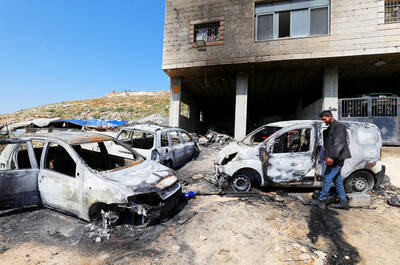
RAMPAGE: A Palestinian man was left dead after dozens of Israeli settlers searching for a missing 14-year-old boy stormed a village in the Israeli-occupied West Bank US President Joe Biden on Friday said he expected Iran to attack Israel “sooner, rather than later” and warned Tehran not to proceed. Asked by reporters about his message to Iran, Biden simply said: “Don’t,” underscoring Washington’s commitment to defend Israel. “We are devoted to the defense of Israel. We will support Israel. We will help defend Israel and Iran will not succeed,” he said. Biden said he would not divulge secure information, but said his expectation was that an attack could come “sooner, rather than later.” Israel braced on Friday for an attack by Iran or its proxies as warnings grew of


 RSS
RSS