


Cheering Nepalese held rallies in several cities and towns yesterday to celebrate Parliament's vote to dramatically cut King Gyanendra's powers and turn him into a figurehead leader.
Communist rebels who control much of the countryside also welcomed the resolution -- passed unanimously by Parliament on Thursday -- but said the king's ceremonial role should also be eliminated.
The sweeping resolution called for King Gyanendra to be stripped of his command over the army, his legal immunity, and freedom from paying taxes. It also said the king should lose his official position as head of the Himalayan nation, changing traditional references to "His Majesty's government" to simply the "Nepal government."
To be enacted, the resolution still must be voted on as a series of laws, officials said. That was expected in the next few days.
The measure's passage "has begun the process," Deputy Prime Minister Khadga Prasad Oli said Thursday.
"The government will work with Parliament to execute the resolution and laws will be drafted to implement the resolution," he said.
Thousands participated in celebratory rallies yesterday in several towns and cities, while top political leaders were to address a major rally in the capital, Kathmandu, later in the day.
The government declared the day a public holiday to celebrate the passage of the resolution. All government offices and schools were closed for the day, the Home Ministry said in a notice.
The seven parties in the ruling alliance called the resolution a historic achievement that had eliminated all of the king's powers.
"This ends the remains of the royal regime and establishes the king as only a figurehead," said Narayanman Bijuchche of the Nepal Workers and Peasants Party.
Rebel leader Prachanda said he welcomed the resolution, but said it failed to address all needs of the people.
"We want to make it clear that this declaration has not been able to fully address the needs and aspirations of Nepal and the Nepali people," the rebel leader, whose real name is Pushpa Kamal Dahal, said in a statement.
He said a continuing ceremonial role for the king "is against the aspiration of the people to abolish the monarchy and establish a republic."
The rebels want to completely abolish the monarchy, but have said they will leave the decision to a special assembly which is to write a new constitution.
The parliamentary vote was the most significant move since the new government assumed power last month after weeks of street protests forced Gyanendra to give up direct control of the government, reinstate Parliament and return political authority to elected officials.
Earlier this week, a delay in voting on the proclamation sparked angry protests in Kathmandu. Government vehicles were set ablaze and traffic was blocked.
The resolution calls for the king to be stripped of his command over the 90,000-strong Royal Nepalese army, which would be renamed the Nepal Army.
The king would also lose his right to make final decisions on major issues, and his immunity from prosecution and taxes. It also would give Parliament the power to set the income of the royal family. The resolution also calls for Nepal -- officially a Hindu nation -- to become a secular state. About 85 percent of Nepal's 27 million people are Hindu.
In Washington, Richard Boucher, US assistant secretary of state for South and Central Asia, encouraged the rebels to honor a cease-fire and join the political mainstream, but said the US remained wary of the group's intentions.

Republican US lawmakers on Friday criticized US President Joe Biden’s administration after sanctioned Chinese telecoms equipment giant Huawei unveiled a laptop this week powered by an Intel artificial intelligence (AI) chip. The US placed Huawei on a trade restriction list in 2019 for contravening Iran sanctions, part of a broader effort to hobble Beijing’s technological advances. Placement on the list means the company’s suppliers have to seek a special, difficult-to-obtain license before shipping to it. One such license, issued by then-US president Donald Trump’s administration, has allowed Intel to ship central processors to Huawei for use in laptops since 2020. China hardliners
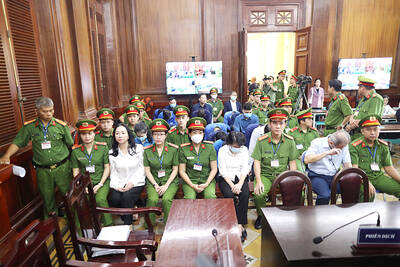
A top Vietnamese property tycoon was on Thursday sentenced to death in one of the biggest corruption cases in history, with an estimated US$27 billion in damages. A panel of three hand-picked jurors and two judges rejected all defense arguments by Truong My Lan, chair of major developer Van Thinh Phat, who was found guilty of swindling cash from Saigon Commercial Bank (SCB) over a decade. “The defendant’s actions ... eroded people’s trust in the leadership of the [Communist] Party and state,” read the verdict at the trial in Ho Chi Minh City. After the five-week trial, 85 others were also sentenced on

‘DELUSIONAL’: Targeting the families of Hamas’ leaders would not push the group to change its position or to give up its demands for Palestinians, Ismail Haniyeh said Israeli aircraft on Wednesday killed three sons of Hamas’ top political leader in the Gaza Strip, striking high-stakes targets at a time when Israel is holding delicate ceasefire negotiations with the militant group. Hamas said four of the leader’s grandchildren were also killed. Ismail Haniyeh’s sons are among the highest-profile figures to be killed in the war so far. Israel said they were Hamas operatives, and Haniyeh accused Israel of acting in “the spirit of revenge and murder.” The deaths threatened to strain the internationally mediated ceasefire talks, which appeared to gain steam in recent days even as the sides remain far

RAMPAGE: A Palestinian man was left dead after dozens of Israeli settlers searching for a missing 14-year-old boy stormed a village in the Israeli-occupied West Bank US President Joe Biden on Friday said he expected Iran to attack Israel “sooner, rather than later” and warned Tehran not to proceed. Asked by reporters about his message to Iran, Biden simply said: “Don’t,” underscoring Washington’s commitment to defend Israel. “We are devoted to the defense of Israel. We will support Israel. We will help defend Israel and Iran will not succeed,” he said. Biden said he would not divulge secure information, but said his expectation was that an attack could come “sooner, rather than later.” Israel braced on Friday for an attack by Iran or its proxies as warnings grew of


 RSS
RSS